Top 10 EOR Providers for Hiring in Tunisia (2027)
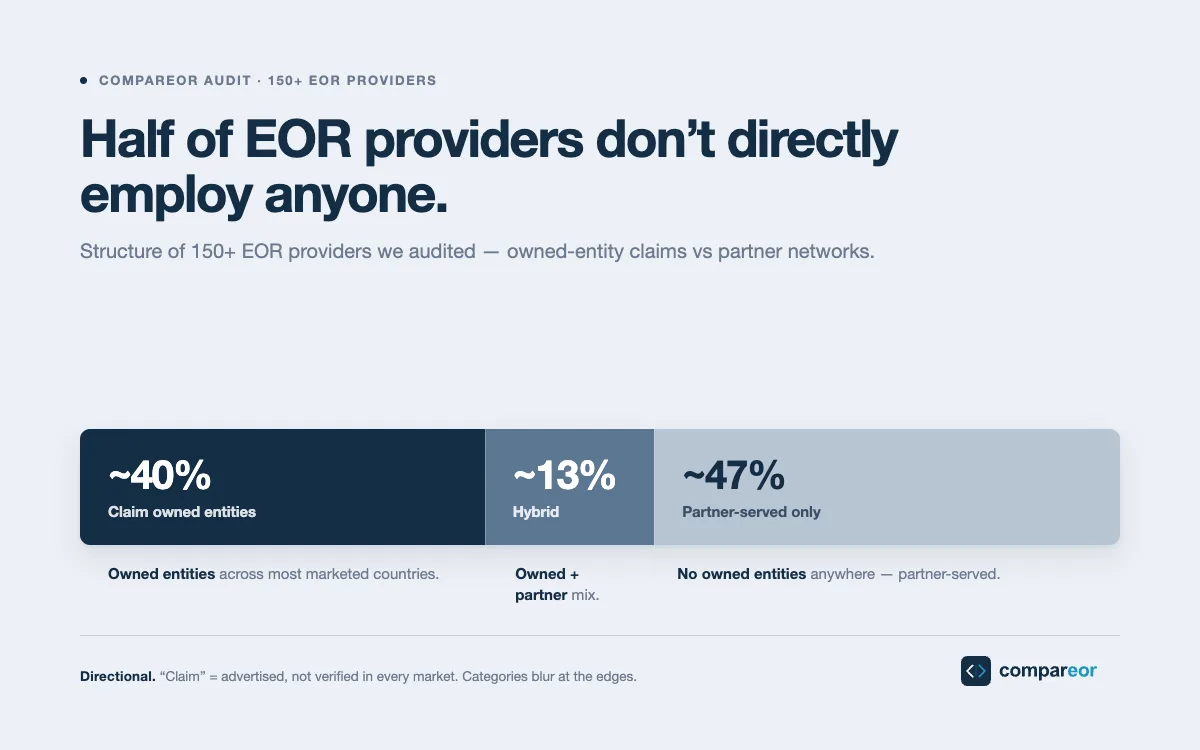
Tunisia has no EOR licence. The test is simpler and harder: which Tunisian company, on the RNE and affiliated to the CNSS, signs the employment contract. Global platforms count Tunisia inside "150+ countries" and leave that question to the sales call. I read each record for a Tunisian office, a named entity or a partner. Two of the ten name Tunisia; the other eight cover it inside a global count, so the entity goes in writing before you sign.
How I scored this list
Five things weighted unequally. No provider in this list carries a verified Tunisian entity: the scores reflect what each record publishes and what it leaves to the sales call.
Tunisian employer evidence, 30%
Whether the record names a Tunisian office, an owned entity or a partner for Tunisia, and whether the provider will hand over an RNE extract and a CNSS attestation d'affiliation on request. A record that names Tunisia scores above one that counts it inside 150+ countries.
CNSS and IRPP handling, 25%
The quarterly CNSS return at 16.57% employer and 9.18% employee with no ceiling, the TFP and FOPROLOS levies, the work-accident class, and monthly IRPP withholding on the eight brackets of the 2025 finance law.
Foreign-staff and contract formalities, 15%
Contracts for non-Tunisians visa'd by the Ministère de l'Emploi, the foreign-staff ceiling, the four-year CDD cap, and probation terms taken from the sector collective agreement rather than a global template.
Presence in Tunisia and the Maghreb, 15%
Offices, French-language service, named sectors and clients in North Africa. A Tunis office outranks a regional hub in Dubai or Casablanca.
Pricing transparency, 15%
A published monthly fee, a stated setup fee, deposit terms, and the FX margin on funding dinar payroll from USD or EUR.
The three I'd flag before you scroll.

Spotlight #1
DI-Africa is the only provider in this list whose record names a direct office in Tunisia, one of eight across Francophone Africa, with 1,477 managed employees and clients such as SLB, TechnipFMC and ENI. The platform runs on Odoo with an employee portal. No published pricing: the fee comes after a French-language call, and the record names no management team.
Spotlight #2
RemotePass publishes $349 a month with no setup fee, one of the lowest EOR rates in this series, and its record names Morocco and Egypt as compliance depth, not Tunisia. Dubai-based, 150+ countries, G2 4.8 across 542 reviews against Trustpilot 3.8. Ask which entity employs in Tunisia and get the withdrawal fees in writing.
Spotlight #3
Deel runs EOR in 150+ countries with owned entities in 100+ markets, from $599 a month with a setup fee of $0 to $1,000 by market. Tunisia is not one of the named markets in its record, so the question is whether the Tunisian employer is a Deel company or a partner. 35,000+ customers and 300+ integrations make it the default for a global programme.


DI-Africa
DI-Africa. The one record with a Tunis office, eight direct offices across Francophone Africa, 1,477 managed staff, an Odoo platform, no published price and French-first service. Best for energy, construction and mining groups staffing Tunisian sites.

RemotePass
RemotePass. $349 a month published, no setup fee, Dubai-based with Egypt and Morocco named in its record; Tunisia sits inside the 150+ count, so ask which entity signs. Best for cost-driven teams hiring Tunisian developers next to Gulf staff.

Deel
Deel. Owned entities in 100+ markets, Tunisia not named in the record, $599 a month with a setup fee that varies by market. 35,000+ customers, Slack and Workday integrations. Best for teams adding Tunisia to an existing global Deel programme.
FMC Group
FMC Group. Stuttgart consultancy whose MENA EOR scope names Tunisia next to Morocco, Egypt and the Gulf; 700+ clients, no platform, no published fee, teams working in French, German and English. Best for German and French mid-caps that want an account manager over a dashboard.

Atlas
Atlas HXM. Direct-entity model across 160+ countries by its own count, $599 a month, setup fee not disclosed, and a mobility and visa practice that matters when the hire is not Tunisian. Best for enterprises moving staff into Tunisia on visa'd contracts.

Remote
Remote. Owned entities only, 90+ countries, Tunisia not in its record's list, $599 a month on annual billing with no setup or termination fee and the strongest IP terms in the series. Best for software teams where IP assignment on Tunisian code matters most.

Multiplier
Multiplier. 150+ owned entities by its record, $459 a month on annual billing, no setup fee, payroll in 100+ currencies and ESOP handling. Tunisia is not named; ask which entity employs. Best for mid-market teams that want a flat fee under $500.

Pebl
Pebl. Formerly Velocity Global, 185+ countries through 65 owned entities, so most markets run through partners; $599 list, $399 promotional since September 2025. Best for enterprises that want the Alfie AI compliance layer and accept a partner in Tunis.

G-P (Globalization Partners)
Globalization Partners. EOR since 2012, direct-entity model across 180+ countries by its record, from $599 a month, setup and termination costs by negotiation, SOC 1, SOC 2 Type II and ISO. Best for regulated buyers who weigh certifications over price.

Playroll
Playroll. $399 a month, no setup or offboarding fee, a refundable deposit of one month's salary, 180+ countries, eight payout currencies and no Tunisia mention in its record. Best for small teams making a first Tunisian hire on a flat fee.
Ranked here? Show it.
Every provider on this list can post its badge. Free, no form: copy the code and paste it on your site. The link back to this list is the only condition, and the badge follows the ranking when it is refreshed.


The badge links to the ranking it refers to, is not altered, and comes down if the provider leaves the list.
How to verify a Tunisian EOR before signing.
Five tests to verify a Tunisian EOR provider before signing.
Step 1
Ask in writing for the legal name of the company that will employ your hire in Tunisia and its RNE number. Look it up on registre-entreprises.tn (the Registre National des Entreprises) and check the matricule fiscal matches. If the provider answers with a partner's name, ask for the partner's extract and for the contract that binds the two.
Step 2
Ask for the CNSS employer affiliation number, a current attestation d'affiliation and the last quarterly declaration. Your employee must appear on that employer's next return, due by the 15th of the month after the quarter. Ask for the work-accident rate class applied to your role (0.4 to 4% by activity): a provider quoting 0.4% for a site job is guessing.
Step 3
If the hire is not Tunisian, ask how the contract gets its visa from the Ministère de l'Emploi and how the provider sits against the foreign-staff ceiling. "No permit needed" is the bad answer. Ask for the timeline in weeks, not days.
Step 4
Ask which contract type and which sector collective agreement apply: CDD or CDI, the four-year CDD cap, probation of 6, 9 or 12 months renewable once, annual leave of 12 days by law or 18 or more by agreement, and whether a 13th month is owed under that agreement. A global template with a 20-day leave entitlement and a three-month probation was not written for Tunisia.
Step 5
Get a gross-to-net in dinars with every line named: CNSS 16.57% employer and 9.18% employee, TFP 1% (or 2%), FOPROLOS 1%, the work-accident premium, IRPP on the eight brackets plus the solidarity surcharge. Then the fee in USD, the FX margin on TND funding, the deposit and the termination reserve: one month's notice and one day of pay per month of service, capped at three months.
How to Choose the Right EOR Provider
When evaluating EOR providers, consider these critical factors: compliance track record (zero violations is non-negotiable), transparent pricing (watch for setup fees, termination costs, and currency conversion markups), country coverage in your target markets, customer support quality (24/7 availability and response times matter), and platform usability for both HR teams and employees.
Also assess local expertise (do they have in-country specialists?), benefits administration capabilities, payroll accuracy (late payments damage employee relationships), contract flexibility (minimum commitments and exit terms), and technology integrations with your existing HR tech stack.
Don't overlook scalability (can they grow with you from 5 to 500+ employees?), data security (GDPR compliance and SOC 2 certification), and customer reviews from companies similar to yours. The cheapest option often becomes expensive when compliance issues arise or service quality suffers.
Find a better EOR — without risk
Compare EOR providers to gain insights on cost, coverage, and contract flexibility, ensuring compliance and payroll continuity.