Hiring in Mexico: Complete Guide 2027
Everything you need to know about hiring and managing employees in Mexico


Overview
Mexico is the largest nearshore market for US companies, offering a bilingual tech workforce, USMCA trade framework alignment, and time zones that fully overlap with US business hours. Mexico City, Guadalajara, and Monterrey are established tech hubs with deep engineering and product talent. EOR is the standard route for US companies testing the market: IMSS registration is due within five working days of the start, and the payroll structure — including mandatory PTU profit sharing — requires local expertise to execute correctly.

Currency

Primary Language

Payroll Tax

Pay Frequency
Overview
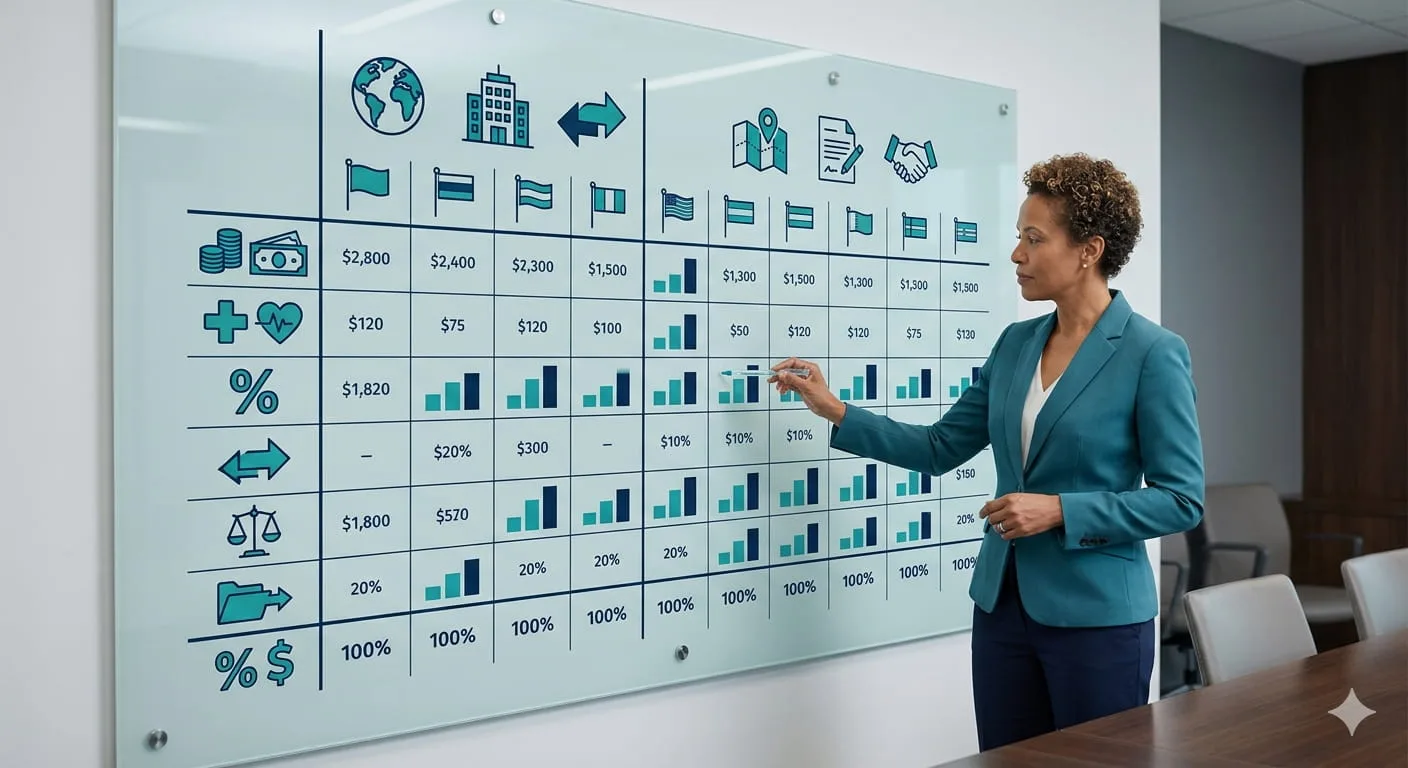
Employer Costs
Employer Social Contributions
Mandatory Benefits
EOR Service Fee
Total Additional Cost
Employee Deductions
Income Tax
Employee Social Contributions
Mandatory Employee Benefits
PAYROLL & SETUP
Setting Up Payroll in Mexico
Mexican payroll is paid at least every 15 days (quincena), weekly for manual work, with IMSS (social security) registration due within five working days of the start, best filed the working day before. Total employer contributions — covering IMSS, INFONAVIT (housing fund), and SAR (retirement savings) — range from about 22–27% of gross salary for office roles (more in high-risk activities). Employees are entitled to mandatory aguinaldo (Christmas bonus) of at least 15 days' salary paid in December, plus a vacation premium (prima vacacional) of 25% above normal vacation pay. An EOR manages IMSS registration, IDSE filings, SUA payroll system integration, and the annual PTU profit-sharing calculation which must be paid to all employees by May 30th.
Key Labor Laws &
Requirements

Employment Contracts
- Written contract mandatory
- Register with IMSS within 5 working days, ideally the day before the start
- Probation up to 30 days (180 for management)

Leave & Time Off
- 12 days annual leave (increases with seniority)
- Paid sick leave via IMSS after 3 days
- Maternity leave 12 weeks

Termination Rules
- No statutory notice period; written notice of the cause at dismissal
- Severance 3 months salary, 20 days per year where reinstatement is refused, and a 12-day-per-year seniority premium
- Unjustified dismissal triggers constitutional severance
COMPLIANCE
Contractor Compliance in Mexico
Mexico's 2021 labor reform (Reforma Laboral) fundamentally changed the contractor landscape. The use of outsourcing (outsourcing/subcontratación) is now heavily restricted — services companies can only provide specialised services that are not part of the client's core business activity, and must be registered in the REPSE registry. Misclassification of employees as contractors carries significant penalties including backdated IMSS contributions and PTU obligations. An EOR employs workers directly under compliant indefinite or fixed-term contracts and ensures all IMSS, INFONAVIT, and PTU obligations are met from day one. It does not remove the outsourcing rules: since the 2021 reform the Ley Federal del Trabajo bans placing staff at another company's disposal (art. 12) and allows only specialised services from a provider registered in the REPSE (arts. 13 to 15).
Figures checked against official sources: Cámara de Diputados (Ley Federal del Trabajo, Ley del Seguro Social and its affiliation regulation, Ley del INFONAVIT, Ley del Impuesto sobre la Renta); INEGI (UMA 2026); CONASAMI (minimum wages 2026). Checked November 2026.
Key Challenges
- Pay at least every 15 days (quincena), weekly for manual work
- IMSS registration within five working days of the start
- High employer cost burden (~22–27%)
- Profit sharing (PTU) obligation
- Security considerations in some states

Country Highlights
Advantages
- Largest nearshore market for US companies
- Same or adjacent time zones to US
- Fast-growing bilingual tech workforce
- USMCA trade framework reduces friction
- Strong manufacturing and engineering base
Popular Industries & Roles
Technology
Salary range: $350k-$800k MXN
Mexico City, Guadalajara, and Monterrey have deep bilingual tech talent aligned to US business hours
Manufacturing & Operations
Salary range: $280k-$650k MXN
Manufacturing operations management is a core need for nearshore and maquiladora operations
Customer Success & BPO
Salary range: $300k-$700k MXN
Customer success, sales, and BPO roles leverage Mexico's bilingual workforce for US market coverage
Top 3 Providers in Mexico
Based on our analysis of pricing, compliance record, service quality, and customer reviews

Serviap Global
- Merged into Rivermate on 28 April 2026
- Pricing historical: was from $399/month
- LATAM EOR founded in Mexico City in 2010
- Existing contracts continue under Rivermate

Atlas
- 160+ countries through owned entities
- From $599/month published, volume discounts
- 9,000+ L&D courses included
- Visa and immigration support in 75+ countries
Alcor
- Tech R&D EOR in LATAM + East Europe
- Percentage-of-turnover, no exit fees
- G2 4.7/5, 98.6% probation success
- In-house recruitment across 8 markets
Frequently asked questions
Hiring in Mexico through an EOR, in short.
Need a shortlist?
Two minutes, ten providers ranked for your brief.
How much does an employer pay on top of salary in Mexico?
Employer contributions in Mexico come to ≈22–27%; the largest mandatory line is PTU profit sharing. With the other statutory benefits and a typical EOR fee, budget ~34–40% on top of gross salary.
What does an EOR charge per employee in Mexico?
Published EOR fees in Mexico run $400–600/mo per employee per month, with any setup fee negotiated separately. The fee is flat, so it weighs less as the salary rises.
What does an employee in Mexico pay in tax and contributions?
Income tax is 1.92–35% and employee social contributions are ≈2.4–2.8% (1.125% retirement (SAR)), both withheld by the employer on every pay run.
How long does it take to hire through an EOR in Mexico?
3-5 Days once the employee's documents are in. The contract is issued by the EOR's local entity and payroll runs on the local cycle (Twice a month).
Which EOR providers rank best in Mexico?
Serviap Global, Atlas and Alcor hold the first three places in our ranking for hiring in Mexico. The full top 10, with the questions to put to each provider before signing, is here: Top 10 EOR providers in Mexico.
Find a better EOR — without risk
Compare EOR providers to gain insights on cost, coverage, and contract flexibility, ensuring compliance and payroll continuity.




 Canada
 Costa Rica
 Panama
 Trinidad and Tobago
 United States