How Compareor Scores EOR Providers
Every provider score is three weighted dimensions (compliance and coverage, platform and features, pricing and transparency) built from verifiable sources. Here is exactly how, and what we leave out.


Every provider page on Compareor carries a score out of 5 and three sub-scores. This page explains how they are produced so you can decide how much weight to give them.
Three dimensions, fixed weights
| Dimension | Weight | What we look at |
|---|---|---|
| Compliance and coverage | 40% | Owned entities versus partner entities per country, registered legal names and registration numbers, statutory handling (payroll tax, benefits, terminations), published liability terms, data-protection posture |
| Platform and features | 30% | Contractor management, payroll and HRIS integration, employee self-service, mobile app, reporting, onboarding time, support model |
| Pricing and transparency | 30% | Published list price, setup and termination fees, FX markup, deposits, minimum terms, how much of this is public versus quote-only |
The overall score is the weighted average, rounded to one decimal. A provider with no public pricing cannot score above 3 on the pricing dimension, whatever its product.
What counts as evidence
- Company registries (Companies House, MCA, Handelsregister and equivalents) for entity ownership and legal names.
- The provider's own pricing and help-centre pages, captured with a date.
- Contract templates and master service agreements when buyers share them with us.
- Review platforms (G2, Capterra, Trustpilot) for volume and direction of customer sentiment, never for the score itself.
- Our own migration work: when we move a client off a provider we record what the exit actually cost.
What we do not count
- Vendor claims without a document behind them ("150+ countries" is only counted when the entity list is published).
- Awards, analyst quadrants and press coverage.
- Referral commissions. Some providers pay a referral fee when a client signs through us; this is disclosed on the affiliate disclosure page and has no effect on scores or rankings. Several of our highest-scored providers pay nothing.
How often reviews change
Every provider review is re-audited at least twice a year, and immediately when a provider changes its pricing page, is acquired, or rebrands. The date at the top of each page is the last full re-audit. The October 2026 pass re-checked every price, country count and review score on the site.
How to read a score
- 4.5 and above: strong on all three dimensions; a safe default for most buyers.
- 4.0 to 4.4: strong overall with a known weakness, named in the "Limitations" block.
- 3.5 to 3.9: fit for a specific use case (one region, one industry) rather than as a global default.
- Below 3.5: either thin evidence or real gaps; read the limitations before shortlisting.
Questions about a specific score, or evidence we should see? Write to us through the about page. We correct pages within a week when a reader shows us a document we missed.

Published October 20, 2026
3 min read
EOR vs PEO: Which One Do You Actually Need?
An EOR becomes the legal employer of your staff abroad; a PEO co-employs people in a country where you already have an entity. Pick by the question "do we have an entity there?"


Published October 20, 2026
3 min read
EOR Cost by Country: Fees, Employer Contributions and Total Cost (24 Countries)
The total cost of an employee through an EOR is salary, plus employer contributions (6% to 35% depending on the country), plus the EOR fee ($199 to $700 a month). This table puts all 24 countries we cover side by side.
Published June 3, 2026
6 min read
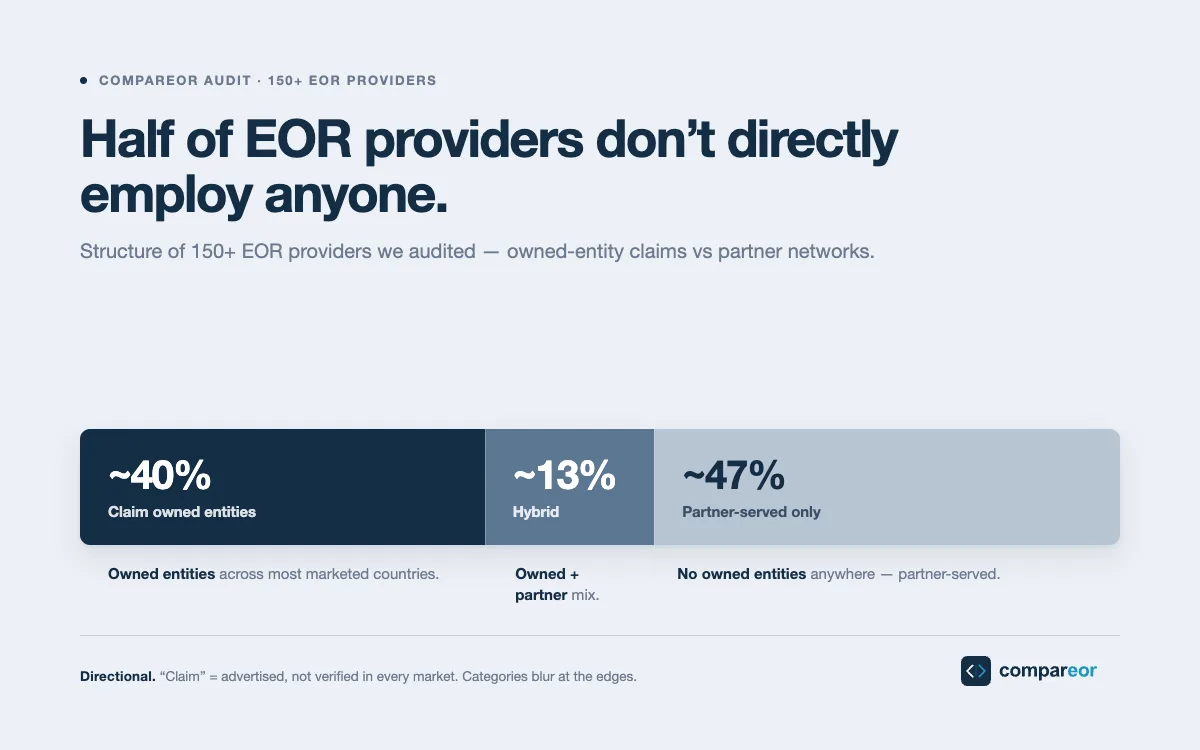
I checked the structure of 150+ EOR providers. Here's how many actually own their entities.
About 40% of EOR providers I audited claim and substantiate owned entities across most of their marketed countries. About 12 to 15% run an honest hybrid. About 45 to 50% are partner-served only, with no owned entities anywhere. The numbers, the methodology, the one honest caveat, and what they mean for buyers.
Stay Updated on Global Hiring
Get weekly insights on EOR trends, compliance updates, and cost-saving strategies

Find a better EOR — without risk
Compare EOR providers to gain insights on cost, coverage, and contract flexibility, ensuring compliance and payroll continuity.