EOR vs PEO: Which One Do You Actually Need?
An EOR becomes the legal employer of your staff abroad; a PEO co-employs people in a country where you already have an entity. Pick by the question "do we have an entity there?"



Employer of Record (EOR) and Professional Employer Organisation (PEO) get used as if they were the same product. They are not, and picking the wrong one is the most expensive mistake we see in first-time global hiring. Here is the difference in plain terms, then a decision table you can forward to finance.
The one-sentence difference
An EOR is the legal employer. It hires your person on its own entity in the country, runs payroll, pays statutory contributions and carries employment-law liability. You direct the day-to-day work. A PEO is a co-employer. You stay the legal employer through your own entity, and the PEO handles payroll, benefits and HR administration under a co-employment agreement.
The practical test: do you have a legal entity in that country? No entity, no PEO. That is why "PEO" in a global context almost always means EOR, and why some vendors market "global PEO" when they are selling an EOR.
What that changes in practice
Where you can hire
EOR: any country where the provider has an entity (or a partner entity, which matters, see our entity audit). PEO: only countries where you are already registered as an employer. In the US, PEO is the common model because most buyers already have a US entity.
Who carries the risk
EOR: the provider is liable for compliant contracts, terminations and statutory payments. PEO: liability is shared, and in most countries outside the US the regulator still sees you as the employer. Misclassification exposure stays with you.
Cost
EOR fees run from about $199 to $699 per employee per month for the mainstream platforms, more for complex countries. PEOs charge a smaller per-employee fee or a percentage of payroll (2 to 8%) because they are not carrying the entity. The EOR premium pays for not having to set up and maintain an entity, which is typically $15,000 to $50,000 a year all-in for a small foreign subsidiary.
Contract and exit
With an EOR, the employment contract is between your person and the provider. If you leave the provider, employees are re-papered onto a new employer, which is the migration work we describe in the switching guide. With a PEO, contracts stay with you; switching PEOs is mostly a payroll and benefits cut-over.
Decision table
| Your situation | Use | Why |
|---|---|---|
| First hire in a country where you have no entity | EOR | Only legal route short of incorporating |
| Fewer than 15 people in a country, no plan to grow there | EOR | Entity cost is not justified |
| 15 to 20+ people in one country, long-term | Own entity, then PEO or local payroll | EOR fees overtake entity cost at this size |
| US company hiring US staff in other states | PEO | You are already the employer; PEO pools benefits |
| Contractors you want to convert to employees abroad | EOR | Removes misclassification risk immediately |
| Testing a market for 6 to 12 months | EOR without annual commitment | Check the minimum term before signing |
Where buyers go wrong
- Buying a "global PEO" that is a partner-served EOR. Ask who the legal employer is in each country and whether the entity is owned.
- Staying on an EOR too long. Past 15 to 20 employees in one country the per-head fee usually exceeds what an entity costs. See why every EOR contract has an expiration date.
- Comparing headline fees only. FX markup, setup fees, deposits and termination fees change the ranking. The cost-by-country table and the switching calculator give the full picture.
Bottom line
No entity in the country: EOR. Entity in the country and fewer HR headaches wanted: PEO or a payroll provider. Entity in the country and a plan to grow: build your own HR stack. If you are between the first two, compare EOR providers by country, price and score or ask us for a shortlist.
Published October 20, 2026
3 min read
How Compareor Scores EOR Providers
Every provider score is three weighted dimensions (compliance and coverage, platform and features, pricing and transparency) built from verifiable sources. Here is exactly how, and what we leave out.


Published October 20, 2026
3 min read
EOR Cost by Country: Fees, Employer Contributions and Total Cost (24 Countries)
The total cost of an employee through an EOR is salary, plus employer contributions (6% to 35% depending on the country), plus the EOR fee ($199 to $700 a month). This table puts all 24 countries we cover side by side.
Published June 3, 2026
6 min read
I checked the structure of 150+ EOR providers. Here's how many actually own their entities.
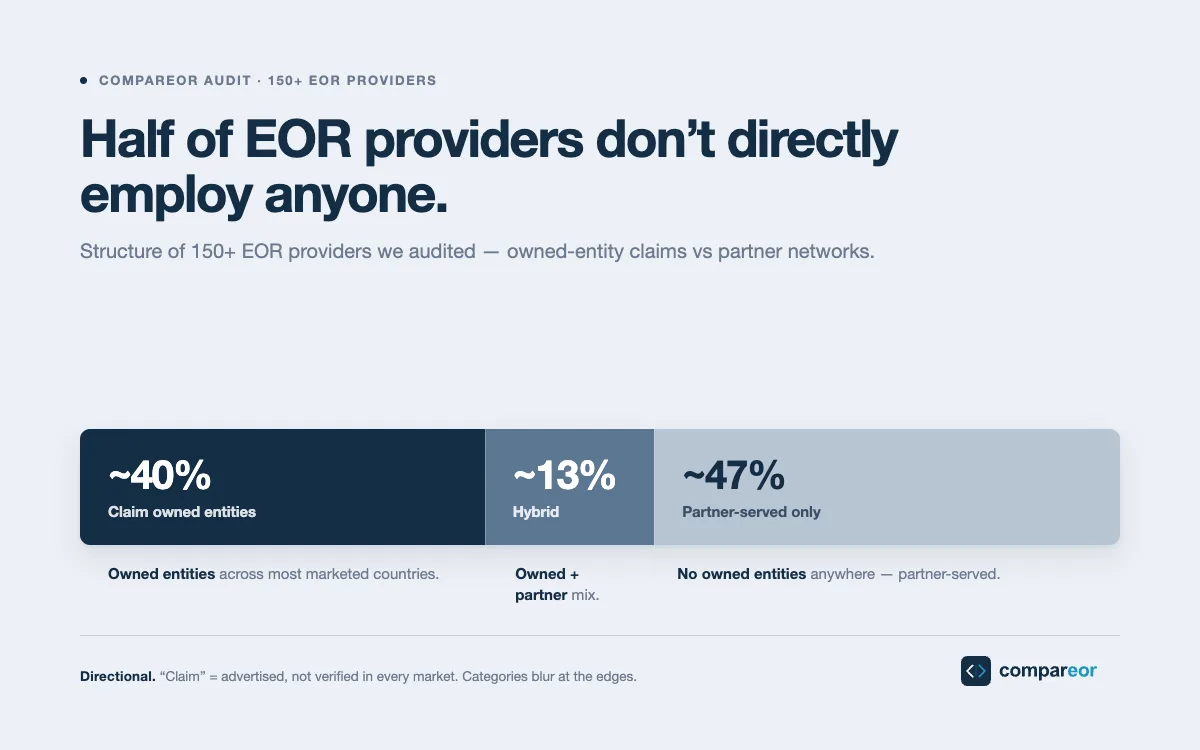
About 40% of EOR providers I audited claim and substantiate owned entities across most of their marketed countries. About 12 to 15% run an honest hybrid. About 45 to 50% are partner-served only, with no owned entities anywhere. The numbers, the methodology, the one honest caveat, and what they mean for buyers.
Stay Updated on Global Hiring
Get weekly insights on EOR trends, compliance updates, and cost-saving strategies

Find a better EOR — without risk
Compare EOR providers to gain insights on cost, coverage, and contract flexibility, ensuring compliance and payroll continuity.