Remote's rebrand and ADP Global EOR: what changed and what it means for buyers
Remote dropped "global employment platform" for "financial operating system" on 13 October 2026, two weeks after ADP started selling an EOR run by Remote. What is confirmed, what is not, and what to ask before buying an EOR through your HRIS.
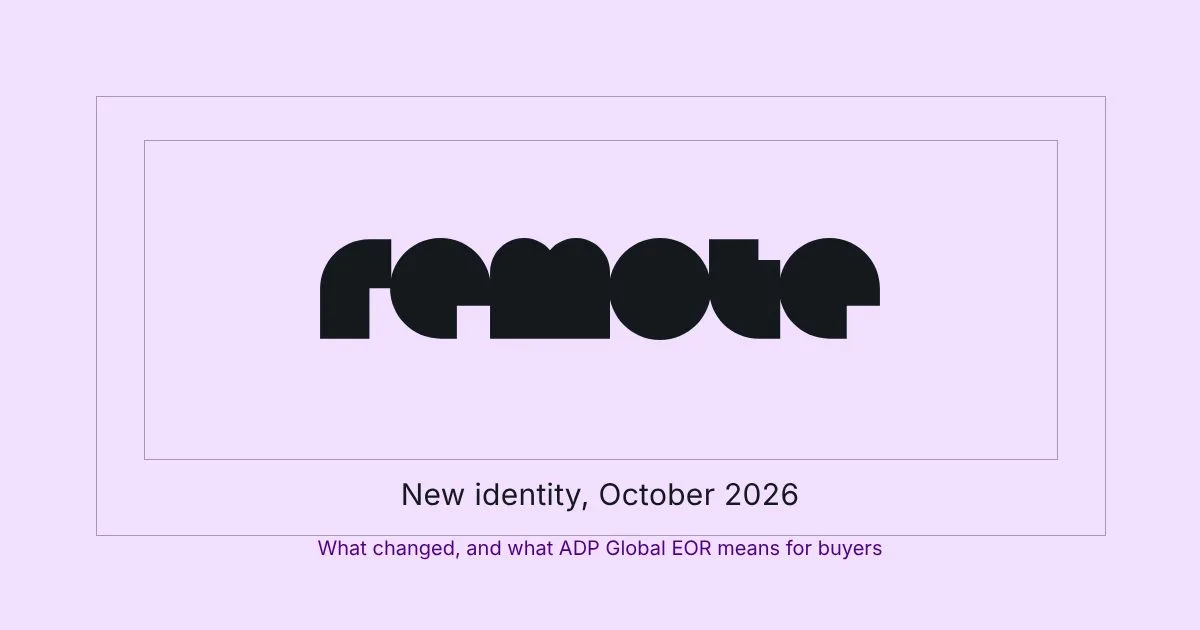


On 13 October 2026 Remote retired the wordmark it had carried since launch and, with it, the phrase "global employment platform". The new line is "financial operating system for the global workforce". Two weeks earlier, Remote's Chief Business Officer had announced ADP Global EOR, an employer of record product sold by ADP and run by Remote. The two moves belong together: the brand says what Remote wants to be, the ADP deal shows where it expects to be bought. This article covers what changed, what is confirmed, what is not, and the questions to put in writing if your HRIS now sells you an EOR.
The new identity, in short
The work comes from COLLINS, the New York and San Francisco agency. The visible changes:
- A lowercase geometric wordmark. Six letterforms built from circles and squares, in off-black (#14191E) on light surfaces or white on dark ones. The guidelines allow no other colour, no outline, no gradient fill. Minimum height 36px on screen, 7mm in print.
- A stacked symbol and an "r" icon. "re / mo / te" on three lines for avatars and app icons, the single "r" on the brand gradient for favicons. Neither is ever paired with the wordmark.
- Rotina, a modernist sans from Sharp Type, for everything set in words.
- A palette "inspired by world currencies": five hues (red, orange, green, blue, violet), each with a dark shade and a light tint, used one hue at a time. Black never enters a marketing gradient.
- A cube. The stackable wireframe box is the one graphic device, drawn behind headlines and around the wordmark.
- A campaign, "For a World That Works", on digital and outdoor placements in seven cities (Amsterdam, Frankfurt, Madrid, New York, London, San Francisco, Paris), with a film produced with Stink Studios.
One item in the brand guide matters more than the colours: a "powered by remote" lockup, reserved for third-party platforms that embed Remote's EOR. The identity was built with resale by other software in mind.
From "employment platform" to "financial operating system"
The wording is the point of the exercise. Remote asks to be described as the system that pays people, with four products under it (Global Payroll, Employer of Record, Contractor Management, US PEO). The coverage claim is "150+ countries" as the product-agnostic figure; a specific product carries its own count. Partners are steered away from "global employment platform" and "all-in-one HR platform", the two labels Remote shared with Deel and Rippling until this autumn.
The reason is in the numbers Remote publishes with the launch: a payroll business up 300% year on year, "tens of thousands of companies" on the platform, and the financial operating system line already in Remote's own material in September, before the visuals arrived. Payroll is the growth business; EOR is the product that got it in the door.
For a buyer comparing EORs, nothing in the service itself moved. Same entities, same contract terms, same public list price ($599 per employee per month billed annually, $699 month to month). What moved is where you will meet Remote: increasingly inside somebody else's software.
ADP Global EOR, powered by Remote
In the first days of October 2026 Michelle Adams, Remote's Chief Business Officer, posted on LinkedIn: "Introducing ADP Global EOR, powered by Remote. Launching today, eligible US-headquartered ADP Workforce Now customers can begin hiring globally, right from within the platform they already use for HR and payroll." The use cases named in the post: engineers placed at client sites abroad, acquisitions, relocations. Remote is the employer of record on the contract; ADP is the front door. Demo requests go through ADP's own page, info.adp.com/EOR.
As of 31 October 2026, that post, with its reposts, is the only public source. What is not published:
- An ADP press release or product page with terms.
- A price list. Remote's direct fee is public; the fee ADP charges for the embedded version is not.
- A country list. "150+" is Remote's general figure, and the brand guide itself says the count should match the product.
- What happens to ADP's earlier EOR route. ADP has referred clients to G-P (Globalization Partners) since a 2021 ADP TotalSource deal, expanded in May 2024. Whether that referral continues alongside the Remote product is not stated anywhere.
ADP is the fourth HR platform to resell Remote's EOR in sixteen months, after BambooHR (June 2025), Personio and isolved (June 2026, "EOR powered by Remote" inside isolved People Cloud). Remote's guide has a name for the programme: Remote Embedded.
What an embedded EOR changes for you
The pitch is one login and one invoice. Both are real. What does not change is the legal structure: the employee's contract is with Remote's local entity, so pay dates and notice periods follow Remote's country playbook, not ADP's, and so do benefits and a termination. Four points deserve a written answer before a first hire:
- Price. An embedded offer is priced by the platform that sells it. Get the embedded quote and a direct quote from Remote for the same country and headcount, and compare the fee lines with the deposit and the FX margin.
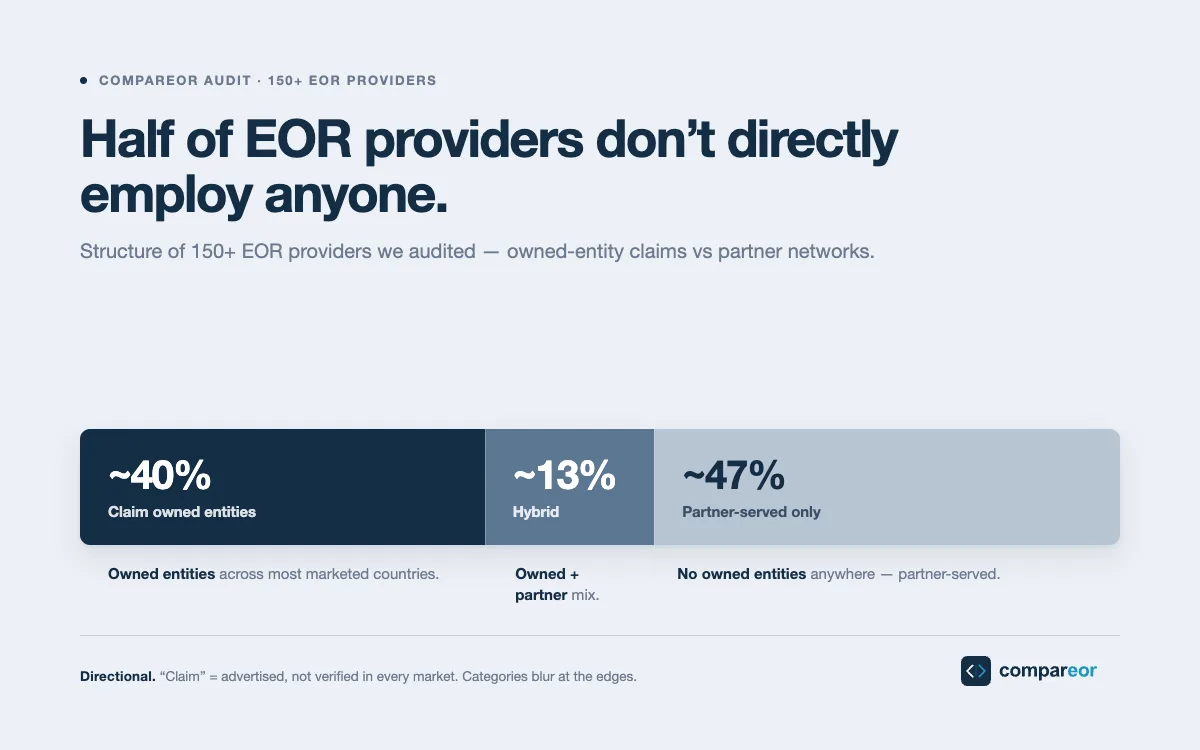
- Coverage. Ask which countries are served through Remote's own entities and which through a partner. The answer decides who holds the employment licence where that matters (China, Germany, the UAE).
- Data. The HRIS keeps the employee record, Remote runs the payroll. Ask where personal data sits, who is controller and who is processor, and whether the two systems reconcile automatically.
- Exit. If you leave ADP Workforce Now, the Remote employees do not leave with the HRIS. Ask for the path to a direct Remote contract or to another provider, in writing, before signing.
The direct route stays open. The Remote review carries the scores and the fee table; the Deel vs Remote and Remote vs Rippling comparisons put it against the two platforms it is now trying to leave behind in wording; the built-in HRIS ranking lists the EORs that carry their own HR system, the configuration ADP's offer replaces.
Six things to ask for in writing
- The legal entity that signs the employment contract in each country, and whether Remote owns it.
- The fee per employee per month with the billing cycle, plus the deposit and the FX margin.
- The country list that applies to this offer, with the countries served through a partner marked.
- The team that answers a payroll or termination question: ADP support or Remote.
- Whether ADP still refers to G-P for countries the Remote offer does not cover.
- The offboarding path if the ADP contract ends and the employees stay.
What changed on Compareor
Remote's new wordmark replaces the old one on every page where the provider appears: the directory and the rankings, the comparisons, the nav panel. Scores and fees are unchanged, the review text too; the review will carry a new date when Remote publishes the embedded terms or the ADP country list.
Sources
- Remote Introduces New Brand Identity for the Next Chapter of Global Workforce Finance, PR Newswire, 13 October 2026.
- COLLINS Rebrands Remote With New Identity for Global Payroll, DesignRush.
- Remote rebrands as financial operating system for workforce, CFOtech.
- Remote Brand Guidelines and Partner Messaging Guide, October 2026 edition, received from Remote.
- Michelle Adams, Chief Business Officer at Remote, LinkedIn post of early October 2026 announcing ADP Global EOR.
- G-P and ADP Expand Collaboration to Simplify Global Employment, PR Newswire, 16 May 2024.
- BambooHR and Remote partnership release, PR Newswire, 30 June 2025.
- Announcing Personio's embedded EOR partnership with Remote, Remote blog.
- Remote Partners with isolved, PR Newswire, 26 June 2026.

Published October 20, 2026
3 min read
EOR vs PEO: Which One Do You Actually Need?
An EOR becomes the legal employer of your staff abroad; a PEO co-employs people in a country where you already have an entity. Pick by the question "do we have an entity there?"

Published October 20, 2026
3 min read
How Compareor Scores EOR Providers
Every provider score is three weighted dimensions (compliance and coverage, platform and features, pricing and transparency) built from verifiable sources. Here is exactly how, and what we leave out.

Published October 20, 2026
3 min read
EOR Cost by Country: Fees, Employer Contributions and Total Cost (69 Countries)
The total cost of an employee through an EOR is salary, plus employer contributions (6% to 35% depending on the country), plus the EOR fee ($199 to $700 a month). This table puts all 69 countries we cover side by side.
Stay Updated on Global Hiring
Price changes, new rankings and compliance news, when there is something worth sending.

Find a better EOR — without risk
Compare EOR providers to gain insights on cost, coverage, and contract flexibility, ensuring compliance and payroll continuity.