
Should You Hire Contractors or Employees Internationally?
The contractor vs employee decision is one of the most important — and most misunderstood — in global hiring. Here's how to make it correctly.


.png)
The question that shapes your international workforce
The contractor-versus-employee question is the single most consequential classification decision in any international hiring plan. Get it right, and you have a flexible engagement model with predictable tax and lower administrative overhead. Get it wrong, and you can face back taxes, statutory contribution clawbacks, employee reclassification, retroactive benefits, termination indemnity liabilities, civil penalties, and — in a handful of jurisdictions — criminal exposure for the signatory officer. The gap between the best and the worst outcome of this single decision is typically larger than the EOR savings being chased.
This guide walks through how labour courts actually decide status (the legal test), where in the world the risk is highest in 2026, when contractors remain the right call, and when converting to employment via an Employer of Record (EOR) is the cleaner path. For the companion country-risk ranking, see contractor misclassification: the countries with the highest risk, and to stress-test your current engagements, take the misclassification risk quiz.
The appeal of contractors
Contractors are legitimately attractive for specific use cases. They are faster to engage (no entity required, no statutory onboarding steps), easier to offboard (notice periods are contractual rather than statutory), and carry no employer social-contribution burden — typically 20–45% of salary in most developed markets. For short-term projects, specialist expertise not available as an employee, or when testing whether a market or skillset justifies permanent headcount, contractors are the right tool.
The problem is that the economics are so favourable that contractors get used for work they were never designed for: long-running operational roles, managed by a client supervisor, following client processes, embedded in client team structures. That is not contracting — it is employment in all but the contract.
The legal test for employment
Virtually every major jurisdiction applies a "substance over form" test. What matters is not what the contract says — it is how the relationship operates day-to-day. Labour courts and tax authorities look at a consistent cluster of factors:
Substitution
Can the worker send a genuine substitute to perform the work, without needing client approval? A real, unfettered right of substitution is the single strongest indicator of contractor status. An unused substitution clause that the parties never intended to honour is discounted by tribunals.
Control
Who decides how, when, where, and what the worker does? Contractors typically set their own hours, choose their method, and are accountable to deliverables rather than to a manager. If the worker has a reporting line at the client, a fixed schedule, and instructions on method, they look like an employee.
Mutuality of obligation
Is there an ongoing obligation on the client to offer work and on the worker to accept it? A true contractor engagement is discrete — defined scope, defined deliverable, defined end date. Evergreen rolling contracts, guaranteed monthly hours, and paid idle time indicate employment.
Integration and economic dependence
Is the worker "part and parcel" of the client's organisation — company email, business cards, invitations to team events, listing on the staff directory? Do they derive the majority of their income from this single client? High integration and high economic dependence are employment indicators virtually everywhere.
Equipment, financial risk, and exclusivity
Does the worker supply their own equipment and bear some financial risk (e.g., loss on an overrun project)? Do they have multiple clients in parallel? Exclusive single-client engagements, using the client's laptop and tools, with no downside exposure, are the archetypal inside-employment pattern.
Different jurisdictions weight these factors differently, but the overall picture is remarkably consistent. The closer the arrangement looks to a job, the more likely a court or tax authority will treat it as one, regardless of the contract.
Country-specific risk levels in 2026
The enforcement landscape is not uniform. Some jurisdictions apply strong presumption of employment by statute; others rely on case-by-case adjudication. Four tiers in 2026:
Very high risk — Brazil, France, Colombia, China
In Brazil, Article 3 of the Consolidação das Leis do Trabalho (CLT) creates a statutory employment presumption for any ongoing personal-services relationship characterised by non-eventuality, subordination, and remuneration. Brazilian labour courts process more than two million cases annually and award full CLT benefits (13th-month salary, FGTS, vacation, notice indemnity, severance) on reclassification. For the full picture, see why Brazil's CLT makes EOR essential for foreign employers and the Brazil country guide.
In France, the Code du travail applies a requalification doctrine — if subordination is established, URSSAF and the labour courts will retroactively reclassify the engagement and reclaim employee and employer social contributions (roughly 42–45% of salary on the employer side), plus interest, plus penalties. French case law has been steadily expanding the subordination definition. See the France country guide and the true cost of hiring in France for the full contribution detail.
In Colombia, the four-factor employment test (personal service, remuneration, subordination, exclusivity) is applied aggressively by the Ministerio del Trabajo, and reclassification produces backpay and social security arrears.
In China, PRC Labour Contract Law requires a written employment contract within one month of work commencing. Failure to issue one exposes the employer to double wages for the period worked without contract, plus reclassification of any "contractor" who operates under employer control. See the China country guide for the specifics.
High risk — UK, Germany, Spain
The United Kingdom operates IR35 (off-payroll working rules) — since April 2021 for medium and large private-sector clients, the end client determines status and the fee-payer bears PAYE and National Insurance liability if the determination is wrong. HMRC's CEST tool provides a baseline assessment, but real-world working practices are what tribunals privilege. See IR35 in 2026 for the full rules.
In Germany, the Scheinselbständigkeit doctrine (bogus self-employment) is enforced by Deutsche Rentenversicherung, which has audit authority over contractor arrangements. Reclassification triggers retroactive social insurance contributions (roughly 20% of wages on the employer side plus the employee share), late-payment interest, and potential criminal exposure for deliberate misclassification under §266a StGB (withholding of employee contributions). A worker who earns the majority of their income from one client and has no employees of their own triggers the automatic presumption. See the Germany country guide and the works council guide for the German employment context.
In Spain, the "falsos autónomos" doctrine produces reclassification of self-employed contractors who operate under client control, with the Ley Rider (2021) specifically codifying the presumption for platform-style workers and the Social Security Inspectorate running periodic audit campaigns. See the Spain country guide.
Medium risk — India, Mexico, Poland
In India, misclassification risk exists through PF and ESI contribution obligations, but enforcement tends to be complaint-driven rather than proactive. The biggest practical risk is tax — contractors above the GST threshold must register and charge GST, and improper invoicing creates exposure for both sides. See the India country guide.
In Mexico, the 2021 labour reform heavily restricted outsourcing and narrowed the contractor category. IMSS (social security) and INFONAVIT (housing fund) contributions kick in from day one of employment, and reclassification produces retroactive contribution obligations plus 26–32% employer-side social cost. See the Mexico country guide.
In Poland, self-employed B2B ("umowa B2B") is a legitimate and widely used structure, but the tax authority (KAS) and ZUS have been increasing scrutiny of single-client B2B engagements that look like employment. A worker with a single client, fixed hours, and client-supplied tools is the archetypal reclassification candidate.
Lower risk — UAE, Singapore
In the UAE, free-zone and mainland contractor structures are well-defined, and the post-2025 expansion of mandatory health insurance to all seven emirates applies only to employees — contractors are not in scope. The practical risk is lower, though long-term contractor engagements that look like employment still produce visa and tax exposure. See the UAE country guide and the 2025 UAE health insurance changes.
In Singapore, the contractor vs employee distinction is adjudicated under the Employment Act and MOM guidelines, and the threshold for reclassification is higher than in most European or Latin American jurisdictions. Genuine single-client contractor engagements are more legally stable here, though CPF contributions are required for any worker treated as an employee under the test.
What misclassification actually costs
The headline number — "back taxes and social contributions" — understates the full liability. A well-run investigation in a high-risk jurisdiction typically produces five cost categories:
- Retroactive employer contributions — 20–45% of cumulative wages paid to the reclassified contractor, depending on jurisdiction.
- Retroactive employee contributions — technically owed by the worker, but in most jurisdictions the employer is jointly liable and cannot recover from the worker.
- Retroactive statutory benefits — 13th-month salary, vacation pay, severance accruals, pension — calculated from the start of the engagement.
- Penalties and interest — 10–100% of the underlying tax owed depending on behaviour and jurisdiction.
- Directors' or officers' liability — in Germany, France, Brazil, and several other jurisdictions, deliberate misclassification carries criminal exposure for the named signing officer.
For a sense of scale, a three-year engagement of a single €90,000-salary contractor in France, reclassified as an employee, typically produces €130,000–€170,000 of cumulative employer liability once all five categories are tallied. That is before legal fees and any reputational cost. For the EOR-side liability picture, see what happens when your EOR gets it wrong and who's liable.
When contractors are appropriate
Contractors are the right choice when all of the following are true:
- Genuinely project-based work with a defined scope, deliverable, and end date — ideally under six months.
- Multiple clients — the worker has demonstrable business independence, not just a clause on paper.
- Specialised expertise not readily available as an employee hire, or needed only intermittently.
- No client-side control over how and when the work is done — you pay for an outcome, not for hours managed.
- Own equipment and process — the contractor supplies their own tools, chooses their own methods, and bears financial risk on overruns.
If a contractor arrangement starts out meeting these tests but drifts over time — hours become regular, scope expands, single-client dependency grows — the correct action is to convert the engagement to employment before a labour authority does it for you.
When to convert to employment via EOR
Convert if any of the following are true:
- The engagement has been running for 6 or more months without a clear project end date.
- The worker derives a majority of their income from your company.
- You are directing their day-to-day work — method, schedule, priorities.
- They are integrated into your team structures — part of 1:1s, performance cycles, internal comms, office presence.
- The engagement is in a very-high-risk jurisdiction (Brazil, France, Colombia, China, Germany) regardless of duration.
For companies with a distributed contractor population, an EOR is the fastest route to compliant employment without entity setup. Onboarding typically runs 2–10 business days in most developed markets, versus 3–6 months for local entity incorporation. For the strategy choice between EOR, PEO, and entity setup, see EOR vs PEO vs entity setup.
A decision framework
A three-question test for any new international engagement:
- Question 1: Is the work genuinely project-based with a defined end date under 6 months? Yes → contractor is viable. No → move to question 2.
- Question 2: Will the worker have multiple clients and control how, when, and where work is done? Yes → contractor may still be viable, with quarterly review. No → move to question 3.
- Question 3: Is the work in a very-high-risk jurisdiction? Yes → use an EOR from day one. No → consider EOR or direct employment via entity.
For a structured walkthrough across multiple countries simultaneously, how to build a remote team across 5 countries without entities models the framework applied across a real 5-country team.
How to convert cleanly
The conversion from contractor to EOR employment is operationally simple but requires three weeks of planning:
- Weeks 1–2: preparation. Select the EOR (use the comparison tool and selection checklist), agree on the total employment cost, draft the new employment contract, and plan the compensation structure (salary + benefits + any grossing-up to match net take-home for the contractor).
- Week 3: communication and signing. Communicate the change to the contractor clearly — this is a promotion to employee, with benefits, not a downgrade. Co-sign the new employment contract with the EOR as legal employer. Terminate the prior contractor agreement on the same effective date.
- Post-conversion: clean break. Make sure there is no invoice overlap, no parallel contractor relationship, and no ambiguity about the transition date. A clean break on a fixed date is what protects you from retroactive claims covering the contractor period.
For the cross-country regulatory context, see the 7 labor law changes in 2026 that affect global hiring and the remote hiring playbook for US companies expanding to Europe.
Frequently asked questions
Does signing a strong contractor agreement protect me from reclassification?
No. In virtually every major jurisdiction, labour courts and tax authorities apply a substance-over-form test — the contract matters, but the day-to-day operating reality matters more. A contractor agreement that includes a substitution clause the parties never honour is discounted. A perfectly drafted contract cannot convert an employment-shaped relationship into genuine contracting.
What's the statute of limitations on misclassification claims?
Varies by jurisdiction. In France, URSSAF can typically reach back three years (five years with fraud). In Germany, social insurance clawback can reach four years (thirty years with intent). In Brazil, labour claims run for two years after employment ends, but cover the preceding five years of unpaid entitlements. In the UK, HMRC can assess up to four years in standard cases, six years for careless error, and twenty years for deliberate fault.
Can an EOR sponsor visas in the same way a direct employer can?
Generally yes — the EOR is the legal employer on record and can sponsor work permits and visas where permitted by local immigration law. A small number of jurisdictions (e.g., some Gulf free zones, specific Asian markets) restrict visa sponsorship to entities with a direct commercial relationship to the worker's function — verify during evaluation.
If I convert a contractor to EOR, do I owe them anything for the prior contractor period?
Ideally no — the contractor period ends cleanly, the employment period begins cleanly, and there is no retrospective element to either. In practice, if the prior arrangement was at high risk of reclassification, some employers offer a one-time conversion bonus to close the period without any lingering claims. Take local legal advice before structuring.
What's the fastest route to compliant international employment?
EOR, consistently. Local entity setup takes 3–6 months in most markets. EOR onboarding typically runs 2–10 business days once contracts and documents are in place. For a shortlist of providers by onboarding speed, see the country-by-country risk ranking and run the providers through the comparison tool.
Bottom line
Contractors are an excellent tool for short-term, project-based, specialist engagements with genuine business independence. They are a structural risk when used for long-term operational roles that look and function like employment — especially in high-enforcement jurisdictions like Brazil, France, Germany, China, and the UK.
The safest rule of thumb in 2026: if you would not tolerate the worker leaving tomorrow without replacement, you probably cannot defend them as a contractor. When in doubt, convert to employment via an EOR — the administrative cost is modest, the compliance certainty is full, and the tail risk goes to zero.
Get your shortlist
Takes ~3 minutes. No account needed.
June 3, 2026
6 min read
I checked the structure of 150+ EOR providers. Here's how many actually own their entities.
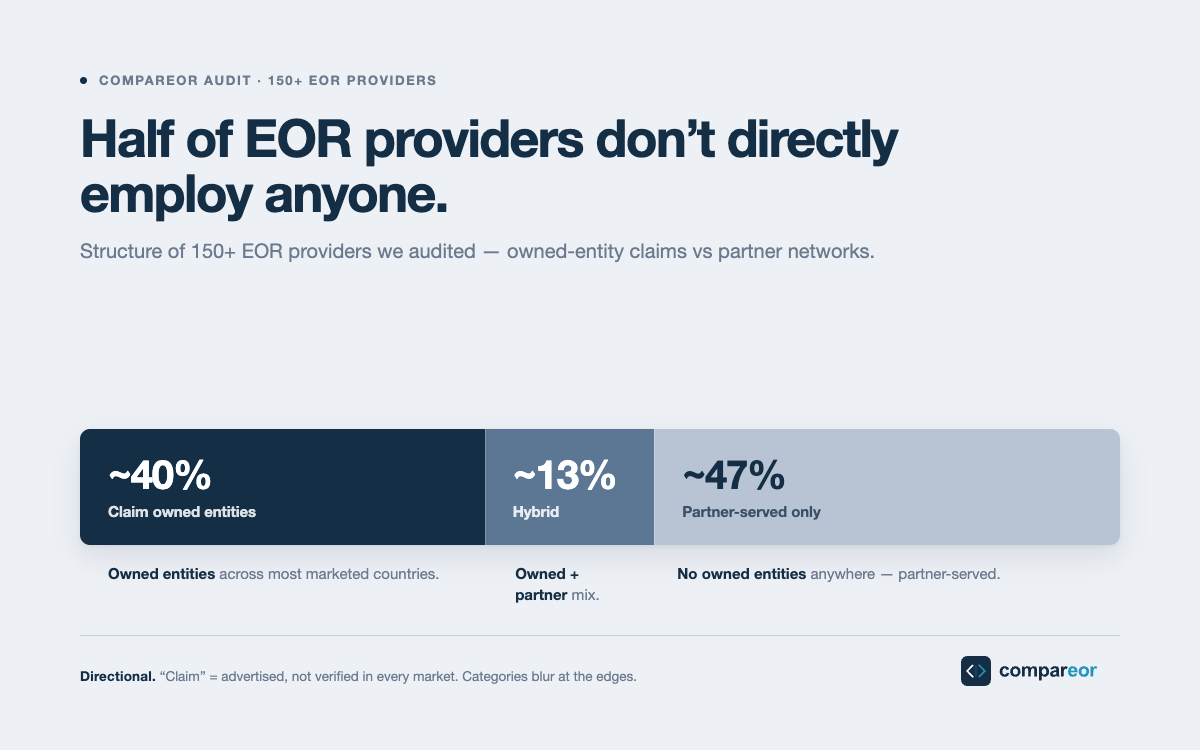
About 40% of EOR providers I audited claim and substantiate owned entities across most of their marketed countries. About 12 to 15% run an honest hybrid. About 45 to 50% are partner-served only, with no owned entities anywhere. The numbers, the methodology, the one honest caveat, and what they mean for buyers.


June 3, 2026
6 min read
Every EOR contract has an expiration date
The EOR model has a built-in expiration date, somewhere between 15 and 20 employees in one country. Past that threshold, the EOR stops being the cheapest option and starts being a tax on growth. Most companies miss it for a year or more, because the contract doesn't mention it and nobody inside is responsible for noticing.

May 25, 2026
5 min read
Why "150+ countries" is the most misleading number in global employment
Every EOR homepage leads with a country count, and after auditing 150+ providers it's the number most likely to lead you to the wrong choice. Coverage comes in three forms, and depth in your countries matters more than breadth across 185 of them.
Stay Updated on Global Hiring
Get weekly insights on EOR trends, compliance updates, and cost-saving strategies

Find a better EOR — without risk
Compare EOR providers to gain insights on cost, coverage, and contract flexibility, ensuring compliance and payroll continuity.


.png)
.png)



