
IR35 in 2026 — What Every UK Hiring Manager Needs to Know
IR35 determines whether your UK contractors should be taxed as employees. Here's what changed in 2021, what's stayed the same, and how EOR removes the risk entirely.


.png)
Why IR35 matters in 2026
IR35 — the UK's off-payroll working rules — is the single most consequential contractor-compliance regime in any major European hiring market. If your business engages UK contractors through their own Personal Service Company (PSC) and you get the tax determination wrong, HMRC can reclaim the unpaid PAYE income tax, employee and employer National Insurance (15% on earnings above the £5,000 secondary threshold from April 2025), and the Apprenticeship Levy — plus interest and penalties. In a multi-year investigation covering a handful of high-rate contractors, the liability can easily reach six figures.
Since April 2021, in most cases, that liability does not sit with the contractor. It sits with the end client or with the fee-payer in the supply chain — which often means your company or your outsourced employer. For UK hiring managers, heads of finance, and anyone making engagement decisions in 2026, IR35 is no longer a theoretical tax topic. It is an operational risk that shapes how you structure every UK engagement. For the broader country picture, see the UK hiring guide, and for the current provider shortlist see the top 10 EOR providers for the UK.
What IR35 is
IR35 — formally the off-payroll working rules — is HMRC legislation that determines whether a contractor working through an intermediary (typically a Personal Service Company) should, for tax purposes, be treated as an employee of the end client. The commercial form of the engagement (contractor invoice, limited company, VAT-registered) does not determine the tax treatment. The substance of the working relationship does.
If the arrangement looks and operates like employment — the contractor works under the client's direction, cannot send a substitute, works a fixed schedule, is embedded in the team, and has no real economic risk — HMRC treats it as "inside IR35" and taxes it as employment. If the relationship is genuinely arm's-length and commercial, it is "outside IR35" and the contractor can pay corporation tax and dividends through their PSC as before.
The rules were introduced in 2000 to stop "disguised employment" — employees converting to PSC contractors to reduce tax, while performing substantively the same role. The original 2000 framework asked the contractor to self-determine status. The 2017 and 2021 reforms moved that responsibility up the supply chain to the end client.
What changed in April 2021 for the private sector
Before April 2021, in the private sector, the contractor's PSC was responsible for determining IR35 status and for any under-paid tax if that determination was wrong. That framework made enforcement difficult — HMRC was chasing thousands of individual PSCs rather than a smaller number of larger clients.
On 6 April 2021, the off-payroll working rules for medium and large private-sector clients changed substantially. The end client now makes the Status Determination Statement (SDS) and bears the compliance risk. The obligation to deduct PAYE and NI sits with the fee-payer in the supply chain — which is typically the client itself (if engaging the PSC directly) or the agency closest to the PSC (in multi-tier supply chains).
For hiring managers, this is the critical structural change: IR35 is now an engager problem, not a contractor problem. You cannot delegate the determination to the contractor, and you cannot push the tax liability back up the chain by contractual clause alone — HMRC looks at the statutory position.
The small company exemption
The April 2021 reform does not apply to "small" private-sector clients. A client is treated as small (and therefore exempt from making the SDS) if they do not meet at least two of the following three Companies Act 2006 thresholds:
- Annual turnover exceeding £10.2 million
- Balance sheet total exceeding £5.1 million
- More than 50 employees
If your business is below two of those thresholds, the pre-2021 rules continue to apply and the PSC self-determines. Once you cross two thresholds, the engager-led regime kicks in — typically from the first financial year after the threshold is crossed, per HMRC's transition rules. If your company is growing through the small-company boundary, plan the IR35 transition six to twelve months ahead of the trigger.
Who makes the Status Determination Statement
For medium and large private-sector clients, the SDS must be:
- Made by the end client — the business that will ultimately consume the contractor's services, not the agency in the middle.
- Communicated in writing to the contractor and to the next party down the supply chain (typically the agency).
- Reasoned — the SDS must include the rationale for the determination, not just the outcome.
- Kept under review — if the working practices change mid-engagement, the SDS must be revisited.
HMRC also requires a status disagreement process. If the contractor or the fee-payer challenges the SDS, the client has 45 days to respond with either a confirmed or revised determination plus reasoning. Failure to respond within 45 days transfers the PAYE and NI liability to the client — this is one of the most consequential operational rules in IR35 and one that small compliance teams regularly miss.
How IR35 status is actually determined
HMRC applies a multi-factor test rooted in UK employment case law. The three primary factors and the broader "part and parcel" tests are:
Personal service and substitution
Can the contractor provide a substitute to complete the work, without needing the client's approval? A genuine, unfettered right of substitution is the single strongest indicator of outside-IR35 status. In practice, most contracts that survive HMRC scrutiny include a substitution clause and the working reality permits it — an unused right on paper that the parties never intended to honour is discounted by tribunals.
Control
Who controls how, when, where, and what the contractor does? Contractors who choose their own hours, pick the method, and are not integrated into the client's management reporting line look more like genuine contractors. Contractors with set shifts, a manager at the client, a badge on the staff directory, and regular 1:1s look like employees.
Mutuality of obligation
Is there an ongoing obligation on the client to offer work and on the contractor to accept it? A true contractor arrangement is discrete — a defined project, a defined deliverable, a defined end date. An "evergreen" contract with rolling extensions, guaranteed hours, and paid time off when there is no project looks like employment.
Other factors
HMRC also considers financial risk (does the contractor stand to lose money if the project overruns?), provision of equipment, exclusivity, the length of the engagement, and whether the contractor is "part and parcel" of the client's organisation (company email, business cards, internal titles, invitations to staff events). No single factor is decisive — the tribunal looks at the overall picture. For an international view of where similar tests apply, see the highest-risk countries for contractor misclassification.
The CEST tool — useful, but with limits
HMRC publishes a free online tool called Check Employment Status for Tax (CEST). It asks a series of questions about the engagement and returns one of three outcomes: employed for tax purposes (inside IR35), self-employed (outside IR35), or unable to determine.
HMRC commits to standing by CEST outcomes — but only if the information provided is accurate and reflects the real working practices. That is the key nuance. A CEST determination based on contract wording alone, without reference to how the arrangement actually operates, is fragile under investigation. Tribunals consistently privilege working reality over contractual framing.
CEST is also heavily weighted on the substitution and control questions and is known to return "unable to determine" in a significant minority of cases — a 2023 review estimated around one in five. For any contested engagement, a CEST output should be one data point, not the whole determination. Where the answer is borderline, commission a legal review.
Liability when it goes wrong
If HMRC investigates and determines that a contractor was inside IR35 but was paid outside IR35, the unpaid income tax, employee NI, employer NI, and Apprenticeship Levy become owed. Under the post-2021 regime:
- The fee-payer (the entity closest to the PSC in the supply chain) is the default liable party. If you contracted directly with the contractor's PSC, that is you.
- In multi-tier chains, liability can transfer up the chain to the client if the client failed to issue an SDS, failed to respond to a disagreement within 45 days, or provided a determination that the client knew or should have known was inaccurate.
- Interest runs from the date the tax was originally due. Penalties typically range from 0% to 100% of the tax owed depending on behaviour — with "deliberate and concealed" attracting the maximum.
For context on how EOR liability works when things go wrong more broadly, see what happens when your EOR gets it wrong and who's liable.
Why contractor-heavy UK teams are a structural risk
The post-2021 IR35 landscape has quietly pushed a wave of UK contractors either onto umbrella payroll or onto direct employment. For engagers, three specific patterns flag elevated IR35 risk:
- Long-term "contractors" who look like permanent staff. Multi-year engagements, fixed hours, line management by a client employee, inclusion in internal comms — these are the archetypal inside-IR35 pattern, and the easiest for HMRC to challenge.
- Blanket "outside IR35" determinations. Some engagers issued wholesale "outside" determinations post-2021 without individual case review. This is now a known HMRC enforcement vector — the absence of reasoning in the SDS is itself a red flag.
- PSCs replaced by loose umbrella arrangements. Some compliance-fragile umbrella companies are themselves being investigated. Using an umbrella does not immunise the client if the umbrella fails to operate PAYE correctly.
For the broader strategic view on contractor-versus-employee structures, see should you hire contractors or employees internationally and take the misclassification risk quiz to stress-test your current engagements.
How an EOR eliminates IR35 risk
When you engage a UK worker through an Employer of Record (EOR), the EOR is the legal employer. The worker is on a compliant UK employment contract — with PAYE, NI, pension auto-enrolment, and statutory rights operating from day one. There is:
- No PSC in the chain
- No SDS required
- No CEST determination to defend
- No IR35 liability for you as the engager
The tax treatment is employment, full stop. The EOR invoices you for a single fully-loaded employment cost (salary + employer NI + pension + service fee), and you direct the work. This is why, for companies that currently use long-term UK contractors or that are converting contractors onto payroll for IR35 reasons, EOR is typically the fastest and cleanest route to compliance — faster than setting up a UK limited company (3–6 months) and without the headcount overhead of running your own payroll.
What to do if you currently engage UK contractors
A practical action list for any engager reviewing their UK contractor book in 2026:
- Run a CEST review on every active engagement. Document the inputs and the outcome. For "unable to determine" or borderline outcomes, commission a specialist status review.
- Issue Status Determination Statements. For every engagement in scope, produce and communicate an SDS with reasoning. "Inside" and "outside" both require documented reasoning.
- Audit your supply chain. If you engage via agencies or umbrellas, confirm in writing who the fee-payer is, how PAYE is operated, and that the agency/umbrella is itself compliant. Weak umbrella companies have repeatedly produced client-side exposure.
- Convert inside-IR35 contractors to EOR employment. For any ongoing role that has consistently returned "inside" or borderline, consider converting the engagement to direct employment via an EOR. This closes the risk and also stabilises the role from an HR point of view.
- Keep the SDS process alive. Review determinations when working practices change, when contracts renew, and whenever an engagement passes the 12-month mark.
Choosing an EOR for UK hiring
Not every EOR is UK-specialised. Look for providers with: direct HMRC-registered payroll operation (not purely outsourced), documented IR35 advisory support, experience converting contractors into employment, pension auto-enrolment compliance (NEST or a private scheme), and a clean track record on employer NI reconciliation. Benchmark options side-by-side using the Compareor comparison tool, prioritise providers with fastest onboarding for contractor-to-employee conversions, and use the EOR selection checklist to walk through the procurement questions.
Before signing any UK engagement, be explicit about cost. UK employer NI at 15% (from April 2025) plus pension auto-enrolment (minimum 3% employer contribution) adds roughly 18% to salary on top of the EOR service fee. For budgeting, see how much EOR really costs country-by-country and hidden fees in EOR contracts. For the 12-question diligence list, see how to evaluate an EOR provider.
IR35 in the broader 2026 regulatory picture
The UK is one of five jurisdictions tightening contractor-vs-employee enforcement in 2026, alongside France, Spain, Brazil, and Germany. For US expanders, this is a particularly important topic because the default US approach of engaging overseas workers as "1099-equivalent contractors" does not translate to the UK without serious tax risk. Review the remote hiring playbook for US companies expanding to Europe and the 7 labor law changes in 2026 that affect global hiring for the cross-jurisdictional context.
Frequently asked questions
Who is responsible for determining IR35 status in 2026?
For medium and large private-sector clients, the end client. For small clients (under two of the three Companies Act thresholds — £10.2m turnover, £5.1m balance sheet, 50 employees), the contractor's PSC continues to self-determine under the pre-2021 rules. Public-sector bodies have been under the client-led regime since 2017.
What is the penalty for an incorrect IR35 determination?
HMRC reclaims the unpaid income tax, employee NI, employer NI, and Apprenticeship Levy, plus interest from the original due date. Penalties range from 0% to 100% of the tax owed based on behaviour — typically 15–30% for careless error, higher for deliberate or concealed error.
Does using an umbrella company eliminate IR35 risk?
A compliant umbrella operates PAYE and NI on behalf of the worker, which can remove the IR35 question — but only if the umbrella is genuinely compliant. Weak umbrella arrangements (mini-umbrella companies, skimmed expenses schemes, disguised remuneration) produce their own enforcement risk that can land back on the client. An EOR employment contract is cleaner and more defensible for long-term engagements.
How quickly can I move a UK contractor onto EOR payroll?
Typical UK EOR onboarding runs 2–5 working days once the contract and compliance documents are collected — meaningfully faster than the 3–6 months required to set up a UK limited company. Where a contractor is already in-country and has a National Insurance number, same-week conversions are routine with the fastest EOR providers.
Can an EOR issue an SDS for me?
No — but once the worker is on EOR employment, there is no SDS to issue. The engagement is employment, so IR35 does not apply. If you still have PSC contractors running alongside EOR employees, the SDS obligation for those PSCs remains with you as the end client.
What about remote UK contractors working for a US client?
The location of the client does not change the IR35 position — what matters is whether the client is a medium or large UK-tax-registered entity, or whether the contractor is performing services for any UK end client. US clients without a UK establishment have historically sat outside the engager-led regime, but HMRC has narrowed this in recent guidance. For any US-to-UK arrangement, take advice before assuming the rules do not apply.
Bottom line
IR35 in 2026 is a compliance regime that punishes ambiguity. Long-term, loosely-structured UK contractor arrangements carry tail risk that is disproportionate to the commercial flexibility they offer. For any engagement that looks and operates like employment, direct employment via a UK EOR is cleaner, faster, and takes IR35 risk out of the equation entirely.
Start with the misclassification risk quiz to surface your exposure, shortlist UK-specialist providers on the UK EOR rankings, and benchmark them side-by-side on the Compareor comparison tool before you sign.
Get your shortlist
Takes ~3 minutes. No account needed.
June 3, 2026
6 min read
I checked the structure of 150+ EOR providers. Here's how many actually own their entities.
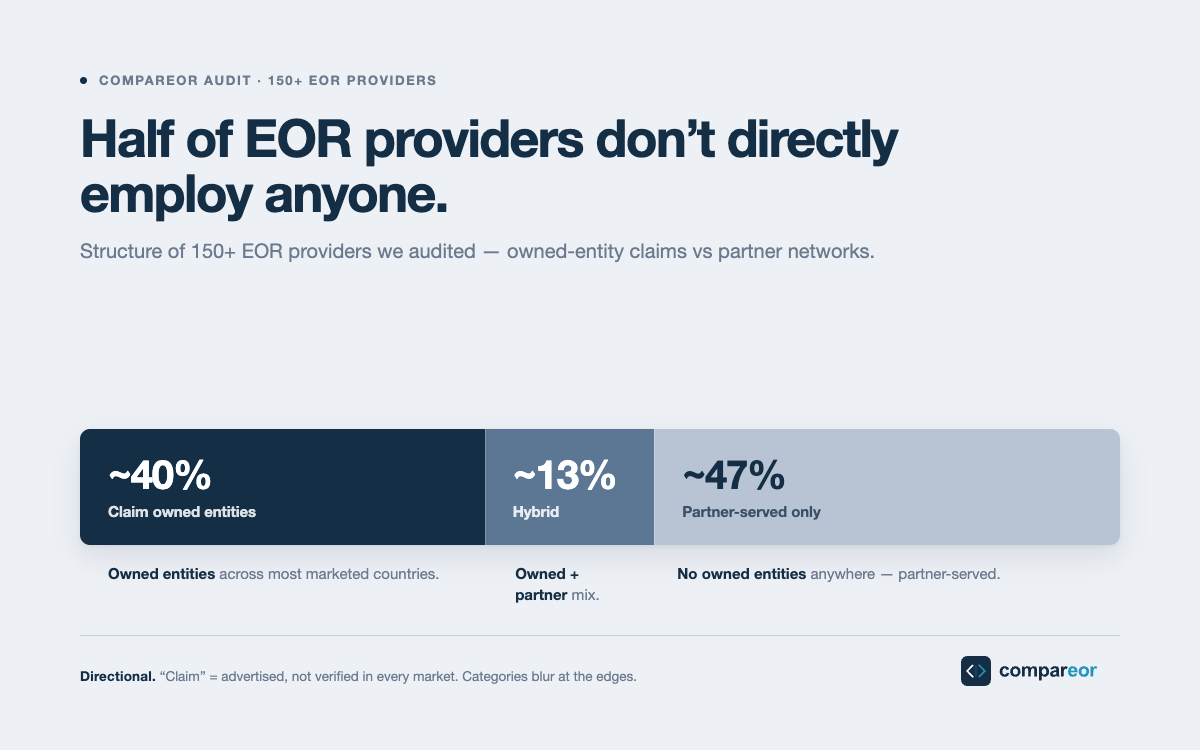
About 40% of EOR providers I audited claim and substantiate owned entities across most of their marketed countries. About 12 to 15% run an honest hybrid. About 45 to 50% are partner-served only, with no owned entities anywhere. The numbers, the methodology, the one honest caveat, and what they mean for buyers.


June 3, 2026
6 min read
Every EOR contract has an expiration date
The EOR model has a built-in expiration date, somewhere between 15 and 20 employees in one country. Past that threshold, the EOR stops being the cheapest option and starts being a tax on growth. Most companies miss it for a year or more, because the contract doesn't mention it and nobody inside is responsible for noticing.

May 25, 2026
5 min read
Why "150+ countries" is the most misleading number in global employment
Every EOR homepage leads with a country count, and after auditing 150+ providers it's the number most likely to lead you to the wrong choice. Coverage comes in three forms, and depth in your countries matters more than breadth across 185 of them.
Stay Updated on Global Hiring
Get weekly insights on EOR trends, compliance updates, and cost-saving strategies

Find a better EOR — without risk
Compare EOR providers to gain insights on cost, coverage, and contract flexibility, ensuring compliance and payroll continuity.


.png)
.png)



