
How to Build a Remote Team Across 5 Countries Without Setting Up Entities
A practical playbook for building a distributed global team using EOR — from first hire to a 20-person international team.


.png)
The distributed team problem
Building a team across multiple countries creates a compliance patchwork that will consume enormous time, legal budget, and operational attention if it is managed without a plan. The surface layer is the obvious part — payroll, tax, and benefits each operate under different rules in each jurisdiction. The deeper layer is the set of interactions between those rules: notice periods that don't match, termination procedures that block your global policy rollout, data protection rules that conflict with your HR stack, equity programs that are taxable in some countries and not in others.
Setting up your own legal entities in five countries simultaneously is typically a 12–18 month project — incorporation, bank accounts, tax registration, payroll infrastructure, local counsel, and an in-country HR function for each. An Employer of Record (EOR) compresses that to 2–6 weeks per country, but only if you approach the scaling problem systematically. This guide walks through the five-step framework we see working across distributed-team deployments on Compareor in 2026.
For the foundational context — what an EOR actually does and when it's the right tool — see our complete 2026 guide to Employer of Record. For the strategic decision between EOR, PEO, and entity setup, see EOR vs PEO vs entity setup.
Step 1 — Define your hiring markets before selecting a provider
The single most common mistake in multi-country EOR procurement is picking the provider first and the countries second. Not all EOR providers are equal across all markets, and the gap between a provider's best and worst jurisdictions can be material — owned-entity vs partner coverage, platform depth for local compliance, quality of local support, termination speed in complex markets.
Before running any provider demo, identify your first five target countries and rank them by hiring priority over the next 18 months. For each country, note: expected headcount, typical role seniority, salary band, and any specific compliance concerns (Works Council in Germany, IR35 in the UK, CLT in Brazil, IMSS in Mexico). That five-country map becomes your scoring sheet for every provider conversation.
A provider that's excellent across Western Europe may have thinner coverage in Southeast Asia or Latin America. A provider with strong DACH (Germany, Austria, Switzerland) specialisation may be oversized for a team concentrated in Eastern Europe. Match provider strength to your hiring map, not the other way around. See the sector-level starting shortlists: EOR for remote-first companies, EOR for scaling from 50 to 500 employees, and EOR for enterprise companies.
Step 2 — Standardise your employment framework
Every country requires locally-compliant contracts. What you can standardise is the non-statutory layer — the contractual elements that sit above the local statutory minimum. Done well, this gives you a consistent global employment framework while staying fully compliant in each jurisdiction.
The four elements to standardise across all countries:
- Notice periods — set at or above the legal minimum in every country, but pick a single global default (e.g. 30 days, 60 days, or tenure-based). The EOR implements this as a local-compliant contract clause.
- IP assignment and invention clauses — critical for tech and SaaS companies. Your EOR should offer a global IP assignment framework that holds up in every jurisdiction on your map. See EOR providers for tech and SaaS for providers with strong IP infrastructure.
- Confidentiality and restrictive covenants — enforceability varies significantly across countries. Build one global framework with country-specific adaptations, rather than a different NDA for every market.
- Garden leave provisions — particularly relevant for senior hires. Standardise the clause language across countries where it's enforceable, omit where it isn't, and make sure your EOR surfaces this per country.
Equity and ESOP administration is another layer worth standardising early. Stock options, RSUs, and vesting are taxed very differently across countries — in some jurisdictions, vesting events trigger immediate payroll tax that must be processed through the EOR. See our EOR providers for equity and ESOP management ranking.
Step 3 — Build a single HR stack that works cross-border
The second most common mistake is letting the HR stack fragment as you add countries. A separate payroll tool for each country, different performance management systems for different offices, country-specific expense tools — within 18 months you're managing 15 separate tools and no one has a single view of the workforce.
The goal is a single system of record regardless of where employees are based. A practical baseline stack:
- Documentation and policy — Notion or Confluence for the HR handbook, org chart, and policies. Country-agnostic, accessible to everyone, with per-country adaptations as sub-pages rather than separate sites.
- Performance management — Lattice, Leapsome, or similar, configured once and used globally. Resist the temptation to use different tools per region.
- Payroll and payslips — your EOR's own platform handles this natively. If you're using multiple EORs (which we'd caution against in most cases), insist on HRIS-layer integrations so data flows to a single source of truth. See EOR providers with built-in HRIS.
- Expense management — a single tool configured for multi-currency (Expensify, Ramp, Brex, Pleo) beats per-country solutions. Make sure the tool integrates with your EOR's payroll system.
- Identity and access — single IdP (Okta, Azure AD, Google Workspace) with SCIM provisioning to your EOR's platform. This is where SSO coverage matters.
One EOR is almost always better than two. The operational overhead of managing two EORs across overlapping countries — data reconciliation, contract coordination, vendor governance — consistently outweighs any per-country price advantage. The only cases where multiple EORs genuinely make sense are when you have a strong country specialist for a single market (e.g. India) that dramatically undercuts your global provider on price.
Step 4 — Localise compensation without creating internal inequity
Paying market rate in each country creates large compensation gaps across your team. A senior engineer in Warsaw earns ~€55,000/year; the same role in San Francisco costs $180,000+. A head of marketing in Mexico City is roughly half the comp of the same role in London. These gaps are economic reality, but they create internal dynamics — particularly in fully remote teams where people talk to each other across borders and see the difference.
Two philosophies dominate in 2026:
Location-based pay. Compensation is benchmarked to local market rate in each country. This minimises cost, maintains competitive positioning in each hiring market, and is the default at most scale-ups and mid-market companies. The downside is visible internal compression when employees compare.
Global pay bands. A single band per role globally, adjusted only for broad cost-of-living tiers (e.g. Tier 1 / Tier 2 / Tier 3). More expensive in aggregate, but flatter and better-received in distributed-first cultures. The downside is that you pay above market in low-cost markets, which can make retention harder once employees realise they're overpaid relative to local peers.
Pick one early and communicate it clearly to all employees. Mid-stream compensation philosophy changes are politically expensive. The EOR does not drive this decision — it executes against whichever framework you pick — but the provider's benefits and equity infrastructure will need to map against your philosophy.
Step 5 — Plan for complexity at scale (the entity transition)
EOR is the right tool for 1–10 employees per country. Somewhere between 10 and 25 employees per country, the economics shift — and if you stay on EOR at the wrong scale, you overpay in monthly service fees and lose some of the strategic control that comes with direct employment.
A simple breakeven calculation we see working in practice: if your country-specific EOR monthly fees are running above $50,000–$80,000/year, entity setup typically pays back in 18–24 months. For detail on entity cost, see EOR vs hiring locally: a full cost comparison for 10 key markets and the EOR vs PEO vs entity setup decision framework.
Build entity setup into your 18–24 month plan for your highest-headcount markets from day one — not because you'll execute it immediately, but because the EOR-to-entity transition is easier when you've designed for it from the start. Key design choices that make later migration easier: your EOR handles employee data in a format you can export cleanly; your HR stack is independent of the EOR platform; your equity and benefits programs are structured to survive a change of legal employer.
Common pitfalls when scaling via EOR
Three failure modes we see repeatedly in distributed-team deployments:
- Misclassifying employees as contractors to avoid EOR fees in high-cost markets. This works until it doesn't — the countries where it looks most tempting (Brazil, France, Colombia, the UK under IR35) are also the countries with the most aggressive misclassification enforcement. See contractor misclassification: the countries with the highest risk and should you hire contractors or employees internationally for the full framework.
- Under-scoping termination timelines. Notice periods of 3+ months are common in Europe and LATAM. Works council consultation adds weeks in Germany. Severance negotiations in France are multi-month. Build these into your performance management cadence from the start.
- Ignoring the PE risk. In some countries, placing senior strategic or revenue-generating roles through an EOR can create Permanent Establishment exposure for your home-country tax. Flag this with tax counsel before deploying senior hires via EOR in complex jurisdictions.
Frequently asked questions
How fast can I build a team across 5 countries via EOR?
With a single global EOR, typical onboarding runs 2–6 weeks per country — faster in owned-entity markets (UAE: 1 day; Singapore: 2 days; UK: 2 days) and slower in partner-coverage jurisdictions. A 5-country team can realistically be live within 6–10 weeks end-to-end, compared with 12–18 months for entity setup in the same countries. See the 10 fastest countries to onboard through EOR.
Should I use one EOR or multiple EORs for multi-country teams?
One, in almost all cases. The operational overhead of managing two EORs across overlapping countries outweighs the per-country savings. Multiple EORs make sense only when a country specialist dramatically undercuts your global provider (typically in India, the Philippines, or Vietnam) and your India headcount is material. For a straightforward single-provider comparison, use the Compareor side-by-side tool.
When should I transition from EOR to my own entity?
Usually between 10 and 25 employees per country — the exact breakeven depends on the country's employer cost structure, entity setup cost, and the EOR rate you've negotiated. A simple heuristic: if your annual EOR fees in a single country exceed $50,000–$80,000, entity setup typically pays back inside 18–24 months. Always model the full transition cost, not just the incremental savings.
Can I standardise contracts across all 5 countries?
Not fully — each country requires locally compliant employment contracts. But you can standardise the non-statutory layer: notice periods (at or above local minimum), IP assignment clauses, confidentiality terms, and equity vesting schedules. Your EOR should implement these as standard additions on top of the local template.
What's the biggest risk in scaling via EOR?
Contractor misclassification is the single biggest cross-country compliance risk we see. When companies grow fast and feel the EOR fee pressure, the temptation to re-classify borderline cases as contractors is strong — and it's exactly the wrong move in the five to six countries with the most aggressive enforcement. For current enforcement priorities see the 2026 labour law changes overview.
Bottom line
Scaling a distributed team across five countries through EOR is a solved problem in 2026 — provided you approach it as a systematic design exercise, not a vendor procurement. Map your countries first, pick a provider that fits the map, standardise the non-statutory employment layer, build a single cross-border HR stack, pick a compensation philosophy early, and design the EOR-to-entity transition path from day one.
The payoff is real: 2–6 week onboarding per country instead of 12–18 months for entity setup, a unified HR stack rather than a patchwork, and compliance risk that sits with a specialist partner rather than your in-house team. Benchmark providers on the Compareor side-by-side tool and walk through the EOR Contract Audit Checklist before signing any multi-country agreement.
Get your shortlist
Takes ~3 minutes. No account needed.
June 3, 2026
6 min read
I checked the structure of 150+ EOR providers. Here's how many actually own their entities.
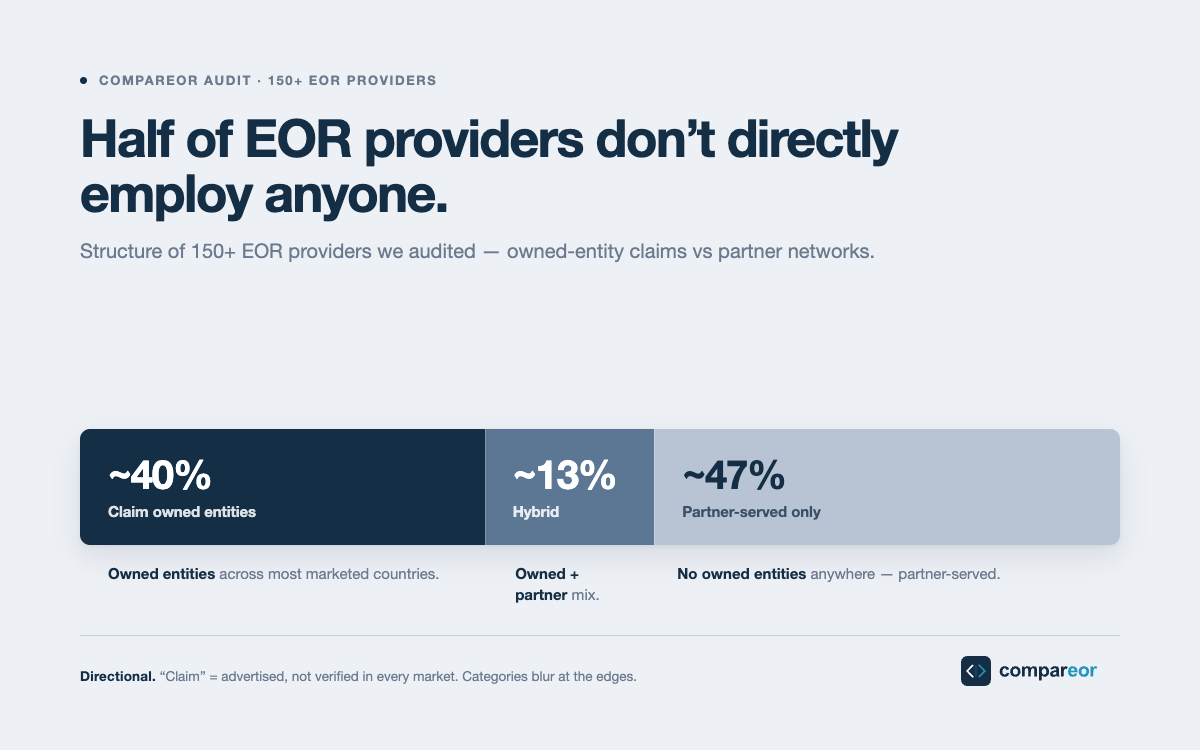
About 40% of EOR providers I audited claim and substantiate owned entities across most of their marketed countries. About 12 to 15% run an honest hybrid. About 45 to 50% are partner-served only, with no owned entities anywhere. The numbers, the methodology, the one honest caveat, and what they mean for buyers.


June 3, 2026
6 min read
Every EOR contract has an expiration date
The EOR model has a built-in expiration date, somewhere between 15 and 20 employees in one country. Past that threshold, the EOR stops being the cheapest option and starts being a tax on growth. Most companies miss it for a year or more, because the contract doesn't mention it and nobody inside is responsible for noticing.

May 25, 2026
5 min read
Why "150+ countries" is the most misleading number in global employment
Every EOR homepage leads with a country count, and after auditing 150+ providers it's the number most likely to lead you to the wrong choice. Coverage comes in three forms, and depth in your countries matters more than breadth across 185 of them.
Stay Updated on Global Hiring
Get weekly insights on EOR trends, compliance updates, and cost-saving strategies

Find a better EOR — without risk
Compare EOR providers to gain insights on cost, coverage, and contract flexibility, ensuring compliance and payroll continuity.


.png)
.png)



