
What is an Employer of Record? The Complete 2026 Guide
A plain-English explanation of what an EOR is, how it works, what it costs, and when it makes sense for your business.


.png)
What is an Employer of Record?
An Employer of Record (EOR) is a third-party company that legally employs workers on your behalf in a country where you have no local entity. You direct the work; the EOR handles payroll, tax withholding, statutory benefits enrolment, local contract drafting, and compliance with labor law. The practical effect is that you can hire a full-time employee in Germany, the UK, Brazil, or the UAE within a week, without setting up a subsidiary and without taking on the multi-month tax, legal, and accounting overhead that entity formation requires.
The EOR signs the employment contract with the worker, runs payroll in local currency, and acts as the legal employer in the eyes of the tax authority, the social security agency, and the labor inspectorate. You maintain full operational control over the employee's day-to-day responsibilities through a commercial services agreement between your company and the EOR. To the employee, the payslip, the contract, and the HR administrator all carry the EOR's name. To their manager and the rest of your team, the relationship is identical to any other employee.
This post covers the full picture: what an EOR actually does, how the relationship works week to week, how costs break down, how it compares to the alternatives (entity setup, PEO, contractor, staffing agency), and how to tell whether it is the right fit for your situation. If you already know EOR is the right structure and are in procurement mode, pair this with the 12-question provider evaluation and the small-team provider shortlist.
How does it work in practice?
The relationship has three structural layers: the employment contract between the EOR and the employee, the services agreement between the EOR and your company, and the operational reporting line between the employee and their manager on your side. Each layer sits separately, which is why the model works legally.
The onboarding flow
The typical sequence runs: (1) you source and interview the candidate through your normal hiring process, (2) you agree role, start date, and total compensation, (3) you hand the offer package to the EOR, (4) the EOR drafts a locally-compliant employment contract and sends it to the employee for signature, (5) the employee completes local onboarding documents (tax registration, social security, bank account details), (6) the EOR enrolls the employee in statutory benefits and sets up payroll, and (7) the employee starts on the agreed date.
Most EOR providers can onboard an employee in 1–5 business days in straightforward markets — the UK, UAE, Singapore, Ireland, Poland, Kenya, Philippines, South Africa, Netherlands, and Romania — where local registrations are fast and documentation requirements are lightweight. Complex markets like Germany, France, Brazil, Mexico, China, and India typically take 2–4 weeks because of heavier registration, mandatory medical checks, or statutory notification periods. Our guide to the fastest EOR onboarding markets covers the country-by-country timing in detail.
The ongoing relationship
After onboarding, the rhythm is predictable. The EOR runs monthly payroll (or fortnightly in some markets), remits taxes and social contributions to the relevant authorities, files statutory returns, administers benefits, and invoices you once per month for a combined total of employer-side costs plus the EOR service fee. You approve the invoice, wire the payment, and the EOR disburses salary to the employee in local currency on payday.
Between pay runs, the EOR handles the full employment-side workflow: leave requests, sickness absence, salary reviews, contract amendments, parental leave administration, and — when necessary — disciplinary and termination procedures under local law. Your managers continue to handle everything that is properly operational: goals, performance, day-to-day direction, team integration.
Who bears what responsibility
The legal employer (the EOR) is the party named on the employment contract and the party that appears before any statutory authority on an employment matter. Your company is the commercial principal — you pay for the service, you direct the work, and you make the hiring and firing decisions. This legal separation is what enables the model, and it is also why the indemnification structure in the EOR contract matters. When something goes wrong, the allocation of liability follows the layers of the contract, not the marketing brochure.
EOR vs the alternatives
EOR vs setting up your own entity
Setting up a local subsidiary or branch office takes 3–6 months, costs $10,000–$50,000 in legal, registration, and initial capital requirements, and creates ongoing obligations for local accounting, payroll, HR, and statutory filings that typically add $2,000–$5,000 per month in overhead. An EOR lets you hire within a week with no capital outlay and a predictable monthly fee.
The crossover logic: for the first 1–10 employees in a country, EOR is almost always cheaper and faster. For 10–15 employees, the two models run roughly even on total cost. Above 15 employees, an entity becomes structurally cheaper per head and also gives you direct control over local HR and benefits, which matters at scale. Our EOR vs PEO vs entity framework walks through the break-even math in detail.
EOR vs PEO
A PEO (Professional Employer Organization) is a co-employment arrangement that exists primarily in the US. Both the PEO and your company are joint employers of the worker, sharing employment responsibilities. PEO is fundamentally a US-only structure — elsewhere in the world, what gets marketed as "global PEO" is almost always actually an EOR. The practical distinction: a PEO requires you to already have a US entity; an EOR gives you an employer presence in a country where you have no entity at all.
EOR vs contractor
Hiring a self-employed contractor (freelancer, independent consultant, auto-entrepreneur) avoids the EOR fee and the employer-side statutory contributions, but it comes with misclassification risk. In most countries, a de-facto full-time worker treated as a contractor is a requalification exposure — tax authorities like URSSAF in France, HMRC in the UK, the IRS in the US, and Deutsche Rentenversicherung in Germany actively audit these arrangements and retroactively reclassify them into employment relationships with back-contributions. Our misclassification risk guide and the risk-quiz cover the country-by-country exposure. Short rule: if the person works exclusively for you, full-time, on your equipment, on your schedule, they are probably an employee — and EOR is the right structure.
EOR vs staffing agency
A staffing agency places short-term or temporary workers with a client under the agency's employment. This overlaps with EOR in structure — both are third-party employment — but the commercial and operational profile is different. Staffing is typically short-duration, agency-sourced, and role-specific. EOR is typically long-duration, client-sourced, and role-agnostic. The fee structures also differ: staffing agencies usually take 20–40% of gross salary; EOR providers typically charge 3–15% of gross or a flat per-employee fee.
What does an EOR cost?
The total cost of hiring through an EOR has three layers: the employee's gross salary, the statutory employer contributions that sit on top of gross, and the EOR service fee.
The service fee
Most providers charge either a flat monthly fee per employee ($300–$700/month in most markets) or a percentage of gross salary (3–15%). Some charge a hybrid. Flat-fee pricing is predictable and usually cheaper for senior hires; percentage-of-salary pricing scales with compensation and is usually cheaper for junior hires. The break-even point depends on salary level and country — our pricing-model comparison has a salary-by-salary break-even table.
Statutory employer contributions
This is the largest line on the invoice and the one most first-time buyers underestimate. Employer-side social security, pension, unemployment insurance, health coverage, and other mandatory contributions vary from ~11% of gross (Ireland) to 42–45% of gross (France) depending on the country. Rough benchmarks: UK 20–25%, Germany 38–42%, Netherlands 18–22%, Spain 29–32%, Italy 28–32%, Brazil 30–35%, India 20–25%, UAE 0–12.5% (varies by emirate and Emirati vs expat status), Mexico 25–30%, South Africa 5–10%. Our country-by-country cost breakdown has the full table.
Hidden fees to watch for
Three categories routinely add 20–40% to the invoiced total above the headline rate: FX conversion markup (1–3% on every wire), benefits administration fees ($30–$100/employee/month in some providers), and offboarding or termination fees ($200–$2,000 per separation). The contract-red-flag guide covers the specific clauses to look for, and the seven-hidden-costs breakdown maps where the real invoice usually deviates from the quote.
A worked example
For a €70,000 gross software engineer in Germany: €70,000 gross salary + ~€28,000 statutory employer contributions + ~€6,000–€9,000 EOR service fee = total annual cost ~€104,000–€107,000. The cost-to-gross multiplier is 1.48–1.53× in Germany, 1.25–1.35× in the UK, 1.55–1.65× in France, and 1.30–1.40× in Poland — ratios that are consistent enough to use as planning shortcuts.
When should you use an EOR?
- You need to hire in a new country without establishing a local entity — the most common trigger, and the one the EOR model was built for
- You are hiring fewer than 10–15 employees in a single jurisdiction — below that threshold, EOR is almost always cheaper than entity setup
- Speed of hire matters and entity setup timelines (3–6 months) are too slow — typical for competitive hires where a candidate will not wait
- You are testing a new market before committing to a permanent presence — EOR provides a reversible commitment that an entity does not
- Your existing EOR does not cover a country you need to hire in — adding a second provider is cheaper and faster than opening an entity in the new market
- You have acquired a company with international employees and need to onboard them cleanly during the transition period
- You are hiring a single senior or specialized role where the cost of entity setup cannot be amortized across a team
The pattern US companies encounter most often is the first two together: a new hire in a new country for a team that is not yet big enough to justify entity overhead. Our US-to-Europe hiring playbook covers the decision sequence in detail, and the multi-country EOR playbook covers the case where you stay on EOR across 3–5 markets.
When should you NOT use an EOR?
Three patterns where EOR is usually the wrong answer, or needs to be reconsidered.
First, when you have 15+ employees in a single country with clear commitment to grow further. The entity math flips, and the per-head cost of continued EOR starts to look excessive. This is the most common reason companies migrate away from EOR — not dissatisfaction with the provider, but scale.
Second, when you need deep local HR control — custom benefits packages, specific collective bargaining agreement nuances, in-country works councils, or bespoke equity arrangements that require a local entity to administer. At a certain level of operational sophistication, the EOR's standardized approach becomes a constraint rather than a convenience.
Third, when the role is fundamentally a contractor relationship — short-term, project-scoped, non-exclusive, non-core work. EOR is designed for FTE-equivalent engagements. A genuine three-month independent consulting engagement should be structured as contracting (with appropriate misclassification analysis), not routed through EOR employment at full statutory cost.
How to choose an EOR provider
Once EOR is the right structural answer, the provider selection matters almost as much as the structural decision. The dimensions that actually differentiate providers:
Country coverage and entity ownership. Providers that run owned entities in your target countries generally deliver faster onboarding, cleaner compliance, and lower FX cost than providers that operate through partner networks. Ask specifically whether each target market is owned or partner-operated.
Pricing model and transparency. Flat-fee vs percentage-of-salary, with written policies on FX markup, benefits administration, and offboarding fees. Transparent providers name these numbers; opaque providers bundle them into the headline rate or leave them for the first invoice.
Service level and responsiveness. SLAs for payroll, onboarding, and issue resolution, with escalation paths. The most common reason companies switch providers is not cost — it is support quality, specifically on edge cases like terminations, visas, and parental leave.
Compliance and liability allocation. Professional indemnity insurance limits, indemnification caps in the master services agreement, and country-specific compliance depth. Run any shortlisted contract through the 20-point contract audit checklist before signing.
The practical sequence: use the Compareor comparison tool to build a shortlist based on country coverage and pricing, run each finalist through the 12-question evaluation, and audit the proposed contract against the checklist before signature. The full provider directory is the starting point for discovery.
Frequently asked questions
Is EOR legal in every country?
EOR is lawful in most countries, with the specific form regulated differently by jurisdiction. Some countries (Germany, France, Italy, Spain) have specific statutory frameworks for employee leasing (Arbeitnehmerüberlassung, portage salarial) that EOR operates under. A few markets (Austria, some Swiss cantons) have restrictions on how long or for what types of roles EOR can be used. Reputable providers know the applicable framework in each country they operate in.
Can I direct the employee's day-to-day work?
Yes — that is the point of the model. You direct the work through the commercial services agreement; the EOR administers the employment relationship. The legal-employer role sits with the EOR, but operational direction is yours.
How long can I keep an employee on an EOR?
Indefinitely, in most countries. A handful of jurisdictions (notably Germany, Netherlands, and Austria) have soft or hard time limits on employee-leasing arrangements — typically 18–48 months — after which a permanent structure is required. Reputable providers flag these limits up front.
Can an EOR sponsor a visa or work permit?
Yes, in most countries with a formal sponsorship regime (UK, Netherlands, UAE, Singapore, Canada, Australia). The EOR acts as the sponsoring employer. Visa timelines add 4–12 weeks to onboarding depending on the country and the applicant's nationality.
How does EOR handle employee equity or stock options?
Equity is granted by your parent company, not by the EOR. The EOR administers local tax reporting on equity events (vesting, exercise, sale) according to the rules in the employee's jurisdiction. For complex cases — senior hires with significant equity, US 409A valuations affecting non-US employees, or jurisdictions with unfavorable equity tax treatment — involve your tax counsel in the structure before the grant.
Bottom line
An Employer of Record is the default structure for hiring internationally without setting up an entity. It transfers the legal-employer role to a third party that runs payroll, files taxes, and administers the statutory employment relationship, while leaving commercial direction and day-to-day management with you. For the first 1–15 employees in a country, it is almost always the right answer on cost, speed, and reversibility.
The EOR market has matured significantly since 2020 — 50+ providers now operate with varying depth of country coverage, pricing transparency, and compliance rigor. Choosing well matters more than the decision to use EOR in the first place. The sequence that works: use the comparison tool to shortlist based on your country mix and budget, run each finalist through the 12-question evaluation, and audit the proposed contract against the 20-point checklist before signing. Do those three things and EOR becomes exactly what it is supposed to be — a clean, fast, compliant way to hire anywhere in the world.
Get your shortlist
Takes ~3 minutes. No account needed.
June 3, 2026
6 min read
I checked the structure of 150+ EOR providers. Here's how many actually own their entities.
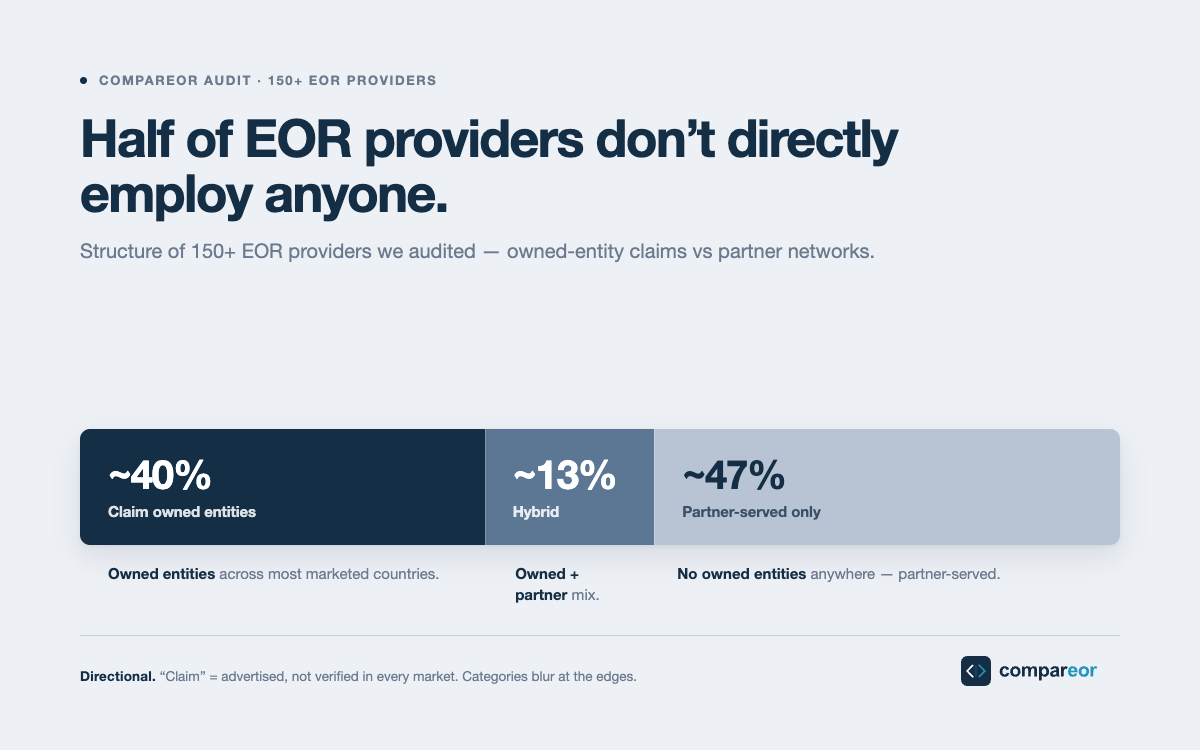
About 40% of EOR providers I audited claim and substantiate owned entities across most of their marketed countries. About 12 to 15% run an honest hybrid. About 45 to 50% are partner-served only, with no owned entities anywhere. The numbers, the methodology, the one honest caveat, and what they mean for buyers.


June 3, 2026
6 min read
Every EOR contract has an expiration date
The EOR model has a built-in expiration date, somewhere between 15 and 20 employees in one country. Past that threshold, the EOR stops being the cheapest option and starts being a tax on growth. Most companies miss it for a year or more, because the contract doesn't mention it and nobody inside is responsible for noticing.

May 25, 2026
5 min read
Why "150+ countries" is the most misleading number in global employment
Every EOR homepage leads with a country count, and after auditing 150+ providers it's the number most likely to lead you to the wrong choice. Coverage comes in three forms, and depth in your countries matters more than breadth across 185 of them.
Stay Updated on Global Hiring
Get weekly insights on EOR trends, compliance updates, and cost-saving strategies

Find a better EOR — without risk
Compare EOR providers to gain insights on cost, coverage, and contract flexibility, ensuring compliance and payroll continuity.


.png)
.png)



