
The 7 Labor Law Changes in 2026 That Affect Global Hiring
Seven significant employment law changes took effect in 2025–2026 that every company hiring internationally needs to know about.


.png)
Global employment law is moving fast
Since 2021, the pace of labour law reform across major hiring markets has accelerated meaningfully. Post-pandemic worker protections, gig economy regulation, AI in the workplace, pay transparency, supply chain due diligence, and payroll re-taxation have all produced concrete legislation in EU, UK, UAE, Singapore, Brazil, Germany, and India. For companies hiring internationally through an Employer of Record (EOR), these changes are not abstract — they reshape employer cost, contract terms, reporting obligations, and the contractor-vs-employee boundary.
This guide distils the seven most consequential 2026 changes for international hiring teams, with the statutory framework for each, the practical impact on EOR cost and compliance, and what to ask your provider. For the broader procurement view, see the 12 questions to ask before signing an EOR and run providers through the Compareor comparison tool.
1. UAE mandatory health insurance — all seven emirates (January 2025)
From 1 January 2025, mandatory employer-provided health insurance applies to all private sector employees across all seven emirates. Previously, the requirement applied only in Abu Dhabi (since 2006, Law No. 23 of 2005) and Dubai (since 2014, Law No. 11 of 2013). The expansion to Sharjah, Ajman, Fujairah, Ras Al Khaimah, and Umm Al Quwain was the most material UAE employment reform in a decade.
The statutory floor is the Essential Benefits Plan at approximately AED 320/year per employee. Comprehensive plans for senior professional hires typically cost AED 3,000–8,000/year. Non-compliance blocks residency visa issuance and renewal — the operational impact is typically larger than the direct fines (around AED 500/month per uninsured employee).
For EOR procurement, the question is whether basic cover is included in the headline UAE fee, passed through separately, or marked up. Get it in writing. Deeper detail in the UAE 2025 health insurance guide, the UAE country guide, and the top 10 EOR providers for the UAE.
2. UK pay transparency direction of travel and the Employment Rights Bill (2025–2026)
The UK is tightening the employee-protection framework on two fronts in 2025–2026. First, pay transparency — the UK government has been consulting on mandatory pay-range disclosure in job adverts, following the trend set by Colorado, New York, California, and the EU Pay Transparency Directive (transposition deadline June 2026). Large employers in scope can expect to publish pay ranges on public-facing job postings and respond to candidate pay requests.
Second, the Employment Rights Bill introduces day-one unfair dismissal rights (removing the current two-year qualifying period), strengthened statutory sick pay from day one, and expanded flexible-working defaults. The Bill is being implemented on a staggered timeline into 2026 and 2027, with some measures live already.
The practical impact for EOR-engaged UK hires is in contract terms and probation periods — expect EOR providers to revise UK contract templates through 2026 as the Bill's measures commence. Combined with the ongoing IR35 regime, the UK employment layer is denser than it has been in a decade. See IR35 in 2026, the UK country guide, and the top 10 EOR providers for the UK.
3. EU Platform Work Directive — transposition deadline 2 December 2026
Directive (EU) 2024/2831 on improving working conditions in platform work was adopted in October 2024 and entered into force in December 2024. EU member states have until 2 December 2026 to transpose it into national law. The Directive creates a legal presumption of employment for platform workers, shifting the burden of proof from the worker to the platform operator when the relationship shows facts of "direction and control".
The Directive's impact extends beyond pure gig-economy platforms. Member states retain some latitude in how they apply the presumption, and several (France, Spain, the Netherlands) already operate stricter national frameworks — see Spain's Ley Rider (2021) and France's long-running requalification case law. For EOR clients with contractor populations in Europe, the post-2026 landscape tightens the contractor-vs-employee boundary further, particularly in France, Spain, and Germany.
Practical actions: audit any contractor engagement that has the characteristics of direction and control (set schedules, integration into client operations, single-client dependence). For high-risk engagements, convert to EOR employment ahead of the transposition deadline. See should you hire contractors or employees internationally, the highest-risk countries for contractor misclassification, and stress-test current engagements with the misclassification risk quiz.
4. Brazil payroll re-taxation — Law 14,973/2024 (2025–2027)
Brazil's Law 14,973/2024, published in September 2024, establishes a gradual re-taxation (reoneração) of payroll for 17 sectors that had previously benefited from the CPRB regime — paying social security on revenue rather than on payroll. The phased return to payroll-based INSS contributions runs across 2025, 2026, and 2027.
The sectors most affected include technology, call centres, transport (road and air), construction, textiles, footwear, communications, and hospitality. For each affected sector, employer INSS contributions ramp up progressively — starting in 2025 at a reduced rate, increasing across 2026 and 2027, and reaching the full 20% employer rate by 2028 (subject to further legislation). The consequence is rising fully-loaded employment cost in Brazil for EOR-engaged workers in these sectors.
Combined with Brazil's existing 70–80% total employment cost (CLT benefits, FGTS, 13th-month salary, vacation premium, plus INSS and system contributions), the re-taxation tilts the Brazilian EOR cost equation upward for the affected sectors. Budget accordingly. See why Brazil's CLT makes EOR essential, the Brazil country guide, and how much EOR really costs country-by-country for the full benchmarks.
5. Singapore CPF Ordinary Wage ceiling increase (2024–2026)
The Singapore CPF (Central Provident Fund) Ordinary Wage (OW) ceiling — the maximum monthly salary on which CPF contributions are calculated — is being progressively raised from SGD 6,000 (pre-2023) to SGD 8,000 (from January 2026). The schedule:
- September 2023: SGD 6,300
- January 2024: SGD 6,800
- January 2025: SGD 7,400
- January 2026: SGD 8,000
For senior hires earning above the ceiling, this directly raises employer CPF cost. Singapore citizens and permanent residents under age 55 attract a 17% employer contribution; at the 2026 ceiling, the maximum employer CPF contribution on Ordinary Wages reaches SGD 1,360/month (SGD 16,320/year). Employees on Employment Pass or S Pass remain outside CPF, so the cost change applies only to citizen/PR hires. See the Singapore country guide.
For Singapore-focused hiring plans, factor the ceiling increase into 2026 salary benchmarking and employer cost models. The cumulative annual cost increase for a citizen-earning mid-six-figures is meaningful — not a rounding error.
6. Germany Supply Chain Due Diligence Act (LkSG) — 1,000+ employee threshold since 2024
The German Lieferkettensorgfaltspflichtengesetz (LkSG, Supply Chain Due Diligence Act) took effect on 1 January 2023 for companies with 3,000+ employees. From 1 January 2024, the threshold dropped to 1,000+ employees — significantly expanding scope. The Act is enforced by BAFA (the Federal Office for Economic Affairs and Export Control), with fines up to €8 million or 2% of global annual turnover for major groups, plus exclusion from public procurement.
The LkSG requires in-scope companies to:
- Establish a risk management system covering human rights and environmental risks in their own operations and direct suppliers
- Conduct regular risk analyses and document preventive and remedial measures
- Appoint a human rights officer and publish an annual report to BAFA
- Operate a grievance mechanism accessible to workers throughout the supply chain
EOR-engaged workers are within scope as an employment relationship, which means the client (if subject to LkSG) must include them in the due diligence framework. Practically, this pushes procurement toward EOR providers with auditable compliance reporting and documented working-conditions standards. See the Germany country guide and the works-council guide for the broader German employment context.
Note that the EU-level Corporate Sustainability Due Diligence Directive (CSDDD) runs on a parallel track and will progressively apply across EU member states from 2027 onward, broadening the framework further.
7. India four new labour codes — state-by-state implementation
India's four consolidated labour codes — the Code on Wages (2019), Industrial Relations Code (2020), Code on Social Security (2020), and Occupational Safety, Health and Working Conditions Code (2020) — were passed in 2019–2020 to replace and consolidate 29 central labour laws. Implementation has been on a rolling state-by-state basis, with several states having published draft rules but only partial operationalisation so far.
For EOR-engaged workers in India, the practical consequences when the codes are fully operational include:
- Universal definition of "wages" — a single definition across all four codes, potentially raising the calculation base for PF, gratuity, and ESIC contributions
- Expanded social security coverage — gig and platform workers brought under the social security umbrella
- Simplified compliance — fewer returns, unified licences
- Standardised working hours and overtime across states
Because implementation is state-led, companies with EOR workers in multiple Indian states need to track which codes are live in each jurisdiction — Karnataka, Maharashtra, and Tamil Nadu typically lead, with smaller states trailing. Ask your EOR to provide state-by-state compliance status in their monthly reporting. See the India country guide.
What this means for EOR procurement in 2026
The seven changes above have three common implications for how procurement teams should evaluate EOR providers this year:
- Price the change in. UAE health insurance, Brazil re-taxation, and Singapore CPF ceilings all push fully loaded employment cost upward in their respective markets. Don't benchmark against 2023 data — pull current country-specific quotes. See the country-by-country cost breakdown.
- Audit contractor populations now. The EU Platform Work Directive and the UK Employment Rights Bill both tighten the contractor-employee boundary. Any contractor engagement that looks like employment has a narrowing window to be restructured cleanly. See contractors vs employees internationally.
- Probe reporting capability. LkSG, CSDDD, and Indian code compliance all demand auditable reporting from employers. Ask your EOR how they document compliance for each jurisdiction and how quickly they can produce audit-ready reports. Providers with strong HRIS integration have an edge here.
Before signing any 2026 engagement, run the EOR selection checklist and verify pricing explicitly reflects the 2025–2026 changes, not legacy figures. Hidden cost exposure frequently traces back to contracts signed against pre-reform benchmarks — see hidden fees in EOR contracts.
A procurement checklist for regulatory-fit providers
Seven questions to ask any EOR shortlisted for 2026 hires:
- Have you updated UAE pricing and compliance processes for the federal health insurance mandate across all seven emirates?
- How are you handling the UK Employment Rights Bill changes as they commence in 2026? Probe for contract template revisions and probation period adjustments.
- What is your plan for the EU Platform Work Directive transposition by 2 December 2026? Especially in France, Spain, and Germany, where the presumption of employment will bite first.
- Are your Brazil invoices reflecting the Law 14,973/2024 payroll re-taxation schedule for my sector?
- Is your Singapore CPF contribution line scaling correctly to the SGD 8,000 ceiling from January 2026?
- Can you produce LkSG-compliant employment records and grievance-mechanism access for my German hires?
- Do you track Indian labour code implementation state-by-state and reflect code rules in payroll as each state commences?
Frequently asked questions
Which of the seven changes has the biggest financial impact on EOR cost?
For most companies, Brazil's re-taxation has the largest cumulative impact — Brazilian total employment cost is already high (70–80% loading), and the sector-specific ramp adds meaningfully to that. For Singapore-heavy hiring plans, the CPF ceiling increase is material for senior hires. For UAE hiring, the health insurance layer adds a modest but real fixed cost.
Does the EU Platform Work Directive affect non-platform businesses?
Indirectly, yes. The Directive creates a legal presumption of employment for platform workers, but the broader effect is to embolden member-state labour authorities and tribunals in non-platform contractor cases. Expect stricter enforcement across the board in France, Spain, Germany, and Italy post-transposition. See the highest-risk countries for contractor misclassification.
Is the UK actually passing mandatory pay transparency legislation?
The UK government has been consulting on mandatory pay-range disclosure, but as of early 2026, no statutory requirement to publish pay ranges in job adverts has been enacted at UK level. The more concrete 2025–2026 UK employment reform is the Employment Rights Bill — day-one unfair dismissal rights, strengthened SSP, and expanded flexible working defaults.
Does LkSG apply to companies headquartered outside Germany?
Yes — the Act applies to companies with 1,000+ employees in Germany, whether the parent is German or foreign. A multinational with a 1,000+ employee German subsidiary is in scope. Worker counts include employees of direct affiliates within the German market, not just the legal entity signing the contracts.
When will the Indian labour codes be fully implemented?
No official date has been set for national commencement. Implementation is proceeding on a state-by-state basis through rule-making processes, with several states having published draft rules but only partial operationalisation. Track the state-level updates for your specific hiring locations rather than waiting for a national commencement.
Bottom line
The 2026 regulatory landscape is not a single change — it's a cluster of reforms happening in parallel across most major EOR markets. The biggest risk for procurement teams is pricing and compliance against the 2023–2024 baseline rather than the 2025–2026 reality. Update your benchmarks, audit your contractor population ahead of the EU Platform Work Directive deadline, and make sure your EOR can produce the compliance reporting that LkSG, CSDDD, and the Indian codes increasingly demand.
Start with the Compareor comparison tool to benchmark providers on current pricing, and walk through the selection checklist and the 12 evaluation questions before signing.
Get your shortlist
Takes ~3 minutes. No account needed.
June 3, 2026
6 min read
I checked the structure of 150+ EOR providers. Here's how many actually own their entities.
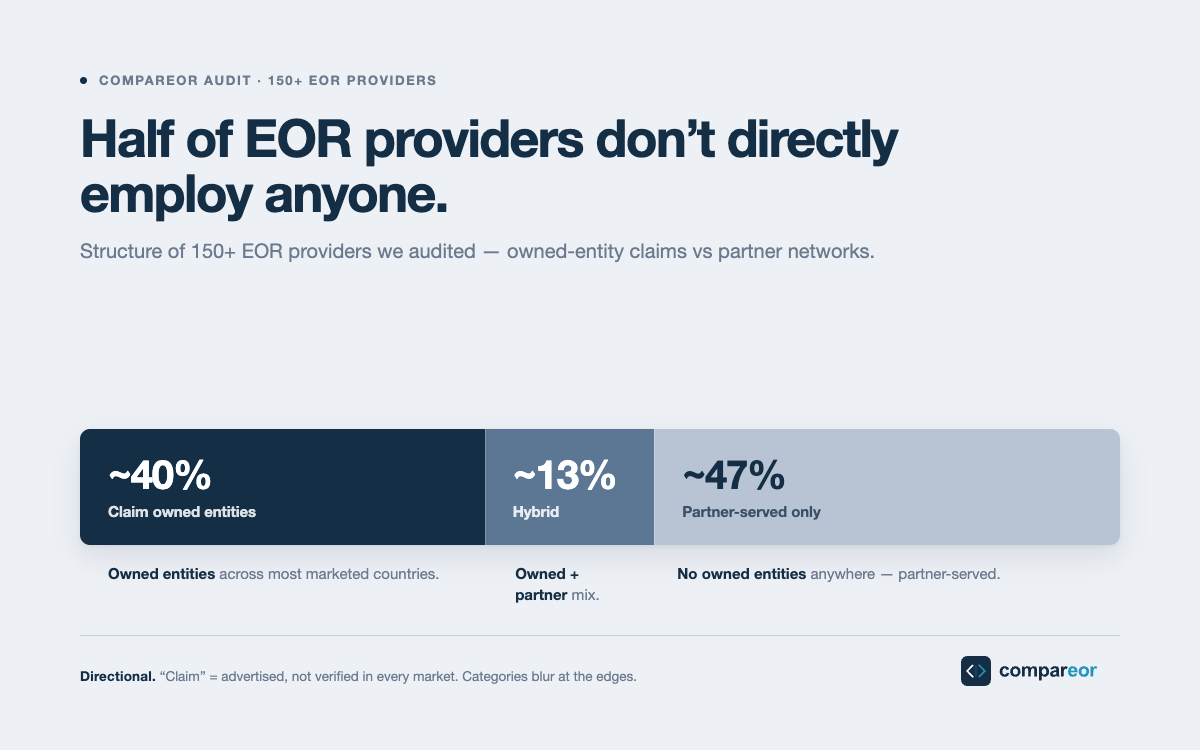
About 40% of EOR providers I audited claim and substantiate owned entities across most of their marketed countries. About 12 to 15% run an honest hybrid. About 45 to 50% are partner-served only, with no owned entities anywhere. The numbers, the methodology, the one honest caveat, and what they mean for buyers.


June 3, 2026
6 min read
Every EOR contract has an expiration date
The EOR model has a built-in expiration date, somewhere between 15 and 20 employees in one country. Past that threshold, the EOR stops being the cheapest option and starts being a tax on growth. Most companies miss it for a year or more, because the contract doesn't mention it and nobody inside is responsible for noticing.

May 25, 2026
5 min read
Why "150+ countries" is the most misleading number in global employment
Every EOR homepage leads with a country count, and after auditing 150+ providers it's the number most likely to lead you to the wrong choice. Coverage comes in three forms, and depth in your countries matters more than breadth across 185 of them.
Stay Updated on Global Hiring
Get weekly insights on EOR trends, compliance updates, and cost-saving strategies

Find a better EOR — without risk
Compare EOR providers to gain insights on cost, coverage, and contract flexibility, ensuring compliance and payroll continuity.


.png)
.png)



