
Hiring in the UAE Post-2025: What Mandatory Health Insurance Changes
From January 2025, mandatory health insurance applies across all seven UAE emirates. Here's what changed and what it means for EOR costs.


.png)
The UAE's expanded health insurance mandate
From January 1, 2025, mandatory employer-provided health insurance applies to all private sector employees across all seven emirates of the UAE. Previously, the requirement was limited to Abu Dhabi (since 2006, via Law No. 23 of 2005) and Dubai (since 2014, via Law No. 11 of 2013). The expansion to Sharjah, Ajman, Fujairah, Ras Al Khaimah, and Umm Al Quwain is the most significant change to UAE employment compliance in a decade, and the single most important cost line item to factor into any UAE hiring plan for 2026.
The UAE remains one of the most attractive Employer of Record (EOR) markets globally — one-day onboarding timelines, no personal income tax, strong English-language business environment, and a deep pool of internationally mobile professionals. But the 2025 reform has redefined the fully loaded cost of employment in the emirates outside Dubai and Abu Dhabi, and EOR clients need to adjust their procurement math accordingly. For the full country compliance picture, see the UAE hiring guide, and for current provider shortlists see the top 10 EOR providers for the UAE.
What the mandate actually requires
Employers must provide a compliant health insurance policy for every employee as a prerequisite for issuing or renewing their residency visa. Without valid health insurance certification registered on the federal and emirate-level systems, the employee's visa cannot be processed. This is the key structural point: health insurance is not a soft benefit that employees can opt out of — it is a hard hiring requirement. No certificate, no visa, no employment.
The mandate is administered federally under the umbrella of Basic Health Insurance Scheme regulations, with implementation variance across the seven emirates. Dubai and Abu Dhabi continue to operate the most mature regulatory infrastructure through DHA (Dubai Health Authority) and DOH (Department of Health Abu Dhabi) respectively. The five northern emirates now operate under the federal framework with similar compliance expectations, though enforcement tooling is still maturing.
The Essential Benefits Plan (EBP)
The baseline compliant plan is the Essential Benefits Plan (EBP), priced at approximately AED 320/year per employee. EBP covers inpatient care (subject to 20% co-pay), outpatient services (25% co-pay), prescription medications (30% co-pay), maternity care, and preventive care. The EBP is designed as a statutory floor — it meets the legal requirement and provides real medical coverage, but it is not a premium benefit.
For lower-salary workforces (construction, service, hospitality, operations), EBP is typically the default plan chosen by employers. For professional-grade hires, EBP is rarely sufficient as a retention tool — market-competitive offers in Dubai, Abu Dhabi, and increasingly the broader UAE include upgraded coverage.
Upgraded plans for professional-grade hires
Comprehensive plans typically run AED 3,000–8,000/year for individual coverage, with family coverage adding a multiple on top depending on the number of dependants. These plans reduce or eliminate co-pays, cover a broader network of hospitals and specialists, include dental and optical cover, and are table-stakes for senior professional hires competing against the salary bands in banking, consulting, tech, and healthcare.
For UAE hiring plans targeting senior roles, budget AED 3,000–8,000/year per employee for health insurance in your fully loaded employment cost model, not the AED 320 statutory floor.
Impact on EOR costs in the UAE
For EOR clients, health insurance is now a fixed, mandatory cost line that must be included in total employment cost calculations for every emirate, not just Dubai and Abu Dhabi. Practices across providers vary — some include basic EBP coverage in the headline UAE EOR fee, others treat it as a separate pass-through line item. A third category bundles upgraded professional plans as part of their "premium benefits" offering at a marked-up rate.
Before signing any UAE EOR engagement, surface three line items explicitly: (1) what health insurance plan is included in the headline rate, (2) what the pass-through cost is for upgraded plans, and (3) whether the EOR applies an administrative markup on insurance premiums. The hidden fees in EOR contracts guide walks through the full line-item audit.
The full UAE employer cost stack
Total additional employment costs for the UAE now include:
- End-of-Service gratuity accrual. 21 days of basic salary per year of service for the first five years, and 30 days per year thereafter. The gratuity is paid out at end of service, but it accrues from day one and must be carried as a liability on payroll.
- Mandatory health insurance. AED 320/year minimum (EBP) up to AED 3,000–8,000/year for professional plans, now applicable across all seven emirates.
- WPS (Wage Protection System) compliance. Mandatory electronic payroll processing through a UAE-licensed bank or exchange house. Non-compliance triggers penalties up to AED 5,000 per delayed worker payment and potential blocking of new work permit applications.
- Visa and work permit fees. Varying per emirate and employee category, typically AED 3,000–7,000 for the initial two- or three-year cycle.
All four line items are managed by the EOR, but all four show up in your fully loaded cost. For the broader cross-country comparison, see how much EOR really costs by country, and for a full UAE-included worked example, EOR vs hiring locally across 10 markets.
Non-compliance penalties — now applicable across all emirates
Pre-2025, health insurance non-compliance primarily carried enforcement risk in Dubai and Abu Dhabi. Post-2025, penalties apply across all seven emirates. The core penalty structures:
- Fines for failing to provide valid health insurance cover: typically AED 500 per month per uninsured employee in Dubai, with equivalent ranges now applying federally. Multi-employee gaps can rack up quickly.
- Visa processing blocks: employees without valid health certification cannot receive or renew residency visas — the business impact of this is typically larger than the direct fine.
- Work permit and establishment card implications: persistent non-compliance can affect a company's ability to sponsor new hires.
The harder operational risk is the visa block. If an employee's insurance lapses during an employment relationship, the renewal cycle breaks — and the employee cannot legally continue to work without valid residency. This is why sync between insurance renewal and visa renewal is the single most important operational discipline for UAE hiring, and why it's a competence you should test your EOR on before signing.
What this means for EOR selection in the UAE
A short procurement checklist — ask every UAE-focused EOR on your shortlist:
- Is basic EBP coverage included in your UAE service fee? If yes, get the plan details in writing. If no, get the pass-through cost per employee.
- What is the cost for upgraded professional-grade plans? For senior hires, budget AED 3,000–8,000/year.
- Do you apply an administrative markup on insurance premiums? Some EORs pass through at cost; others add 5–15%. The answer should be explicit.
- How do you sync insurance renewal with visa renewal timelines? This is the key operational question — request a specific process description, not a generic "we handle it".
- Do you cover all seven emirates with the same quality of process? Post-2025, this matters — an EOR with mature Dubai infrastructure may still be building out process for the northern emirates. Benchmark against the EOR providers with best visa and immigration support.
- What is your penalty reimbursement policy if insurance or WPS non-compliance produces a fine attributable to EOR process failure? Strong providers carry liability here.
Why the UAE remains one of the best EOR markets despite the reform
The 2025 health insurance expansion raises UAE employer cost — but the UAE still compares favourably against most EOR markets on three dimensions that matter for hiring velocity.
First, onboarding speed. UAE is the fastest EOR market globally — one-day onboarding in Dubai and Abu Dhabi free zones, 2–5 days in other emirates depending on visa category. See the full ranking in the 10 fastest countries to onboard through EOR and the EOR providers with fastest onboarding.
Second, no personal income tax. The UAE remains one of the few jurisdictions where employee net pay is close to gross pay, which compresses the cost of hitting competitive net-salary benchmarks for international talent.
Third, stable, English-language regulatory environment. Despite emirate-level variation, the federal framework is consistent, predictable, and well-documented. For the broader APAC and Middle East context, see the Asia EOR guide.
The right framing in 2026 is that the UAE is still a top-tier EOR market — the reform has simply tightened the health insurance compliance layer that always existed in Dubai and Abu Dhabi and extended it to the full federation.
Frequently asked questions
When did mandatory health insurance expand across the UAE?
The federal expansion took effect on January 1, 2025, applying the mandate previously in force in Dubai (2014) and Abu Dhabi (2006) to all seven emirates. Sharjah, Ajman, Fujairah, Ras Al Khaimah, and Umm Al Quwain now operate under the federal framework.
How much does basic UAE health insurance cost per employee?
The statutory baseline Essential Benefits Plan (EBP) costs approximately AED 320/year per employee and covers inpatient care (20% co-pay), outpatient services (25% co-pay), prescription medications (30% co-pay), maternity care, and preventive care. Comprehensive plans for professional hires typically run AED 3,000–8,000/year.
Does the EOR pay for health insurance, or does the client?
The EOR is the legal employer and carries the statutory obligation. In practice, the cost flows through to the client via the EOR invoice — either included in the headline UAE fee or passed through as a separate line item. Always confirm the inclusion and any administrative markup in writing before signing.
What happens if an employee's health insurance lapses?
The residency visa renewal cycle is blocked — and the employee cannot legally continue to work in the UAE without valid residency. The employer (EOR) is also exposed to per-month fines for the lapse. This is why insurance-to-visa sync is the most important operational discipline for UAE hiring.
Does mandatory health insurance apply to free zone employees?
Yes — the mandate applies across all private sector employees regardless of free zone or mainland status. Some free zones have additional specific requirements, but the federal baseline applies universally from 2025.
Can an employee decline employer-provided health insurance?
No. The insurance is a prerequisite for the residency visa, not an optional benefit. An employee cannot waive the requirement — there is no opt-out mechanism in the current regulatory framework.
Bottom line
The UAE's 2025 health insurance expansion is the most material employer-cost change in the region in a decade — but it is also a manageable, predictable one. The statutory floor at AED 320/year per employee is small relative to total cost; the upgraded professional plans at AED 3,000–8,000/year are the more consequential budget line for senior hiring plans.
The real differentiator in UAE procurement is process, not price. Choose an EOR with documented insurance-to-visa sync, transparent pass-through pricing on both EBP and premium plans, and proven compliance coverage across all seven emirates — not just Dubai and Abu Dhabi. Benchmark providers on the Compareor side-by-side tool and pull the top 10 EOR providers for the UAE before signing.
Get your shortlist
Takes ~3 minutes. No account needed.
June 3, 2026
6 min read
I checked the structure of 150+ EOR providers. Here's how many actually own their entities.
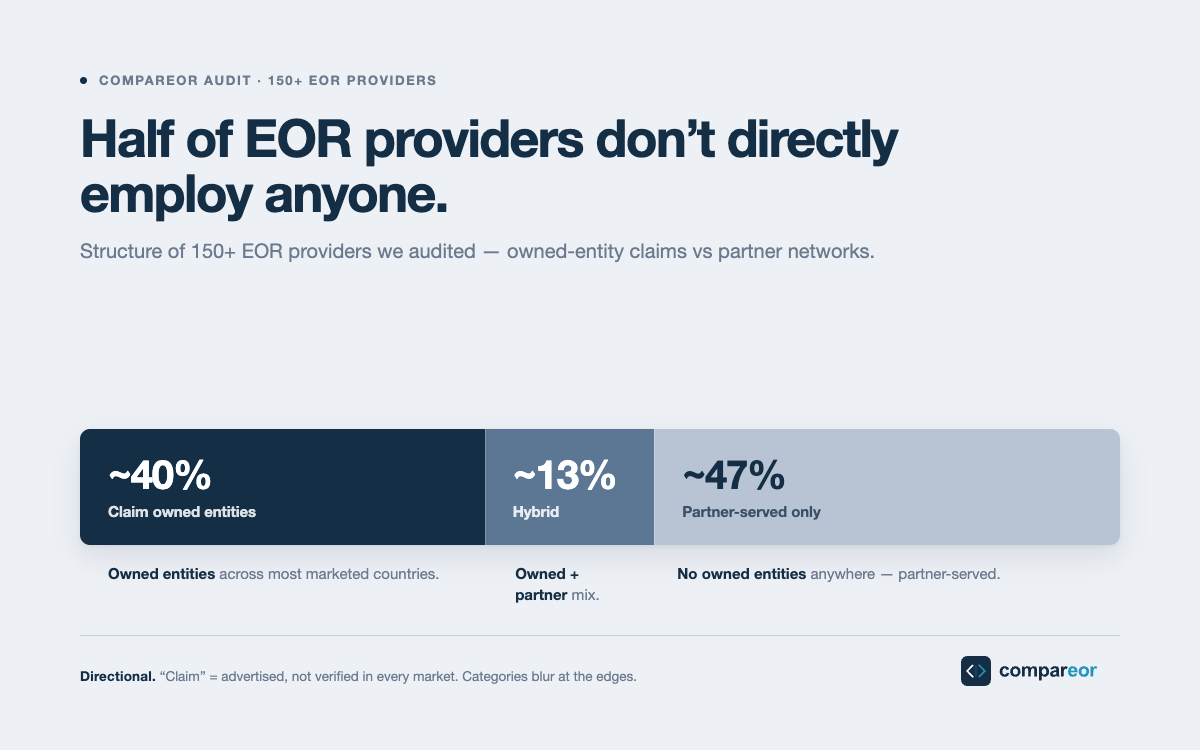
About 40% of EOR providers I audited claim and substantiate owned entities across most of their marketed countries. About 12 to 15% run an honest hybrid. About 45 to 50% are partner-served only, with no owned entities anywhere. The numbers, the methodology, the one honest caveat, and what they mean for buyers.


June 3, 2026
6 min read
Every EOR contract has an expiration date
The EOR model has a built-in expiration date, somewhere between 15 and 20 employees in one country. Past that threshold, the EOR stops being the cheapest option and starts being a tax on growth. Most companies miss it for a year or more, because the contract doesn't mention it and nobody inside is responsible for noticing.

May 25, 2026
5 min read
Why "150+ countries" is the most misleading number in global employment
Every EOR homepage leads with a country count, and after auditing 150+ providers it's the number most likely to lead you to the wrong choice. Coverage comes in three forms, and depth in your countries matters more than breadth across 185 of them.
Stay Updated on Global Hiring
Get weekly insights on EOR trends, compliance updates, and cost-saving strategies

Find a better EOR — without risk
Compare EOR providers to gain insights on cost, coverage, and contract flexibility, ensuring compliance and payroll continuity.


.png)
.png)



