
Contractor Misclassification: The Countries With the Highest Risk
Misclassifying employees as contractors is a global compliance risk — but some markets are far more aggressive than others in pursuing it.


.png)
Why contractor misclassification matters
Contractor misclassification happens when a worker is engaged as an independent contractor but the working arrangement meets the legal definition of employment in the country where they work. When local authorities or courts disagree with your classification, the relationship gets requalified as employment — retroactively. The consequences include backdated income tax, social security contributions, mandatory benefits (13th-month salary, severance, vacation), civil penalties, and in some jurisdictions criminal liability for directors.
The risk is not evenly distributed. A handful of countries apply a narrow, contract-based test and rarely reclassify. Others look at the substance of the relationship — the reality of how work is done, not how the contract is drafted — and apply a strong employment presumption that is very hard to rebut. If you engage contractors cross-border, the single most important question you can ask is which bucket your jurisdiction falls into. For the broader decision of whether to use contractors at all, see our guide on hiring contractors vs employees internationally.
What actually triggers a misclassification finding
Most high-risk jurisdictions apply some variation of the same four tests: control (who decides when, where, and how the work is done), integration (is the worker operationally embedded in the business), economic dependence (does the contractor derive most of their income from you), and exclusivity (are they free to serve other clients). A "yes" on three out of four is usually enough for a labour court to requalify the relationship — regardless of what your contract says. Payroll risk is only part of the exposure; the requalification itself can trigger employer-of-record-equivalent obligations going back years.
The five countries below are where we consistently see the highest enforcement activity in 2026, the broadest legal tests, and the steepest retroactive penalties. If you have contractors in any of them, a review is overdue.
The highest-risk countries for contractor misclassification in 2026
Brazil
Brazil's CLT (Consolidação das Leis do Trabalho) applies an employment presumption to any ongoing paid service relationship where the four classic factors — subordination, non-eventualidade, onerosidade, pessoalidade — are present. Labour courts are highly active, with over 2 million cases filed annually, and the Ministério do Trabalho routinely audits companies with large contractor workforces. Exposure on requalification includes backdated INSS (employer social security, ~20%), FGTS (8% severance fund), 13th-month salary, vacation plus one-third bonus, and significant civil penalties. The statute of limitations runs five years back and up to two years after contract end.
Brazil is an almost universal case for using an EOR rather than contractors — the CLT is complex enough that even well-advised companies struggle to keep a contractor arrangement compliant over time. We explain the mechanics in why Brazil's CLT makes EOR essential for foreign employers, and you can see current Brazil EOR options in our top 10 EOR providers for Brazil ranking. For the full compliance picture — employer costs, mandatory benefits, notice periods — see the Brazil hiring guide.
France
French labour law presumes employment wherever economic dependence and subordination exist, regardless of how the contract is styled. The requalification en contrat de travail doctrine allows labour courts (conseils de prud'hommes) to convert a contractor relationship into a permanent CDI retroactively, triggering the full stack of French employer obligations: URSSAF social contributions (42–47% on top of gross salary), paid leave, 13th-month-equivalent provisions where applicable, and — critically — severance exposure calculated on the reconstructed employment period.
URSSAF enforcement has intensified against platform and consulting-heavy operating models, and travail dissimulé (undeclared work) is a criminal offence in France carrying fines of up to €225,000 for legal persons and possible director liability. For cross-border hiring into France through compliant employment rather than contractors, see the France hiring guide and our top 10 EOR providers for France.
Colombia
Colombia's labour inspectorate (Ministerio del Trabajo) actively audits outsourcing and contractor arrangements and applies a four-factor employment test: personal service, ongoing subordination, continuous payment, and economic dependence. The use of "contrato de prestación de servicios" (civil service contracts) to avoid employment obligations is a common pattern that is increasingly prosecuted under Colombia's 2022 labour reform framework.
Requalification triggers retroactive parafiscal contributions (~21% employer share), severance fund (cesantías), mandatory 13th-month pay (prima), and interest on late social security. Penalties from the labour inspectorate can reach 5,000 minimum monthly wages per violation. For compliant hiring, the Colombia hiring guide covers the full employer cost stack, and our 2026 labour law changes overview tracks the most recent enforcement trends.
China
China operates on a statutory employment model that is fundamentally incompatible with most Western contractor structures. The Labour Contract Law requires a written employment contract within one month of the worker's start date — failure triggers a double-salary penalty for every month without a contract, up to 11 months. A sustained contractor arrangement that resembles employment (regular payments, defined role, ongoing instruction) is routinely reclassified by local labour bureaus, with retroactive social insurance contributions (30–40% employer share), housing fund obligations, and severance exposure.
Compounding the risk: foreign companies generally cannot directly engage Chinese workers without a licensed local entity (FESCO, CIIC, or equivalent), which in practice forces the use of a compliant EOR. See the China hiring guide for the licensing and social insurance detail.
United Kingdom (IR35)
The UK's IR35 off-payroll working rules create significant misclassification risk for PSC (personal service company) contractors. Since April 2021, end clients — not the contractor — bear the liability for an incorrect Status Determination Statement (SDS) on engagements inside the private sector medium/large-company regime. HMRC enforcement has intensified significantly, with high-profile cases against broadcasters, consulting firms, and technology companies over the last three years.
If HMRC deems a contractor "inside IR35" retroactively, the end client is liable for backdated income tax, employee and employer National Insurance Contributions, the Apprenticeship Levy, and interest. The reasonable-care standard requires the end client to make a substantive determination — template or "blanket" determinations are a common source of exposure. For the full playbook, see our deep-dive on IR35 in 2026 and the UK hiring guide.
How to mitigate contractor misclassification risk
The underlying playbook is the same across all five jurisdictions: stop relying on the contract to prove the classification, and start looking at what the working relationship actually looks like on any given Tuesday. A senior engineer who works exclusively for you, uses your laptop, attends your standups, and has done so for 18 months is not a contractor in any of the countries above — regardless of what the PDF says.
- Audit every contractor engagement against the local employment tests — control, integration, economic dependence, exclusivity — not just the contract terms.
- Flag any contractor who has been with you over 12 months, has no other clients, works fixed hours, or uses your equipment. These are the three highest-correlation triggers we see in requalification cases.
- Use an Employer of Record to employ workers directly in the five high-risk jurisdictions above. An EOR carries the local compliance liability and eliminates the classification question.
- Avoid exclusive, long-term, operationally-integrated contractor arrangements in any country with a substance-over-form legal test.
- Document the contractor's independence in real operating terms — client list, invoicing patterns, equipment ownership, work schedule autonomy — not just in the master services agreement.
- Run the Compareor Contractor Misclassification Risk Quiz to assess your current exposure per jurisdiction in under 5 minutes.
If the quiz flags exposure in a country where you're currently engaging contractors, the fastest path to a compliant state is to move those workers onto an EOR payroll in the same country. Compare providers by country coverage and compliance model on the Compareor side-by-side tool.
Frequently asked questions
What penalties can you face for misclassifying a contractor?
Typical exposure includes backdated income tax, employee and employer social security contributions, mandatory benefits (13th-month salary, severance, vacation), interest, civil penalties, and in several jurisdictions criminal liability for directors. In Brazil, France, and Colombia the retroactive social contribution component alone commonly exceeds 30–50% of the total amounts paid to the contractor over the lookback period.
How far back can a misclassification claim go?
Lookback periods vary. Brazil runs five years back and up to two years after contract end. France generally applies a three-year limitation for social contributions and five years for employment claims. The UK's IR35 can reach back four years with extended periods for deliberate behaviour. China, Colombia, and most civil-law jurisdictions operate in the same two-to-five-year range.
Does using an EOR eliminate misclassification risk?
For workers employed through the EOR, yes — they are statutory employees of the EOR's local entity, so there is no classification question. The EOR carries the local employment liability. This does not retroactively clean up past contractor exposure, so if you have existing contractors in a high-risk country, convert them before your next audit window rather than after. For the scope of what an EOR actually covers (and does not), see our complete guide to Employer of Record.
What are the biggest red flags in a contractor relationship?
The strongest predictors of requalification are: the contractor works exclusively or near-exclusively for you; the relationship is over 12 months old with no clear end; the contractor uses equipment, email, or systems you provide; fixed-hours or defined schedule; operational integration (standups, reporting lines, performance reviews); and payment on a recurring fixed basis rather than against deliverables. Any three of these simultaneously is a high-risk pattern in all five jurisdictions covered above.
Which country has the strictest contractor misclassification enforcement?
Brazil has the most active labour courts in absolute volume, and France has the most aggressive administrative enforcement via URSSAF. The UK has tightened most in the last five years under IR35. On a risk-adjusted basis — probability of enforcement multiplied by size of penalty — Brazil and France are the two most expensive jurisdictions to get wrong.
Bottom line
Contractor misclassification is a country-by-country problem with country-by-country penalties. Brazil, France, Colombia, China, and the UK are the five jurisdictions where the gap between a compliant contractor relationship and a requalified one is narrowest, and where the cost of getting it wrong is highest. If you engage contractors in any of them, audit now — not after an inspector shows up. Start with the misclassification risk quiz for a five-minute exposure check, and if a switch to EOR employment makes sense, benchmark providers on the Compareor side-by-side tool.
Get your shortlist
Takes ~3 minutes. No account needed.
June 3, 2026
6 min read
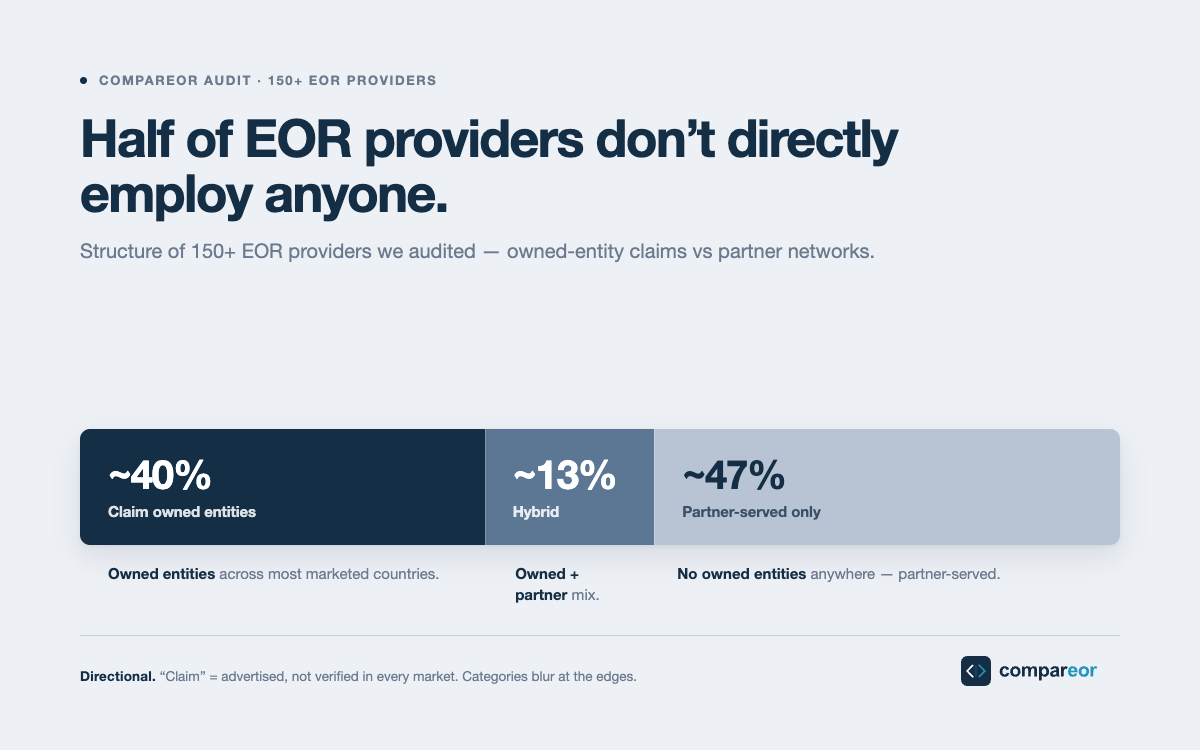
I checked the structure of 150+ EOR providers. Here's how many actually own their entities.
About 40% of EOR providers I audited claim and substantiate owned entities across most of their marketed countries. About 12 to 15% run an honest hybrid. About 45 to 50% are partner-served only, with no owned entities anywhere. The numbers, the methodology, the one honest caveat, and what they mean for buyers.


June 3, 2026
6 min read
Every EOR contract has an expiration date
The EOR model has a built-in expiration date, somewhere between 15 and 20 employees in one country. Past that threshold, the EOR stops being the cheapest option and starts being a tax on growth. Most companies miss it for a year or more, because the contract doesn't mention it and nobody inside is responsible for noticing.

May 25, 2026
5 min read
Why "150+ countries" is the most misleading number in global employment
Every EOR homepage leads with a country count, and after auditing 150+ providers it's the number most likely to lead you to the wrong choice. Coverage comes in three forms, and depth in your countries matters more than breadth across 185 of them.
Stay Updated on Global Hiring
Get weekly insights on EOR trends, compliance updates, and cost-saving strategies

Find a better EOR — without risk
Compare EOR providers to gain insights on cost, coverage, and contract flexibility, ensuring compliance and payroll continuity.


.png)
.png)



