
EOR vs PEO vs Entity Setup — Which Is Right for Your Company?
A practical comparison of the three main routes to international hiring — with a clear framework to help you choose.


.png)
Three routes to international hiring
When you're ready to hire internationally, you have three main structural options: an Employer of Record (EOR), a Professional Employer Organisation (PEO), or setting up your own local entity. The three look similar on the surface — all of them get a foreign worker legally employed and paid — but they differ on almost every dimension that matters: who is the legal employer, what you own, how fast you can start, how much it costs, and how much compliance overhead lands on your team.
The wrong structural choice can cost tens of thousands of dollars a year and expose you to employment liability you do not need. This guide explains each model, where it wins, where it fails, and how to pick the right one for your specific hiring plan. For the foundational definition, see our complete guide to Employer of Record.
At a glance: EOR vs PEO vs entity setup
The short version, country by country. If you do not have a legal entity in the country where you want to hire, you need an EOR — a PEO is not an option. If you already have a US entity and are hiring in the US, a PEO is usually the cheapest way to access group benefits and outsource payroll admin. If you are committing to 10+ permanent employees in a single country and the market is a confirmed long-term hub, setting up your own entity eventually wins on cost and strategic control.
Everything else is a nuance on top of those three rules.
Employer of Record (EOR)
An EOR is the full legal employer of your workers in a foreign country on your behalf. The EOR holds the local entity and employment licence, issues the employment contract, runs payroll, remits social contributions and taxes, administers benefits, and owns the compliance liability. You direct the work through a commercial agreement with the EOR. To the employee, the EOR is their employer on paper; to you, they are your team member in practice.
How EOR works, mechanically
You sign a services agreement with the EOR. You select candidates. The EOR issues the local employment contract in the worker's country of residence, onboards them onto local payroll, and enrolls them in mandatory and optional benefits. You invoice-and-pay the EOR monthly; they run payroll locally. Termination, promotions, and contract amendments go through the EOR. Typical time-to-first-payroll is 2–7 days in mature EOR markets.
When EOR is the right choice
- You have no legal entity in the country where you want to hire.
- You are hiring 1–15 employees in a new country.
- You need fast market entry — weeks, not months.
- You are testing demand in a market before committing to an entity.
- You want to offload employment compliance entirely, including liability for local labour law, tax, and statutory benefits.
- You are hiring across multiple countries and want one vendor rather than a stack of entities — see our guide to building a remote team across 5 countries without setting up entities.
Typical EOR costs in 2026
Flat-fee EOR pricing sits at $400–$700 per employee per month in most Tier-1 and Tier-2 markets, with country specialists from $99–$199/month. Compare the two common pricing structures in our breakdown of EOR pricing models — per-employee fee vs percentage of salary. For a country-by-country cost view including employer charges and mandatory benefits, pair with our country-by-country EOR cost breakdown.
To benchmark providers for your specific country mix, run a side-by-side comparison across 23 EORs on the Compareor comparison tool, or browse the full providers directory. If this is your first international hire, the best EOR providers for first-time global hire shortlist is a useful filter.
Professional Employer Organisation (PEO)
A PEO is a co-employment arrangement. The PEO and your company share employer responsibilities: the PEO handles payroll processing, benefits administration, workers' compensation, and regulatory filings, while you retain direct employment of the worker and legal control over day-to-day work. Critically, a PEO requires you to already have a legal entity in the country where you're hiring — the PEO does not replace the entity, it supplements it.
Why PEO is primarily a US model
PEOs exist almost entirely in the United States, where the co-employment structure was designed to solve a specific US problem: small and mid-size companies needing access to group benefits rates (healthcare, 401k, workers' comp) that they cannot get on their own. By pooling employees across many client companies, the PEO can negotiate Fortune 500–level benefits and spread risk across a large population.
Outside the US, true co-employment has limited legal basis. Most non-US "PEOs" are either payroll outsourcing services (not co-employment) or global EORs marketing under a different name. If a vendor pitches you a "global PEO," ask whether you need an entity in the country where you're hiring — if the answer is yes, it's a PEO; if no, it's an EOR. In practice most global HR platforms now offer both: Deel and Rippling both run EOR and US PEO products depending on your entity structure.
When PEO is the right choice
- You already have a US legal entity (C-Corp, S-Corp, LLC) and are hiring US employees.
- You want access to better group benefits rates than you can negotiate on your own — this is the primary economic advantage.
- You want to outsource HR admin, payroll, and compliance but retain direct employment.
- You are a US SMB between 5 and 500 employees — the sweet spot for PEO economics.
Gusto and JustWorks are the most common US PEO brands at the SMB end — see the Gusto review and JustWorks review for pricing and use cases. For US-specific provider comparisons that cover both PEO and EOR offerings, see the top 10 EOR providers for hiring in the US and the US hiring guide.
Setting up your own local entity
A local subsidiary or branch gives you full, direct ownership of the employment relationship. You are the legal employer on paper. You carry the compliance liability. You own the IP assignment. You control the employment brand in-market. You also pay for all of it — legal setup, ongoing accounting, tax filings, statutory audits, HR admin, local labour counsel — permanently.
How entity setup works
Typical timeline: 3–6 months end-to-end, including company registration, banking, tax registrations, payroll system setup, and labour authority filings. Setup cost: $5,000–$40,000+ depending on the country (Germany, France, and Brazil are the high end; UK, Singapore, and UAE the low end). Ongoing annual maintenance: $4,000–$25,000+ in accounting, tax filings, statutory audits, and registered agent/corporate secretary fees. For the full break-even analysis by market, see our EOR vs hiring locally cost comparison across 10 markets.
When entity setup is the right choice
- You are committing to 10+ permanent employees in a single country with a 3+ year horizon.
- You need full IP ownership and direct employment contracts (common for highly regulated sectors and for R&D-heavy teams).
- The country is a confirmed strategic hub, not an experiment.
- You want local employer brand — a recognised in-country employer can be a material recruiting advantage at scale.
- The break-even economics favour an entity at your planned headcount, after factoring in ongoing compliance overhead.
The hidden costs of running an entity
The accounting-fee line item on the spreadsheet is rarely the full picture. Running a local entity typically adds: a local HR lead or third-party HR partner, employment counsel retainer, payroll system licence and administration, statutory audit fees, works council or collective bargaining admin where applicable, and senior-management time on cross-border reporting and oversight. Most companies that leave EOR for an entity underestimate the first-year fully loaded cost by 30–50%. Many run EOR in parallel during setup so there's no hiring freeze.
A decision framework
In order of priority, choose based on whether you already have an entity, how many people you plan to hire, and your time horizon.
- Choose EOR if you're hiring 1–15 employees in a new country, need speed, or are testing a market. EOR is also the right answer for mixed cross-country hiring, short-horizon engagements, and any country where you have no legal entity.
- Choose PEO if you already have a US entity and want to outsource HR, payroll, and benefits admin while retaining direct employment. Outside the US, "PEO" usually means EOR in disguise — check the entity requirement.
- Choose entity setup if you're committing to 10+ permanent employees in a single country for 3+ years and need full ownership of the employment relationship. Run EOR in parallel during the 3–6 month setup window so you can keep hiring.
- Consider a hybrid approach if you have multi-country expansion: entity in your two or three core hubs, EOR everywhere else. Most mid-market companies operating in 8+ countries run this model.
For a structured due-diligence framework before committing to any EOR provider, see our 12 questions to ask before signing an EOR contract.
A common path: EOR first, entity later
The most common pattern we see at Compareor across companies expanding internationally is EOR first, entity later. It works like this: use an EOR for the first 12–24 months in a new country while you validate the market, build a local team, and measure actual demand. If the country becomes a confirmed permanent hub and headcount crosses the break-even threshold for that market, start entity setup — usually with EOR running in parallel during the 3–6 month transition so hiring doesn't pause. After the entity is live, migrate employees from the EOR to the entity with appropriate local-counsel review.
This pattern works because it preserves optionality. Markets that don't work out close cleanly on an EOR — there's no wind-down of a local entity to manage. Markets that do work out transition to the long-run structure without ever stopping hiring.
Frequently asked questions
What is the main difference between EOR and PEO?
An EOR is the sole legal employer of the worker in a country where you have no entity. A PEO is a co-employment arrangement in a country where you already have an entity. The single diagnostic question: do you already have a legal entity in the country? If no, you need an EOR; a PEO is not an option.
Can I use a PEO outside the United States?
Rarely, and usually not in the true co-employment sense. True PEOs exist almost entirely in the US where the regulatory framework supports co-employment. Most non-US "PEO" products are either payroll outsourcing (not co-employment) or global EORs re-branded. If the vendor does not require you to have a local entity, it is functionally an EOR.
At what headcount should I stop using EOR and set up an entity?
Break-even ranges from 2–3 employees in simple markets (UK, Singapore, UAE, India) to 5–6 employees in complex markets (Brazil, France, Germany). See the full country-by-country analysis in our EOR vs hiring locally cost comparison.
Can I run EOR and an entity in the same country at the same time?
Yes. This is the standard pattern during entity setup — EOR covers new hires for the 3–6 months it takes to stand up the entity, then employees migrate to the entity once it's live. Many companies also maintain EOR long-term for specific hires (short-term, project-based, or in locations where the entity is not licensed to operate).
Is EOR the same as staffing or contractor management?
No. Staffing agencies supply talent and manage recruitment, but the employment relationship typically sits with you or a third-party payroll service. Contractor management covers independent contractors, not employees. An EOR is specifically the statutory employer of full-time employees in a country where you have no entity, carrying full employment compliance liability.
Bottom line
Use EOR to enter new countries, test demand, and hire under 15 employees per market. Use PEO when you already have a US entity and want outsourced HR, payroll, and group benefits. Use entity setup when a country becomes a long-term strategic hub and your headcount justifies the compliance overhead. The three models are not competitors — most successful global companies use a combination, with EOR as the default for new markets and entities reserved for permanent hubs.
Before committing to any structure, benchmark the underlying cost. Run a live comparison on the Compareor side-by-side tool or browse the EOR providers directory to see current pricing for your specific countries.
Get your shortlist
Takes ~3 minutes. No account needed.
June 3, 2026
6 min read
I checked the structure of 150+ EOR providers. Here's how many actually own their entities.
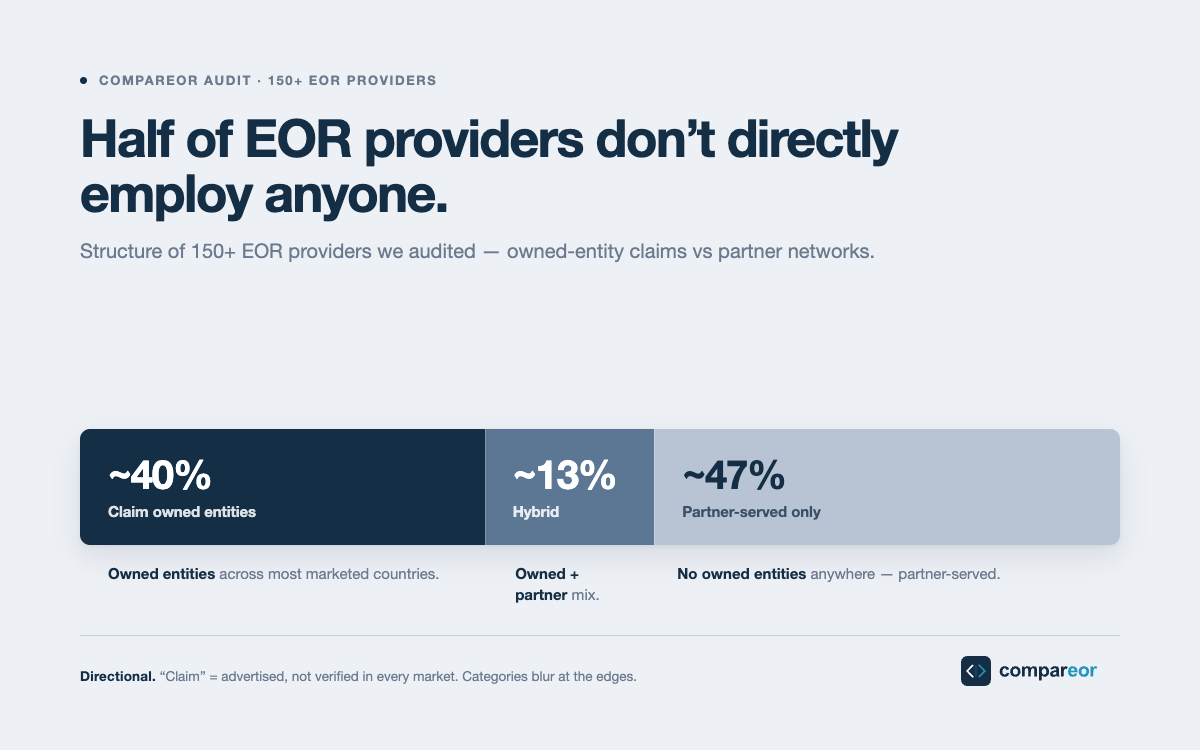
About 40% of EOR providers I audited claim and substantiate owned entities across most of their marketed countries. About 12 to 15% run an honest hybrid. About 45 to 50% are partner-served only, with no owned entities anywhere. The numbers, the methodology, the one honest caveat, and what they mean for buyers.


June 3, 2026
6 min read
Every EOR contract has an expiration date
The EOR model has a built-in expiration date, somewhere between 15 and 20 employees in one country. Past that threshold, the EOR stops being the cheapest option and starts being a tax on growth. Most companies miss it for a year or more, because the contract doesn't mention it and nobody inside is responsible for noticing.

May 25, 2026
5 min read
Why "150+ countries" is the most misleading number in global employment
Every EOR homepage leads with a country count, and after auditing 150+ providers it's the number most likely to lead you to the wrong choice. Coverage comes in three forms, and depth in your countries matters more than breadth across 185 of them.
Stay Updated on Global Hiring
Get weekly insights on EOR trends, compliance updates, and cost-saving strategies

Find a better EOR — without risk
Compare EOR providers to gain insights on cost, coverage, and contract flexibility, ensuring compliance and payroll continuity.


.png)
.png)



