
Hiring in Germany: What the Works Council Requirement Actually Means for You
Germany's works council rules are one of the most misunderstood aspects of hiring there. Here's what they actually mean for EOR clients.


.png)
Why Germany's labor framework is different
Germany is one of the most attractive Employer of Record (EOR) markets in Europe — deep engineering talent, strong English proficiency in tech hubs, and an EU-standard legal framework that integrates cleanly with cross-border payroll. It's also the country where most foreign employers run into their first serious compliance surprise: the works council system.
Germany has the most developed co-determination framework in the world. For any company hiring through an EOR in Germany, understanding how works councils interact with employment decisions is not optional — it shapes termination timelines, working hours decisions, monitoring tool rollouts, and, in some cases, the speed at which you can grow the team. This guide walks through what a Betriebsrat actually is, what rights it holds, when those rights are triggered, and how the obligations flow through to you as the EOR client. For the broader country compliance picture — social security, notice periods, mandatory benefits — pair this with our full Germany hiring guide, and for current provider shortlists see the top 10 EOR providers for Germany.
What is a works council?
A Betriebsrat (works council) is an elected employee representative body that exists in German workplaces with five or more permanent employees. It is not a trade union — it's a statutory body with formal rights under the Works Constitution Act (Betriebsverfassungsgesetz, or BetrVG), which has governed the German co-determination model since 1952 in its modern form.
Three structural points that often surprise foreign employers. First, a works council is not automatic: it exists when employees choose to elect one. But the right to elect one is absolute at five employees — the employer cannot prevent formation, cannot retaliate, and cannot refuse to cooperate. Second, the works council operates independently of management and is funded by the employer. Third, once formed, a works council holds statutory rights that extend far beyond information-sharing — it can block certain employer decisions entirely. This is the biggest mental shift for US- and UK-based hiring leaders, who are generally used to employment frameworks where the employer holds unilateral decision rights.
At what headcount does a works council form?
The five-employee threshold is a right-to-elect threshold, not an automatic formation threshold. In practice, smaller foreign employer payrolls in Germany (under 20 employees) often operate without a works council because employees don't initiate formation. Once a company passes 20–30 employees in a single establishment, works council formation becomes substantially more likely — particularly in industries with a history of employee organisation.
There are also size-based thresholds that scale the works council's powers. At 100+ employees, an economic committee (Wirtschaftsausschuss) must be formed to provide input on commercial decisions. At 200+ employees, certain council members are released from their day jobs to focus on council duties full-time. These thresholds matter most for fast-scaling companies — if you're planning to grow a German team past 100 employees in the next 18 months, model the works council implications into your hiring plan. For the broader European context, see our remote hiring playbook for US companies expanding to Europe.
What rights does a works council have?
Works councils hold three tiers of rights, in increasing order of binding effect.
Information rights
The employer must inform the works council of certain business decisions — for example, changes in company structure, hiring plans, strategic decisions affecting the workforce. The council cannot block these decisions at the information tier, but it must receive timely, substantive information. Information rights are the lowest-stakes category but the widest in scope.
Consultation rights
The employer must consult the works council and consider its views before implementing certain decisions. Consultation rights cover areas like mass layoffs, restructuring, and introduction of major operational changes. The works council's view is not binding, but consultation must be substantive — a 48-hour notice with a pre-made decision is not consultation in the legal sense.
Co-determination rights
This is the tier that trips up foreign employers. Co-determination means the works council's agreement is required before certain employer decisions can be implemented. If the employer and works council cannot agree, the decision goes to a mediation body (Einigungsstelle) whose ruling is binding on both sides.
Co-determination rights apply to a specific list of topics, including: working hours and scheduling, overtime policies, introduction of performance monitoring or IT systems (including common SaaS tools with employee tracking), hiring and dismissal procedures, workplace regulations, and compensation principles. An employer cannot unilaterally implement changes in these areas over a works council's objection. In practice this is the single most consequential feature of German employment law for foreign employers to internalise.
How this affects EOR clients in Germany
When you hire an employee through an EOR in Germany, the EOR is the legal employer. Payroll, tax withholding, social security contributions, and statutory compliance all sit with the EOR. So — critically — works council obligations sit with the EOR's German entity, not with you as the EOR client.
That said, the operational impact still flows through to you. Two scenarios to understand:
Scenario 1 — a works council already exists at the EOR. If your EOR's German entity already has a works council (most of the larger EOR providers do once they pass the formation threshold), then any employment decision affecting your workers that falls under a co-determination or consultation category will require council involvement. Dismissals, changes to working hours, introduction of monitoring tools — all of these need to be routed through the EOR's works council process.
Scenario 2 — the threshold is reached during your engagement. If your EOR's German headcount passes the threshold while you're a client, a works council can form at any time. The EOR manages the formation process, but the practical effect on your workers is the same: post-formation, affected employment decisions flow through the council.
The implication for planning: dismissals, changes to working hours, and introduction of monitoring or performance tracking tools all require works council involvement once a council exists. Your EOR should run this process end-to-end — but you need to factor the timeline into any affected employment decision. Typical consultation windows run 1–3 weeks, and complex cases (mass layoff, significant policy changes) can run longer.
Dismissal protection under the KSchG
Separate from works council rights, Germany has one of the most protective dismissal frameworks in the EU — the Kündigungsschutzgesetz (KSchG, Dismissal Protection Act). Three practical points:
First, KSchG protection kicks in after 6 months of continuous employment in a German workplace with more than 10 employees. Before the 6-month mark, dismissals can be effected with cause or without, subject only to general statutory minimum notice periods. After 6 months, dismissals require one of three valid grounds: personal reasons (e.g. long-term incapacity), behavioural reasons (e.g. serious misconduct after prior warnings), or operational reasons (e.g. genuine redundancy).
Second, if a works council exists, the employer must consult it before issuing any dismissal notice. Failure to consult renders the dismissal legally void — not merely open to challenge. This is a harder rule than in most other EU jurisdictions.
Third, notice periods in Germany scale with tenure — from 4 weeks for employees under 2 years to up to 7 months for employees with 20+ years of service. Combined with the consultation requirement, terminations in Germany routinely take 2–4 months from decision to effective date. For the full notice period table and employer cost breakdown, see the Germany hiring guide. For the cost impact versus alternative jurisdictions, see our EOR vs hiring locally cost comparison.
Timelines to factor into your planning
Typical timelines for common decisions that involve works council consultation or co-determination:
- Individual dismissal with works council consultation: 1–2 weeks consultation + statutory notice period (4 weeks to 7 months depending on tenure).
- Introduction of a new monitoring or HR tool: 2–6 weeks for co-determination agreement, longer if mediation is required.
- Changes to working hours or shift patterns: 2–4 weeks for co-determination agreement.
- Mass redundancy (over 5 employees in a small workplace, or scaled thresholds in larger workplaces): 30 days minimum consultation plus notification to the Federal Employment Agency (Bundesagentur für Arbeit).
- Hiring-related process changes: 1–3 weeks co-determination if the change affects hiring procedures.
These timelines are not optional padding — they are statutory process steps. Building them into your operating rhythm early is far cheaper than compressing them under pressure.
What your EOR should be doing
The quality of your EOR's works council handling is one of the most material differentiators in the German market — and one of the questions most buyers forget to ask in procurement. Three concrete things to verify before signing:
- The EOR has owned entity infrastructure in Germany, not a partner arrangement. Works council processes are hard to manage through third parties. Both global providers and European specialists (see Workmotion and Parakar) have strong Germany infrastructure.
- The EOR has documented process for works council consultation on dismissals, with clear SLA on how consultation is initiated and how the final decision is communicated back to the client.
- The EOR's Germany compliance team can speak to the works council in German — not through translation. The quality of the consultation relationship is a compounding factor across all future decisions.
Run a live comparison across your shortlist on the Compareor side-by-side tool. Ask specifically about works council handling on every Germany-focused EOR demo.
Key practical points
- Works councils are a right at 5+ employees in Germany — they cannot be blocked or prevented once employees move to elect one.
- Dismissals require works council consultation where a council exists. Failure to consult renders the dismissal void, not just challengeable.
- KSchG dismissal protection kicks in after 6 months of continuous service in a workplace with more than 10 employees.
- Notice periods scale with tenure, from 4 weeks to 7 months. Terminations in Germany are a 2–4 month process end-to-end.
- Co-determination rights cover working hours, monitoring tools, hiring procedures, and workplace regulations. Unilateral changes are not legally effective.
- Your EOR should own the works council relationship end-to-end. Verify in procurement that the EOR has owned entity, documented process, and German-speaking compliance capacity.
- Factor 1–3 week consultation windows into any planning that affects German employees, with longer windows for complex changes.
Frequently asked questions
Does every German EOR engagement involve a works council?
No — not automatically. A works council is a right, not an automatic formation, and smaller foreign employer payrolls in Germany (under 20 employees) often operate without one. However, most larger EOR providers already have a works council at their German entity because they've passed the formation threshold across their entire German book. Ask your EOR directly whether a works council exists at their German entity.
Can I avoid works council obligations by using a smaller EOR?
Only until that EOR passes the formation threshold, which most do as they grow. Works council obligations are a feature of the German labour framework, not a negotiable contract clause. The realistic expectation for any multi-year Germany engagement is that works council involvement will be part of the operating reality at some point — plan accordingly.
What happens if my EOR dismisses my German employee without works council consultation?
The dismissal is legally void. The employee can continue to come to work, continue to draw salary, and has a strong claim for reinstatement or severance. This is one of the hardest-to-unwind compliance failures in the EU, and it's the specific failure mode that makes EOR selection for Germany so consequential.
Do works councils affect contractor engagements?
Not directly — works councils represent employees, not contractors. However, if a contractor engagement is reclassified as employment by a German court or labour authority, works council rights may apply retroactively to the reclassified relationship. For the broader classification picture, see our contractor misclassification risk ranking and the 2026 labour law updates.
Is Germany still worth it as a hiring market given the works council complexity?
For most tech, SaaS, and engineering-heavy employers — yes. The talent depth, English proficiency in tech hubs (Berlin, Munich, Hamburg), and strong EU legal integration typically outweigh the works council complexity, provided you're working with an EOR that handles the process competently. See the broader Europe EOR guide for regional benchmarks.
Bottom line
The works council system is the single most distinctive feature of German employment law for foreign employers. It is not an exotic edge case — it is the default operating framework once your EOR's German headcount passes five employees. Planned for correctly, it adds 1–3 weeks to affected employment decisions and requires a competent EOR partner. Planned for incorrectly, it produces void dismissals, stalled rollouts, and the kind of compliance failures that end up on your board agenda.
Choose your Germany EOR on process depth, not just platform UX. Benchmark providers on the Compareor side-by-side tool, and pull the top 10 EOR providers for Germany before signing anything.
Get your shortlist
Takes ~3 minutes. No account needed.
June 3, 2026
6 min read
I checked the structure of 150+ EOR providers. Here's how many actually own their entities.
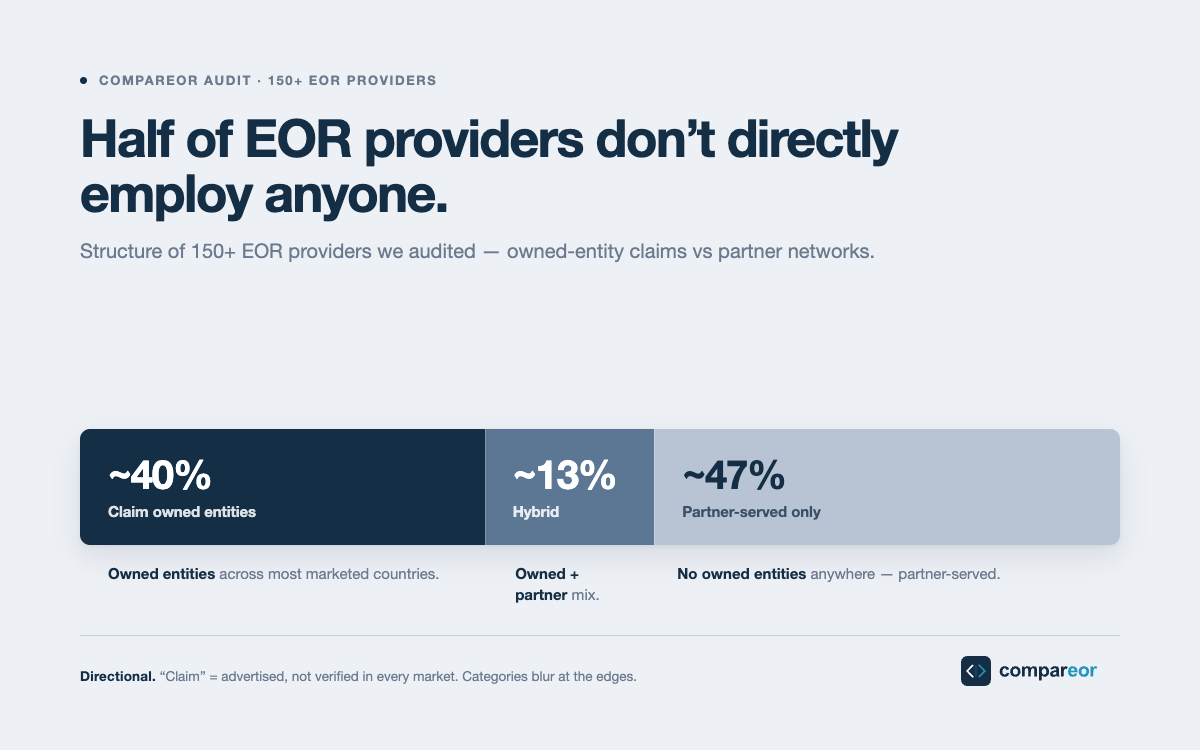
About 40% of EOR providers I audited claim and substantiate owned entities across most of their marketed countries. About 12 to 15% run an honest hybrid. About 45 to 50% are partner-served only, with no owned entities anywhere. The numbers, the methodology, the one honest caveat, and what they mean for buyers.


June 3, 2026
6 min read
Every EOR contract has an expiration date
The EOR model has a built-in expiration date, somewhere between 15 and 20 employees in one country. Past that threshold, the EOR stops being the cheapest option and starts being a tax on growth. Most companies miss it for a year or more, because the contract doesn't mention it and nobody inside is responsible for noticing.

May 25, 2026
5 min read
Why "150+ countries" is the most misleading number in global employment
Every EOR homepage leads with a country count, and after auditing 150+ providers it's the number most likely to lead you to the wrong choice. Coverage comes in three forms, and depth in your countries matters more than breadth across 185 of them.
Stay Updated on Global Hiring
Get weekly insights on EOR trends, compliance updates, and cost-saving strategies

Find a better EOR — without risk
Compare EOR providers to gain insights on cost, coverage, and contract flexibility, ensuring compliance and payroll continuity.


.png)
.png)



