
The True Cost of Hiring in France — Employer Charges Explained
France has the highest employer social charges in the OECD. Here's exactly what you're paying, and why EOR is the most efficient route.


.png)
France: exceptional talent, exceptional costs
France is one of Europe's most attractive hiring markets — deep engineering, consulting, and financial services talent, world-class English proficiency in Paris and increasingly in Lyon, Toulouse, and Nantes, and a time zone that bridges US and European markets more cleanly than Madrid or Berlin. It is also the most expensive employment market in the OECD. Employer social contributions run 42–45% of gross salary for standard roles, and over 50% once complementary pension obligations for executives (cadres) are layered on. That number is not inflation. It funds a state pension, a contributory unemployment system that protects workers through genuine career gaps, universal health coverage, and training rights that transfer across employers. Knowing exactly what you are paying for — and what you will pay for a specific hire — makes the difference between a budget that holds and a budget that breaks within the first quarter. This post breaks down every line item, shows how cost shifts between cadres and non-cadres, and works through four realistic scenarios so you can model a French hire before you sign the offer.
If you are still deciding whether France makes the cut in your European expansion, pair this read with our US-to-Europe hiring playbook and the full cross-market cost comparison — France usually lands as the third or fourth market US companies enter, behind the UK, Germany, and Netherlands, specifically because of the cost profile below.
What makes up French employer costs
French employer contributions fund a broad set of statutory programs, most of them collected monthly through the Déclaration Sociale Nominative (DSN) filing that consolidates what used to be dozens of separate declarations. The line items below are the ones that appear on every French payslip and that determine your all-in cost.
URSSAF core contributions — ~13% of gross
URSSAF is the primary collection agency for French social security. Its core contributions cover health insurance (assurance maladie), maternity, disability, and death insurance, and run approximately 13% of gross salary. These contributions are uncapped in most components, meaning they scale with salary rather than plateauing at a ceiling.
Pension contributions — base and complementary
French pension has two mandatory tiers. The state pension (retraite de base, administered by CNAV) takes approximately 8.55% from the employer side, capped at the Plafond Annuel de la Sécurité Sociale (PASS — €47,100 in 2026). The complementary pension scheme AGIRC-ARRCO is the layer that makes executive hires meaningfully more expensive — contribution rates are ~6.01% on the Tranche 1 (up to PASS) and ~12.95% on Tranche 2 (between 1× and 8× PASS) from the employer side. For a €120,000 gross cadre salary, the AGIRC-ARRCO employer contribution alone is roughly €10,000–€11,000 annually.
Unemployment insurance (chômage) — 4.05%
Employer unemployment contribution is 4.05% of gross, capped at 4× PASS (€188,400 annually in 2026). This funds the contributory unemployment system administered by France Travail (formerly Pôle emploi), which pays laid-off employees up to 57% of prior salary for 18–36 months depending on tenure and age.
Work accident insurance (AT/MP) — 1–5%, variable by industry
The work accident and occupational disease contribution (accidents du travail / maladies professionnelles) varies by sector risk rating. For office-based tech and professional services, the rate is typically 1–1.2%. For construction, manufacturing, and physical labor, it rises to 3–5% or more. The rate is published annually by the CARSAT (regional pension and health-at-work fund) based on the employer's NAF code (French industry classification).
Training levy (formation professionnelle) — ~1%
The vocational training contribution funds the Compte Personnel de Formation (CPF), which gives every French employee a personal training budget that accrues with hours worked and is portable between employers. The employer rate is approximately 1% of gross for companies with 11+ employees (0.55% below 11).
Other contributions — transport, housing, FNAL, CSA
The remaining bucket covers transport (versement mobilité, 1.75–2.95% in Paris and major urban areas, zero in rural areas), housing (FNAL, 0.1–0.5% depending on headcount), and the Contribution Solidarité Autonomie (CSA, 0.3%). Combined, this cluster is 1–3% of gross depending on the employer's location and size.
Cadre vs non-cadre — the status that changes your all-in cost
French employment law distinguishes between cadre and non-cadre status, and it is the single biggest cost driver at the individual-hire level. Cadre status — roughly, executive/managerial/senior-professional — carries higher AGIRC-ARRCO complementary pension contributions, longer notice periods (typically 3 months vs 1–2 for non-cadres), a different annual working-hours regime (forfait jours convention), and supplementary death-and-disability coverage (prévoyance cadres) at a 1.5% employer contribution on Tranche 1.
Status is determined partly by the role, partly by the applicable convention collective, and partly by agreement in the employment contract. Engineering, R&D, finance, legal, and senior commercial roles are almost always cadre. Junior support, administrative, and early-career technical roles are typically non-cadre. For budgeting purposes, expect cadre total employer cost to run 45–50% of gross (up to 55% at executive levels), versus 42–45% for non-cadres.
The EOR service fee on top
EOR providers typically charge €600–€900/month on top of the employment costs for France — occasionally higher for providers running owned entities with in-country tax and HR specialists, occasionally lower for providers working through a partner network. The fee reflects genuine administrative complexity: DSN monthly filings, URSSAF registration and variance reporting, convention collective applicability analysis (France has 400+ active collective agreements, each with its own rules on minimum compensation, notice, and leave), mutuelle health-top-up enrolment, and — on exit — rupture conventionnelle or licenciement administration.
Not every France-capable EOR is equally strong. Providers running owned French entities generally deliver faster onboarding and cleaner compliance than those operating through partners. Our France EOR leaderboard ranks the top 10 France-focused providers, and the Remote vs Rippling comparison covers the two most common choices for European-heavy US teams.
Total cost examples — four realistic scenarios
Single-line cost estimates hide where the money actually goes. The four scenarios below show the full stack from gross to invoice.
Junior software engineer, non-cadre, €45,000 gross
Employer social contributions at 42% = ~€18,900. EOR fee €7,200–€9,000. Supplementary mutuelle at €40/month employer share = ~€480. Total annual cost: ~€71,600–€73,400. Cost-to-gross ratio: 1.59–1.63×.
Mid-level software engineer, cadre, €65,000 gross
Employer social contributions at 45% = ~€29,300. EOR fee €7,200–€9,000. Prévoyance cadres at 1.5% on Tranche 1 = ~€700. Mutuelle employer share ~€600. Total annual cost: ~€100,800–€102,600. Cost-to-gross ratio: 1.55–1.58×. This is the scenario most closely matching the source article's worked example.
Senior engineer or tech lead, cadre, €95,000 gross
Employer social contributions at ~48% (higher AGIRC-ARRCO on Tranche 2) = ~€45,600. EOR fee €7,200–€9,000. Prévoyance cadres + supplementary benefits ~€1,800. Total annual cost: ~€149,600–€151,400. Cost-to-gross ratio: 1.58–1.59×.
Executive, cadre, €150,000 gross
Employer social contributions at ~50% (full Tranche 2 loading on AGIRC-ARRCO plus uncapped URSSAF lines) = ~€75,000. EOR fee €7,200–€9,000. Executive-level prévoyance and supplementary benefits €2,500–€4,000. Total annual cost: ~€234,700–€238,000. Cost-to-gross ratio: 1.56–1.59×.
The ratio holds remarkably steady across seniority bands at 1.55–1.65×, which makes French cost modeling easier than it looks once you know the multiplier. The absolute number rises because of AGIRC-ARRCO Tranche 2 and prévoyance cadres, but the proportional load barely moves.
Where the convention collective applies
Every French employer is bound by the convention collective applicable to its primary industry activity (NAF code) — whether or not the company is a signatory or a member of the relevant employers' federation. The convention sets minimum compensation grids, notice periods, annual leave over the statutory 25 days, 13th-month salary conventions, and sector-specific benefits.
For tech and consulting, the most commonly applicable conventions are:
- Syntec (IDCC 1486) — software, engineering consulting, IT services. Covers the majority of US tech hires in France
- Bureaux d'études techniques — overlapping with Syntec for engineering consulting
- Commerce de gros — distribution and wholesale commerce
- Hôtellerie-restauration — for hospitality roles
Syntec is the one most US companies will encounter. It adds a modest wage-grid floor and defines the forfait jours regime for cadre employees (typically 218 working days per year). A competent EOR will apply the correct convention automatically based on the employer's declared activity — but it is worth confirming during onboarding, because misapplying the convention can create back-pay exposure years later.
Contractor as an alternative — and why it usually isn't
French contractor (auto-entrepreneur or micro-entrepreneur) arrangements look attractive on paper — lower effective tax rate for the contractor, no employer social contributions on the client side, simple contracting. The problem is that France is the single most aggressive requalification jurisdiction in Europe. URSSAF actively audits contractor relationships, and the statutory test it applies — lien de subordination, integration into the client organization, exclusivity, defined working hours, provided equipment — requalifies most de-facto full-time consultants into employees with back-contributions covering 3–5 years.
The typical requalification bill for a single misclassified French contractor earning €80,000/year is €130,000–€170,000 in back-contributions, penalties, and interest, plus ongoing exposure to criminal charges under travail dissimulé (concealed employment) provisions. Our contractor-risk guide covers the mechanics, and the misclassification risk quiz walks through the specific factors URSSAF examines. For short-term, project-scoped, non-core work, contracting is fine. For anything that looks like an FTE, EOR employment is the only durable answer in France.
Is it worth it?
For most companies, yes — with the caveat that France should be a deliberate strategic choice, not a default.
French senior engineering and product talent is world-class. The école system (Polytechnique, Centrale, Mines, Télécom, ENS) produces exceptionally strong technical graduates, and Paris has become one of Europe's two largest AI and machine learning hubs alongside London. Senior software engineers with 5–8 years of experience at top-tier French teams cost 30–40% less than equivalent US West Coast talent and 10–15% less than London, even factoring in the full 45–50% employer cost load.
Where the math gets harder is for junior and mid-level commercial roles — sales, customer success, operations. French comp for these bands is close to German or Dutch levels, but the employer cost load is materially higher, so the total cost runs 15–25% above Germany and 20–30% above Netherlands for equivalent roles. For those hires, Germany, Netherlands, or Poland usually win on cost-adjusted terms.
How to manage the cost
Three practical levers that meaningfully move the all-in number on a French hire.
First, run a transparent EOR procurement. The EOR fee is 8–10% of total cost on a mid-senior hire and 5–6% at executive levels — enough to matter over 2–3 years. Put the shortlist through the 12-question provider evaluation and the contract audit checklist before signing, and pay particular attention to FX markup and offboarding fees — both of which compound across a multi-year relationship and are covered in our hidden-fees guide.
Second, pick the right pricing model. Flat-fee EOR providers are almost always cheaper than percentage-of-salary for France at any role above €60,000 gross. For a €120,000 cadre hire, a 12% percentage model is €14,400/year in fees vs €7,200–€9,000 for a flat-fee provider — a €5,400–€7,200 annual difference that is worth the procurement effort.
Third, evaluate entity setup at the right threshold. French entity setup costs €8,000–€15,000 upfront and €2,000–€4,000/month in ongoing accounting and payroll overhead — which means the EOR-to-entity break-even in France typically lands at 10–12 employees in a single country, slightly higher than the UK or Germany because of payroll complexity. Our EOR vs entity framework covers the full decision, and the Compareor comparison tool lets you benchmark provider pricing across your shortlist.
Frequently asked questions
Why are French employer charges so much higher than the UK or Germany?
Because France funds a broader statutory safety net — stronger unemployment protection, higher complementary pension contributions for cadres, a dedicated training levy, and mandatory mutuelle health top-ups. The UK and Germany both have lower headline employer rates but narrower statutory coverage on pension and unemployment. The trade-off is real, not accounting noise.
Is the 42–45% figure accurate for all roles?
For non-cadre roles below €60,000 gross, yes — expect 42–45%. For cadre roles, the number rises to 45–50% because of higher AGIRC-ARRCO complementary pension rates on Tranche 2 and the prévoyance cadres obligation. At executive levels above 4× PASS, the load can reach 50–55% of gross.
Can I reduce the cost by hiring a French contractor instead?
For genuinely short-term, well-scoped project work — yes. For anything FTE-like, no: URSSAF requalification is the most aggressive in Europe and typical back-assessments run €130,000–€170,000 per misclassified contractor. Run the misclassification quiz before structuring anything as contracting.
How does France compare to other major European markets on total cost?
Roughly: Germany 38–42% employer load, UK 20–25%, Netherlands 18–22%, Ireland 11–13%, Spain 29–32%, Italy 28–32%. France is the outlier on the high side. Our country-by-country cost breakdown has the full comparison.
Do I need a French entity or is EOR the long-term answer?
EOR is the right answer up to about 10–12 employees in France. Above that, an entity becomes cheaper within 18–24 months and also gives you direct control over HR, benefits, and offboarding. Our EOR vs entity framework covers the trigger logic in detail.
Bottom line
French employer costs are the highest in the OECD, and the 42–45% figure that makes the rounds is a reasonable baseline for non-cadre roles and rises to 45–55% for cadres and executives. The EOR fee adds another 5–10% on top. The cost-to-gross multiplier stays remarkably steady at 1.55–1.65×, which makes budgeting easier than the number of line items suggests.
The right way to think about France is not "cheap or expensive" but "does the quality of the specific hire justify the absolute cost." For senior engineering, product, and financial services talent — where French quality genuinely competes with Silicon Valley and London — the answer is almost always yes. For mid-level commercial roles where the differentiation is smaller, Germany, Netherlands, or Poland usually win the cost-adjusted comparison. Model your specific role through the multiplier above, pressure-test your EOR shortlist through the provider directory and the France hiring guide, and the rest is execution.
Get your shortlist
Takes ~3 minutes. No account needed.
June 3, 2026
6 min read
I checked the structure of 150+ EOR providers. Here's how many actually own their entities.
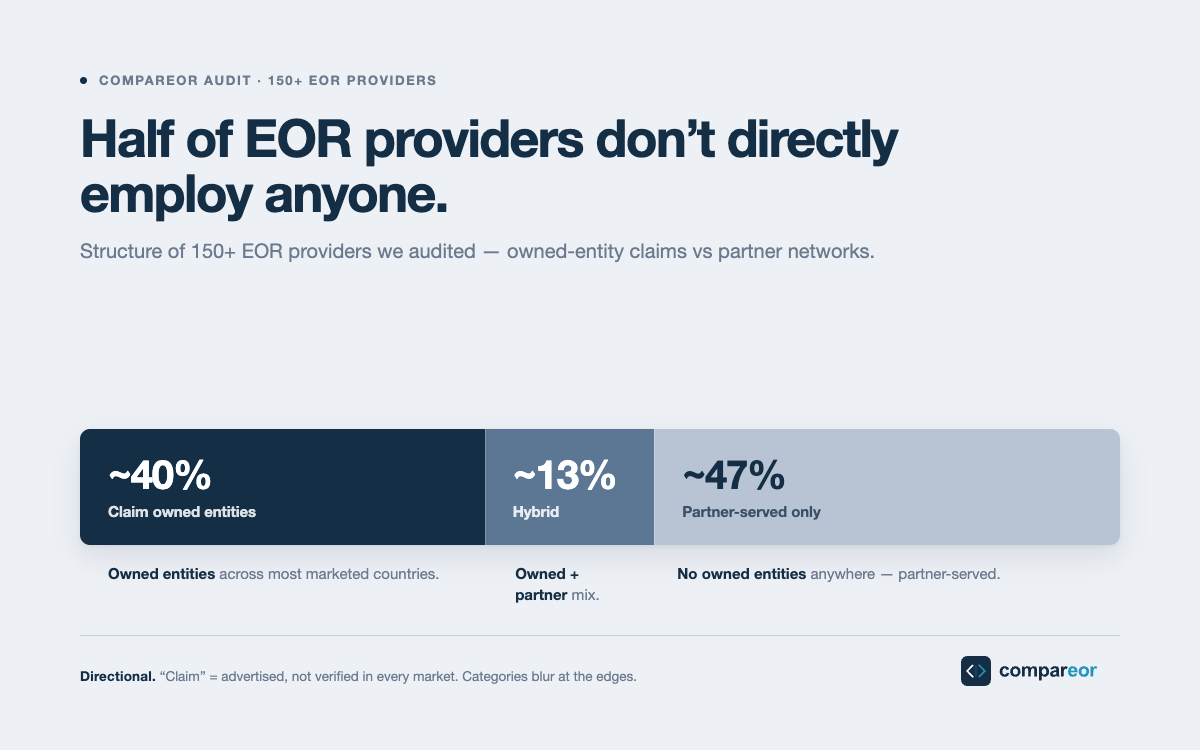
About 40% of EOR providers I audited claim and substantiate owned entities across most of their marketed countries. About 12 to 15% run an honest hybrid. About 45 to 50% are partner-served only, with no owned entities anywhere. The numbers, the methodology, the one honest caveat, and what they mean for buyers.


June 3, 2026
6 min read
Every EOR contract has an expiration date
The EOR model has a built-in expiration date, somewhere between 15 and 20 employees in one country. Past that threshold, the EOR stops being the cheapest option and starts being a tax on growth. Most companies miss it for a year or more, because the contract doesn't mention it and nobody inside is responsible for noticing.

May 25, 2026
5 min read
Why "150+ countries" is the most misleading number in global employment
Every EOR homepage leads with a country count, and after auditing 150+ providers it's the number most likely to lead you to the wrong choice. Coverage comes in three forms, and depth in your countries matters more than breadth across 185 of them.
Stay Updated on Global Hiring
Get weekly insights on EOR trends, compliance updates, and cost-saving strategies

Find a better EOR — without risk
Compare EOR providers to gain insights on cost, coverage, and contract flexibility, ensuring compliance and payroll continuity.


.png)
.png)



