
Why Brazil's CLT Makes EOR Essential for Foreign Employers
Brazil has one of the world's most complex labor frameworks. Here's why EOR is the only practical route for most foreign companies.


.png)
Brazil's talent market is too good to ignore
Brazil is Latin America's largest economy and by a wide margin its largest talent market. São Paulo is the second-largest software engineering hub in the Americas after the San Francisco Bay Area, Florianópolis has emerged as a world-class product and engineering cluster, and Brazilian engineers, financial analysts, and product managers routinely operate at US benchmark quality at 40–60% of US comp. For any US or European company building an international team, Brazil is one of the top three candidate markets in the world on talent-cost ratio.
What makes Brazil uniquely hard to hire in is not the talent — it is the legal framework sitting around the talent. Brazil has the world's highest payroll burden outside a handful of European outliers (35–42% employer load on top of gross), one of the most prescriptive labor codes in any major economy (the Consolidação das Leis do Trabalho, or CLT), and — critically — the most litigious labor court system on earth. The Brazilian Tribunal Superior do Trabalho processes over 2 million new labor cases each year, roughly 1 per 100 working-age adults annually, and the average case produces an award to the employee in more than 90% of disputes that reach decision. For a foreign employer without local legal infrastructure, running a direct entity in Brazil without deep CLT expertise is a structurally risky proposition. An EOR is not just the fastest way in — it is usually the only workable way in below a certain scale.
This post covers exactly what the CLT requires, why the cost stack reaches the numbers it does, the specific litigation exposures that catch foreign employers, the contractor-vs-employee question (including the pejotização trap), and how EOR eliminates the operational surface area that makes Brazil dangerous. If you are still choosing between markets, pair this read with our 10-market cost comparison and the country-by-country cost breakdown.
What is the CLT?
The Consolidação das Leis do Trabalho, enacted in 1943 under President Getúlio Vargas and substantially updated in 2017 and 2022, is Brazil's comprehensive labor code. It consolidates employment law into a single framework covering contracts, working hours, compensation, benefits, leave, termination, and the role of trade unions and the Ministério do Trabalho. It is reinforced by the 1988 Federal Constitution, which enshrines specific employment rights at the constitutional level — including maximum 44-hour working weeks, paid weekly rest, paid annual leave, 13th-month salary, and FGTS severance protection. Constitutional rights cannot be contracted around; CLT provisions can only be varied through a formal collective bargaining agreement (convenção coletiva) or accord (acordo coletivo) with the relevant union.
Every Brazilian employment relationship is governed by the CLT. The defining element, under Article 3, is the relação de emprego — a working relationship with four characteristics: personal performance (the worker must perform the work personally), non-eventuality (the work is continuous, not ad-hoc), onerosidade (the work is paid), and subordinação (the worker takes direction from the employer). If all four apply, the relationship is an employment relationship by operation of law — regardless of what the contract says, regardless of whether the worker is set up as a pessoa jurídica (legal entity / contractor), and regardless of where the hiring company is based. This is the doctrine that makes contractor misclassification uniquely dangerous in Brazil.
Why the CLT is complex for foreign employers
The CLT's cost structure has half a dozen layers that foreign employers consistently under-budget. Each one is described below with the underlying math.
13th-month salary (décimo terceiro)
All employees are entitled to a mandatory 13th-month salary (gratificação natalina, commonly called décimo terceiro), paid in two instalments — 50% by 30 November and the remaining 50% by 20 December. The 13th-month adds approximately 8.33% (one-twelfth) to annual salary costs and is subject to INSS and FGTS contributions on top, which adds another 3–4%. Effective added cost: ~11–12% of annual gross.
FGTS — the severance fund
Employers must deposit 8% of each employee's monthly salary (and 13th-month) into a government-managed Fundo de Garantia do Tempo de Serviço (FGTS) account in the worker's name at Caixa Econômica Federal. The fund is owned by the worker and accrues at a statutory interest rate (3% + TR). On termination without just cause, the employer pays an additional 40% penalty on the total accumulated FGTS balance. For a worker with 3 years of tenure and a R$10,000/month salary, the FGTS balance at termination is approximately R$30,000, and the 40% penalty is R$12,000 — a single-incident termination cost that most foreign employers fail to budget for.
FGTS is not an accounting line item that sits somewhere in the tax return. It is a segregated government fund with real-time balance visibility to the worker. Non-deposit is directly actionable.
INSS — the social security load
Employer-side INSS (Instituto Nacional do Seguro Social) contribution is 20% of gross salary, uncapped — the largest single line item in the Brazilian payroll stack. On top of that, the Riscos Ambientais do Trabalho (RAT) contribution adds 1–3% depending on industry risk rating, and the Terceiros contribution to SENAI, SESI, SEBRAE, and similar third-party training and social funds adds another 5.8%. Combined INSS + RAT + Terceiros employer contribution: roughly 26.8–28.8% of gross.
The recent Reoneração Gradual da Folha de Pagamento (Law 14.973/2024) restored the full 20% employer INSS rate for 17 previously-exempt labor-intensive sectors (technology, call centers, transport, hospitality, construction, media) on a gradual 2025–2027 schedule — which means employer cost in several affected sectors has risen meaningfully in the last 18 months and will continue rising through end-2027. Any Brazilian cost estimate older than Q3 2024 should be rebuilt from scratch.
Vacation + one-third bonus
After 12 months of employment (the período aquisitivo), employees are entitled to 30 days of paid annual leave. When the leave is taken, the employer pays the regular monthly salary plus a one-third vacation bonus (adicional de férias) — a constitutional right that cannot be waived. Effective added cost: ~8.33% (the 30 days of paid leave) × 1.33 (the bonus) ÷ 12 = approximately 2.78% of annual gross.
Aviso prévio — paid-in-lieu notice
Notice periods are 30 days minimum (for employees with less than 1 year of service), rising by 3 days per additional year of service to a maximum of 90 days. Employer-initiated termination without just cause requires paid-in-lieu notice (aviso prévio indenizado) — the employer pays out the notice period in cash rather than requiring the worker to continue working. This adds one full month of salary at minimum to termination cost, on top of the FGTS 40% penalty.
Other statutory items
The remaining bucket includes transport allowance (vale-transporte), meal voucher (vale-refeição), mandatory profit-sharing (PLR) where a collective agreement requires it, and overtime at 50% premium on weekdays and 100% on Sundays and holidays. Together these typically add 5–10% of gross to total cost, depending on the applicable convenção coletiva.
The total
Stack these layers and the Brazilian cost-to-gross multiplier lands at approximately 1.60–1.80× depending on sector and location. For a R$120,000/year Brazilian software engineer, total annual cost is approximately R$195,000–R$215,000 before the EOR service fee. Adding a standard EOR fee (€400–€700/month, or roughly R$2,500–R$4,500/month at current rates) brings the full loaded cost to approximately R$230,000–R$270,000/year. The Brazil hiring guide has the full line-item breakdown.
eSocial — the reporting spine
All employment data — contract formation, salary and role changes, working-hours declarations, leave events, sick leave certificates, terminations, and tax-relevant individual-level data — must be reported in real time through eSocial, the Brazilian government's consolidated electronic labor reporting system. eSocial unified what used to be a dozen separate filings (CAGED, SEFIP, DIRF, RAIS, and others) into a single integrated system that feeds directly into Receita Federal (the federal tax authority), Ministério do Trabalho, Caixa Econômica Federal (FGTS), and INSS.
Filing deadlines are tight (typically within 24 hours to 7 days of the event depending on the event type), and late or incorrect filings trigger automatic fines that compound monthly. The eSocial fine schedule runs from R$201.27 per occurrence up to R$402.53 for basic late-filing violations, with much larger penalties for systemic non-compliance. For a company with 10 Brazilian employees, even modest filing discipline issues can generate R$30,000–R$50,000 in annual exposure — more than the EOR service fee itself.
The labor litigation risk
Brazil's labor courts process over 2 million new cases per year — more than the entire civil court system of most countries combined. The statute of limitations on labor claims is 5 years, with claims filed up to 2 years after the end of the employment relationship. A single disgruntled former employee can revisit 5 years of pay, overtime, vacation, 13th-month, FGTS, and working-hours treatment and bring the full stack into a single claim. Aggregate claim values of 1–3× annual salary are common, and in misclassification or systemic non-compliance cases they can reach 5–10×.
The most frequent claim types:
- Unpaid overtime (especially where working-hours controls were weak or the worker was misclassified as cargo de confiança / management-exempt)
- Incorrect FGTS deposits or INSS contributions
- Moral harassment (assédio moral) — a broad statutory category that covers excessive pressure, humiliation, and hostile supervision
- Misclassification of contractors as employees with retroactive CLT benefits
- Incorrect convenção coletiva application
- Procedural defects in termination (missing homologação, incorrect severance calculation)
The courts are systematically pro-worker, an intentional consequence of the CLT's 1940s protective framing. A foreign employer operating directly in Brazil without deep CLT process discipline is, statistically, likely to face a claim within 18–24 months of the first employee. Our EOR liability guide covers how liability allocates when an EOR is running the employment, and the misclassification risk guide covers Brazil's specific contractor exposures.
The PJ contractor trap
Many Brazilian workers — especially in technology and creative sectors — operate as pessoa jurídica (PJ), setting up a one-person company to receive payment as a services invoice rather than as salary. For the worker, PJ status reduces personal tax from ~27.5% to roughly 6–15.5% under the Simples Nacional regime and provides short-term cashflow flexibility. For the paying company, it eliminates apparent CLT exposure — the contract is B2B, not employment.
The pattern is so widespread that it has a name — pejotização — and it is under active enforcement scrutiny. In 2024, the Brazilian Supreme Court (STF) upheld the validity of PJ relationships in knowledge-work contexts, but the underlying Article 3 doctrine is unchanged: if the four employment characteristics are present (personal performance, non-eventuality, onerous, subordinate), a labor court can and routinely does requalify the PJ into CLT employment with retroactive benefits. The typical requalification award runs 2–4× what the employer would have paid had the worker been hired as CLT from day one, plus penalties.
The practical rule: PJ is workable for genuinely independent consultants, fractional experts, and short-term project work. For full-time, exclusive, integrated workers, CLT employment via EOR is the durable answer. Run the risk quiz if you are unsure.
The homologação process
Historically, termination of an employee with more than 1 year of tenure required homologação — a formal ratification of the termination paperwork at the local union (sindicato) or the Ministério do Trabalho. The 2017 labor reform (Law 13.467/2017) removed the mandatory ratification requirement for most cases, but many collective agreements still require it, and most reputable employers continue the practice voluntarily to create a clean record that forecloses later litigation.
In practice, any termination at scale (mass layoffs, restructurings, or terminations in sectors with strong union presence) still involves formal union notification and often negotiated homologação. A competent EOR handles this routinely; a direct employer attempting it without local expertise regularly triggers procedural disputes that become the basis for later claims.
How EOR handles all of this
An EOR takes the CLT operational surface area off your balance sheet. Specifically, the EOR handles CNPJ registration (the employer's tax identifier), eSocial filings on the full event cadence, INSS and FGTS deposits on the statutory schedule, 13th-month and vacation-bonus calculations, convenção coletiva applicability analysis, termination procedure including homologação where required, overtime and working-hours compliance, and the ongoing reporting cadence to Caixa, Receita, and Ministério do Trabalho.
For a foreign company, this eliminates the need for a local entity, a local accountant, a local payroll team, and a local labor lawyer to handle the day-to-day employment relationship. You still need to handle commercial direction — goals, projects, performance management — but that is operational, not statutory.
The right EOR structure for Brazil is one with an owned Brazilian entity (not a partner-network arrangement), demonstrated CLT expertise at the contract-drafting level, and a track record of clean homologação and termination execution. Our Brazil EOR leaderboard ranks the top providers for the market, and the 12-question evaluation framework covers the specific questions to ask about Brazilian coverage. Brazilian onboarding typically takes 2–4 weeks even through a well-operated EOR, driven by the CNPJ-side registrations and mandatory pre-employment medical exam (ASO).
EOR vs entity for Brazil — where the break-even sits
Brazilian entity setup takes 4–6 months, costs USD $15,000–$40,000 in initial legal and registration fees, and generates ongoing monthly overhead of USD $3,000–$6,000 for mandatory local accounting, payroll, labor lawyer retainers, and statutory filings. The break-even against EOR lands at approximately 15–20 employees in Brazil — materially higher than the typical 8–12-employee break-even in Europe, because Brazil's statutory overhead does not scale with headcount the way simpler jurisdictions do.
For under 15 Brazilian employees, EOR is structurally cheaper and operationally safer. For 15–25 employees, the two are close and the decision depends on growth trajectory. Above 25 employees with a firm commitment to stay, entity setup starts to pay back within 18–24 months. Our EOR vs entity framework has the detailed decision logic, and the South America regional guide covers similar logic for Argentina, Colombia, Chile, and Mexico.
Frequently asked questions
What is the effective cost-to-gross ratio for a Brazilian hire?
1.60–1.80× depending on sector, location, and applicable convenção coletiva. For a R$120,000/year gross engineer, expect R$195,000–R$215,000 in total employment cost before EOR fee and R$230,000–R$270,000 fully loaded.
Can I hire Brazilian workers as contractors (PJ) to avoid CLT cost?
For genuinely independent, short-term, non-core engagements — yes. For full-time, exclusive, integrated workers — no. Article 3 of the CLT operates on substance, not form, and labor courts requalify thousands of PJ relationships per year into CLT employment with 2–4× retroactive cost. Run the risk quiz before structuring anything as PJ.
How bad is the labor litigation risk actually?
Statistically significant. Brazil processes over 2 million labor cases annually, awards to employees in 90%+ of decided cases, and the 5-year statute of limitations means a single complaint can cover 5 years of accumulated exposures. EOR shifts the operational compliance discipline onto a provider whose full business is not to generate these claims.
What is eSocial and why does it matter?
eSocial is Brazil's unified electronic labor reporting system covering all employment-side events — contracts, changes, leaves, terminations. Filings are real-time or near-real-time, and late or incorrect filings trigger automatic fines. A single mid-sized team can accumulate R$30,000–R$50,000/year in exposure from filing discipline lapses alone.
When should I set up a Brazilian entity instead of using EOR?
When you are committed to 20+ employees in Brazil for multiple years. Below that threshold, EOR is structurally cheaper and operationally safer. The entity decision should also factor in whether you need local IP holding, local revenue invoicing, or local banking that EOR cannot provide. Our framework has the full decision logic.
Bottom line
Brazil's combination of talent quality and talent cost is one of the best in the world — and its labor framework is one of the most unforgiving. The CLT prescribes in detail what can be agreed and what cannot, 13th-month and FGTS and INSS and vacation bonus and aviso prévio stack into a 1.60–1.80× cost-to-gross multiplier, and 2 million labor cases per year mean that operational discipline on eSocial, convenção coletiva application, and termination procedure is not optional.
For any foreign employer hiring fewer than 20 people in Brazil, EOR is almost always the right answer. It removes the entity overhead, the legal exposure, and the filing discipline burden that make direct employment uniquely dangerous in Brazil — and it does so for a monthly fee that is typically smaller than the eSocial fine exposure of a disorganized direct-employer alternative. Above 20 employees with firm commitment to the market, entity setup becomes economically rational — and at that point, the Brazilian team has typically acquired enough in-country knowledge to operate the entity safely. Until then, a Brazil-strong EOR provider is not a procurement choice. It is the structure.
Get your shortlist
Takes ~3 minutes. No account needed.
June 3, 2026
6 min read
I checked the structure of 150+ EOR providers. Here's how many actually own their entities.
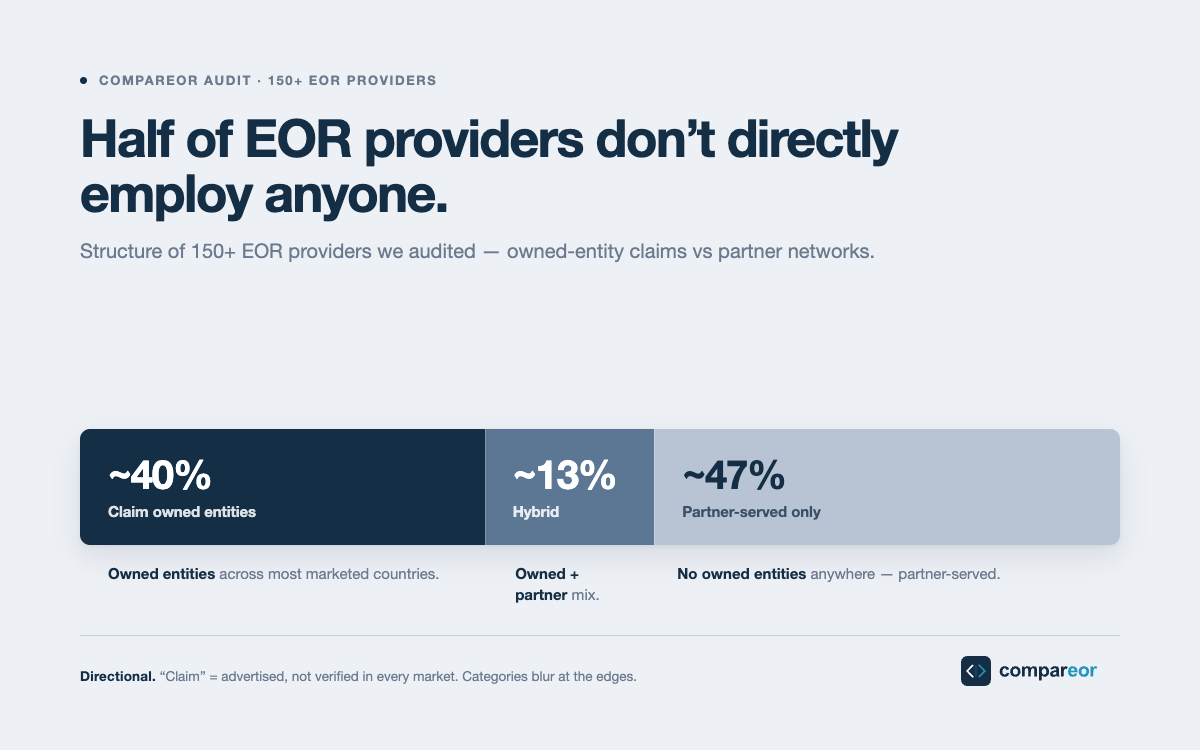
About 40% of EOR providers I audited claim and substantiate owned entities across most of their marketed countries. About 12 to 15% run an honest hybrid. About 45 to 50% are partner-served only, with no owned entities anywhere. The numbers, the methodology, the one honest caveat, and what they mean for buyers.


June 3, 2026
6 min read
Every EOR contract has an expiration date
The EOR model has a built-in expiration date, somewhere between 15 and 20 employees in one country. Past that threshold, the EOR stops being the cheapest option and starts being a tax on growth. Most companies miss it for a year or more, because the contract doesn't mention it and nobody inside is responsible for noticing.

May 25, 2026
5 min read
Why "150+ countries" is the most misleading number in global employment
Every EOR homepage leads with a country count, and after auditing 150+ providers it's the number most likely to lead you to the wrong choice. Coverage comes in three forms, and depth in your countries matters more than breadth across 185 of them.
Stay Updated on Global Hiring
Get weekly insights on EOR trends, compliance updates, and cost-saving strategies

Find a better EOR — without risk
Compare EOR providers to gain insights on cost, coverage, and contract flexibility, ensuring compliance and payroll continuity.


.png)
.png)



