
9 Questions to Ask on an EOR Demo Call (The Ones They Hope You Won't)
EOR sales reps have rehearsed answers for the five questions every buyer asks. These nine are the ones they hope you won't — owned entity vs. partner, FX spread in writing, benefits markup, indemnification depth, references from disputes. Use this as your demo-call checklist.


.png)
EOR demo calls are structured for the provider's benefit
A typical 45-minute EOR demo call follows a predictable arc — 5-minute discovery, 25-minute platform walkthrough, 10-minute pricing summary, 5-minute close. Inside that arc, the provider controls the topic flow, the demo content, and the rhythm. The buyer's questions, when they come, tend to be the same five every provider hears: countries covered, pricing, contractor versus employee, onboarding speed, integrations. Each of those questions has a rehearsed answer the rep delivers a dozen times a week.
The structural information that actually determines whether the provider is a good fit — the data points that take real work to extract — does not come up unless the buyer asks specifically. Most buyers do not, because they do not know which questions reveal the structure and which questions hit the marketing material. The result is a procurement decision made on demo polish rather than on operational reality.
This post is a list of the nine questions that reveal the structure. They are not difficult to ask, but they are uncomfortable to answer for several providers — which is exactly what makes them useful. Run them in your next demo call. Pair with the negotiation playbook, the quote decoder, and the contract review checklist for the rest of the procurement workflow.
Question 1 — Owned entity or partner network in each target country?
Ask: For each country in our target list, do you operate through your own owned local entity, or through a partner or aggregator?
Why it matters. An owned entity means the provider has the local legal infrastructure — registered employer of record, local payroll team, direct relationships with tax authorities and benefits providers. A partner-network arrangement means a layered structure where the provider contracts with a local third party who holds the actual employment relationship. Partner-network pricing typically runs 20–30% above owned-entity pricing because there are two margins in the chain, and quality control is one layer removed from the provider you signed with.
A good answer looks like a country-by-country list, in writing, with the entity status for each country explicitly labelled. Owned entity for primary markets, vetted partner network with named partners for secondary markets, with the provider taking primary contractual responsibility for both. A deflection looks like we have full coverage in 150+ countries without distinguishing the structure underneath — the headline number conflates owned and partner coverage and obscures where margin and operational risk actually sit.
What to do with the answer. For your top three target countries, owned entity should be a hard requirement unless the partner is named and verifiable independently. For tertiary countries, partner-network is acceptable if the contract clearly designates which party carries which liability.
Question 2 — Exact FX spread, in writing, in the contract?
Ask: What is your exact FX spread over the mid-market rate, and will you commit to that number in our contract?
Why it matters. The FX spread is the single most opaque cost line in most EOR quotes. The difference between 0% (Deel's published mid-market policy) and 3% (legacy provider average) on a 20-employee team with $200,000/month in local-currency payroll is $72,000 per year. Providers who set the rate at their discretion will not commit a specific number to writing. Providers who price competitively on FX will, gladly.
A good answer looks like a specific number, in basis points, with the methodology stated: mid-market rate from XE on the date of invoice, plus a maximum of 150 basis points — and the rep agrees to write it into the master agreement. A deflection looks like we use bank rates, it varies by currency, or I'll have to check with finance. All three signal the spread is being managed as a variable margin lever rather than a fixed methodology.
What to do with the answer. Insist on the number in the contract before signing. If the provider cannot commit, ask why on the call — the answer reveals whether FX is a pricing line or a margin lever.
Question 3 — What is the benefits administration markup?
Ask: What is your administrative markup on benefits, and can you show me the wholesale cost from the underlying provider separately from your fee on top?
Why it matters. Benefits markup is the single largest source of hidden margin in EOR contracts. The EOR sources health insurance, pension, and life and disability coverage from local providers at wholesale prices and bills you at retail. The markup ranges from 0% (rare, offered by a handful of providers as a competitive differentiator) to 25%+ (common, especially in mid-market providers). For most contracts, this single number affects total cost more than the headline service fee.
A good answer looks like a specific percentage, in writing, with the underlying wholesale cost available on request and itemised in the quote. 5–10% administrative fee on benefits, applied transparently, with the wholesale cost shown alongside. A deflection looks like benefits are charged at cost without disclosure of the markup, or we don't break that out separately — both of which mean the markup is in the bundled benefits package number and not visible to you.
What to do with the answer. Require itemisation in the contract. If the provider's actual markup is below 10%, they will be happy to itemise. If it is above 15%, they will resist, which is the answer to the original question.
Question 4 — Who is liable if your team causes the compliance failure?
Ask: If your local payroll team makes a compliance error — late statutory filing, incorrect tax remittance, contractor misclassification through your own contract template — who is financially liable for the resulting penalty or claim?
Why it matters. Standard EOR contracts often have one-sided indemnification — the EOR indemnifies narrowly, and the client carries the broader liability. In high-litigation jurisdictions (Brazil, France, Italy), a single misclassification or termination procedural error can produce 2–4× annual salary in damages. Knowing who pays before something goes wrong is meaningfully different from finding out after.
A good answer looks like clear written indemnification covering the EOR for any failure arising from its own conduct — missed filings, incorrect statutory calculation, employment-law violations in the EOR's execution — with the client retaining liability only for failures arising from client direction (false employment data, instructions to misclassify, etc.). A deflection looks like our standard contract covers compliance without specifying what compliance means, or indemnification is mutual without the specific scenarios spelled out.
What to do with the answer. Get the specific scenarios in writing. Read the EOR liability guide for the full framework. If the provider refuses to indemnify for clear EOR-caused errors, that is a structural problem — look at a different provider.
Question 5 — References from customers who've been through a dispute?
Ask: Can you give me two reference customers who have been through a labor dispute, wrongful termination claim, or compliance audit with you running the EOR relationship?
Why it matters. Easy references are the customers who never had a problem. The customers who matter for evaluation are the ones whose relationship was tested. How the EOR handled a labor court case in Brazil, a redundancy in France, an audit in Germany — that is the data that predicts how your relationship will go when something hard happens. The marketing references and the dispute references are different sets of customers, and only one set is diagnostic.
A good answer looks like two or three names of customers willing to speak to dispute or audit handling, with the EOR's permission to discuss specifics. The customer's account should align with the EOR's narrative when you cross-check. A deflection looks like our customers haven't really had disputes — statistically implausible for any EOR at meaningful scale, and a signal that the EOR has not been involved in dispute defence at the level the buyer needs.
What to do with the answer. Make the reference calls. Ask the customer specifically about response time, quality of legal support, and whether the EOR honoured its indemnification commitments. Worst-case behaviour is much more diagnostic than best-case marketing.
Question 6 — What is the renewal cap, written into the contract?
Ask: What is the renewal cap on the service fee, written into the contract?
Why it matters. Standard renewal uplifts run 3–8% annually. Without a contractual cap, providers can adjust unilaterally. Over a three-year contract, the cost difference between an unbounded escalator and a capped one is typically $25,000–$50,000 on a 30-employee team. This is one of the most negotiable contract clauses and one of the most consistently overlooked at signing.
A good answer looks like a capped escalator — annual service fee adjustment capped at CPI or 3%, whichever is lower — already in the standard contract template, or accepted without resistance as a redline. A deflection looks like our contracts are subject to annual review without specifying the cap, or we've never had to increase fees significantly — both of which preserve the unilateral right for future use without committing the provider to anything.
What to do with the answer. Negotiate the cap into the contract before signing. If the provider resists, that is itself a signal about how the renewal will go. Read the contract red flags guide for the redline pattern and the rest of the structural clauses to watch.
Question 7 — Minimum employment commitment and termination fee?
Ask: What is the minimum employment commitment per employee, and what is the early termination service fee if a hire does not work out?
Why it matters. Many EOR contracts include 6 or 12-month minimum commitments per employee, with early-termination service fees that can run $5,000–$15,000 per employee on top of statutory severance. If a hire does not work out — wrong fit, performance, role redundancy — the lock-in incentivises keeping an underperformer to avoid the cost, which compounds the original hiring mistake.
A good answer looks like no minimum commitment, or 90 days maximum, with a defined termination service fee that covers actual offboarding work (final payroll, statutory filings, settlement documentation) — typically 0.5–1× standard service fee. A deflection looks like we have a standard 12-month commitment or early termination is subject to penalty, both of which install the lock-in without justifying its size.
What to do with the answer. Negotiate the lock-in out or compress to 90 days. The termination service fee should reflect actual offboarding work cost (small), not future service fee revenue protection (large).
Question 8 — Actual time-to-first-payroll, with an SLA?
Ask: For [specific target country], what is your actual time-to-first-payroll from contract signing to first paid invoice, and can you put that as an SLA in the contract?
Why it matters. Marketing claims of onboard in 24 hours rarely match operational reality. Country-specific onboarding involves entity registration, employment contract drafting, statutory filings, pre-employment medical exams (in some markets like Brazil), and banking setup. Actual time-to-first-payroll varies from 5 business days (UK, US, basic markets) to 2–4 weeks (Brazil, India, complex markets). The gap between marketing claim and operational reality is one of the most reliable predictors of how the rest of the relationship will run.
A good answer looks like a specific number of business days per country, backed by an SLA in the contract with a service-fee credit if missed. 10 business days in the US, 15 in Brazil, 12 in Mexico, with a 25% service-fee credit if the SLA is missed. A deflection looks like it depends on the country without a number, usually about a week without commitment, or we don't offer SLAs on onboarding.
What to do with the answer. Request the SLA in writing. Then verify with a reference customer in the same country whether the SLA reflects actual performance. The gap between commitment and reality is the predictive number.
Question 9 — Sub-processor chain and data residency?
Ask: What is your complete sub-processor chain for payroll, tax, and HR data — and does any employee data leave the country of employment or our preferred data residency zone?
Why it matters. For EU customers under GDPR, for regulated industries (healthcare, finance, defence), and increasingly for any company with serious data governance posture, the sub-processor chain matters. Many EORs use multiple sub-processors for payroll, benefits, accounting, and HRIS, with data flowing across borders in ways that are not disclosed by default. A single sub-processor change after signing can move your employee data into a jurisdiction you would not have agreed to upfront.
A good answer looks like a complete sub-processor list, in writing, with a data flow diagram showing what data goes where, plus explicit contractual commitments on data residency, encryption, sub-processor change notification, and breach response. A deflection looks like we're fully GDPR compliant without the sub-processor list, or data is encrypted in transit and at rest without the residency commitment.
What to do with the answer. Request the sub-processor list and data flow diagram before signing. If your industry or jurisdiction requires data residency commitments (EU citizens' data in EU, healthcare data in country, financial data in country), make those contractual rather than verbal.
Bonus questions worth asking
A handful of additional questions for specific contexts:
- What is your professional liability insurance coverage and limit? — particularly relevant in regulated industries and high-litigation jurisdictions.
- What languages do your local support teams cover in [target country], and what are the actual support hours in local time? — marketing claims of 24/7 support in 50 languages often diverge sharply from operational reality, especially in non-business hours.
- Who is the dedicated account manager assigned to our account, and what is their tenure with the provider? — newer reps have less discretion and weaker internal escalation paths, both of which matter when something goes wrong.
- What is the contract term and the auto-renew notice period? — auto-renew clauses with short notice windows are an easy trap that renews the unbounded escalator.
How to actually run the demo call
Five tactics consistently surface better answers.
Send the questions in advance. Most provider reps cannot answer all nine from memory. Sending the list ahead of the call ensures researched answers rather than improvised deflections, and signals from the start that this is a structural evaluation rather than a feature tour.
Take written notes. Especially for answers involving numbers — FX spread, benefits markup, renewal cap, lock-in period, SLA days. Memory is unreliable; written notes are negotiation evidence in the contract phase.
Push for writing on every commitment. The answer to most of these questions only matters if it ends up in the contract. Will you commit to that in writing? should be the follow-up to every numeric answer.
Run the same nine questions across multiple providers. The pattern of who answers cleanly and who deflects is itself diagnostic. A side-by-side comparison of answers, not a side-by-side comparison of pricing pages, is the right basis for the procurement decision.
Verify the answers with references. The provider's answer is one source; the reference customer's experience is another. Where they diverge, the truth is closer to the reference's account. This is the highest-value due diligence step most buyers skip.
How a Compareor advisor changes the demo dynamic
Running nine hard questions in a sales call is uncomfortable for most buyers. Sales reps are trained to redirect, defer, and circle back on the hard answers. A buyer asking these questions alone faces an asymmetric conversation — the rep does this every day; the buyer does it two or three times a year at most.
A Compareor advisor changes the dynamic. The service is free to buyers (Compareor is compensated by the provider on closing, not by you) and built around the procurement workflow described in this post. The advisor joins the demo call with you, asks the structural questions in their natural flow, pushes back on deflections in real time based on dozens of comparable conversations, and captures the answers in writing for use in the contract negotiation. Where a buyer asking these questions alone might catch 60% of the deflections, an advisor brings it to 90–95%.
The advisor also runs the same nine questions across the multiple providers in your shortlist and produces a side-by-side comparison showing where each provider answered cleanly, where they deflected, and where the structural risks sit. That comparison is the actual basis for the procurement decision — much more useful than the side-by-side feature spec sheet most companies build. Request a Compareor advisor before your next demo call.
Frequently asked questions
When should I send the questions in advance versus ask cold on the call?
Send the structural pricing questions in advance — FX spread, benefits markup, renewal cap, lock-in. These benefit from researched answers and concrete numbers. Ask the operational and reference questions live — time-to-first-payroll, references from disputes, indemnification scenarios. These benefit from unrehearsed responses and reveal the rep's actual depth.
Will sales reps push back if I ask all nine questions?
The good ones welcome them — the structural questions get out of the way early and the close is cleaner. The weaker ones will redirect to platform features or circle back on the hard answers. The redirect itself is a useful signal about how the relationship will run post-signing.
Can I ask these questions of an established vendor mid-contract?
Yes, but the leverage is much weaker. The questions are most useful pre-signing, before commitments are locked in. Mid-contract, they are useful for renewal preparation — especially the renewal cap, lock-in, and benefits markup questions, all of which can be revisited at renewal.
What if a provider refuses to answer specific questions?
Refusal is itself an answer. Document what was asked and what was refused, and use the pattern in your provider comparison. A provider that refuses to disclose its FX spread or benefits markup is telling you the answer is unfavourable; otherwise, disclosure would be the easy choice.
How long should the demo call be to cover these questions?
Allow 60 minutes minimum for a serious evaluation call. The first 15–20 minutes typically cover platform demo; the back half should be for these structural questions, with time built in for follow-up clarifications and writing-commitment requests.
Should my legal or finance team be on the demo call?
For deals above 25 employees, yes. Legal for the indemnification and contract questions; finance for the pricing structure and FX questions. For smaller deals, the procurement lead can usually cover both with the right preparation. A Compareor advisor can also substitute for both at smaller deal sizes.
Can a Compareor advisor really replace having my own team on the call?
For most procurement evaluations under $500K in annual contract value, yes. The advisor knows the structural questions, knows how each provider typically responds, and captures answers for documentation. For deals requiring deep legal review (regulated industries, multi-million-dollar contracts), the advisor complements internal counsel rather than replacing it.
Bottom line
EOR demo calls are structured for the provider's benefit. The five questions every provider expects have rehearsed answers; the nine questions in this post are the ones that reveal whether the provider is a good fit, what the structural cost will actually be, and whether the contract is signable on standard terms.
The buyers who get fair deals treat the demo as a structured information extraction exercise, not a marketing presentation. The buyers who overpay let the demo deck define what gets discussed and accept rehearsed answers as resolution. The difference between the two postures is usually 15–25% of total contract cost over the contract term — and a much bigger difference in operational quality when something goes wrong.
Use this list as your demo-call checklist. Run it with every provider in your shortlist. Document the answers, compare across providers, and use the comparison as the primary basis for the procurement decision. If you want a human to run the questions with you, a Compareor advisor joins the call, asks the structural questions in their natural flow, pushes back on deflections in real time, and captures every answer in writing. The service is free. The questions are free. The only cost is letting the demo call control itself.
Get your shortlist
Takes ~3 minutes. No account needed.
June 3, 2026
6 min read
I checked the structure of 150+ EOR providers. Here's how many actually own their entities.
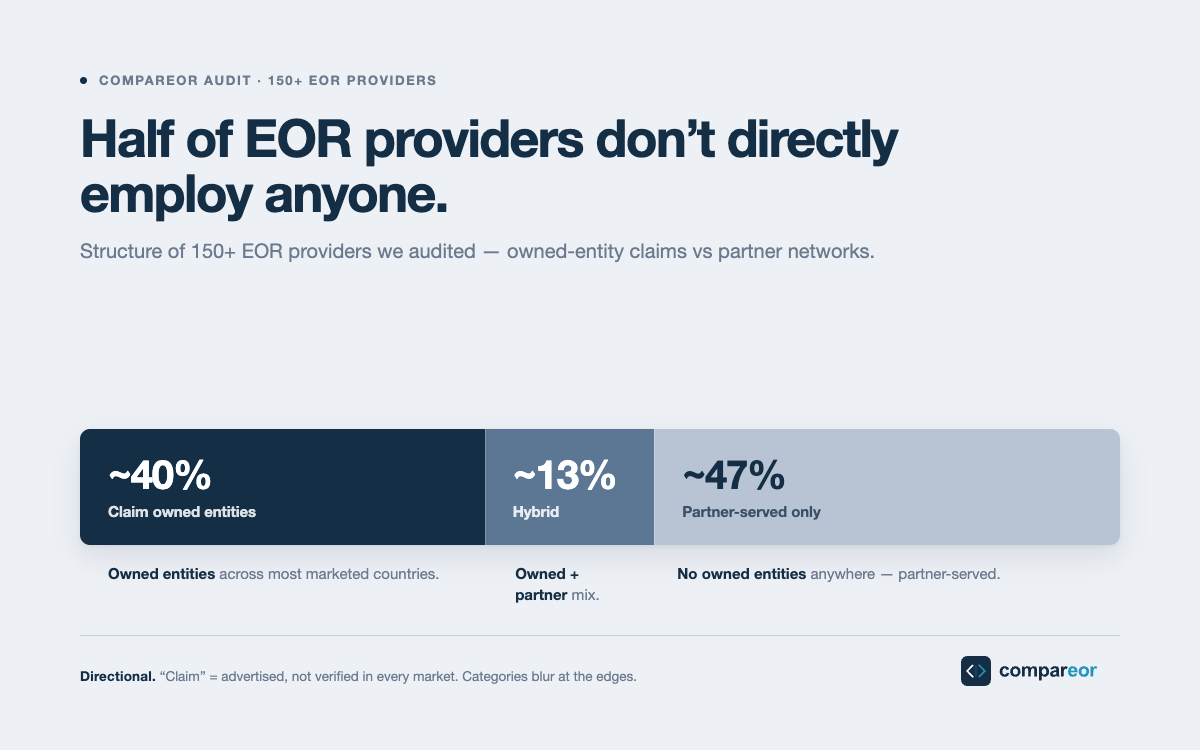
About 40% of EOR providers I audited claim and substantiate owned entities across most of their marketed countries. About 12 to 15% run an honest hybrid. About 45 to 50% are partner-served only, with no owned entities anywhere. The numbers, the methodology, the one honest caveat, and what they mean for buyers.


June 3, 2026
6 min read
Every EOR contract has an expiration date
The EOR model has a built-in expiration date, somewhere between 15 and 20 employees in one country. Past that threshold, the EOR stops being the cheapest option and starts being a tax on growth. Most companies miss it for a year or more, because the contract doesn't mention it and nobody inside is responsible for noticing.

May 25, 2026
5 min read
Why "150+ countries" is the most misleading number in global employment
Every EOR homepage leads with a country count, and after auditing 150+ providers it's the number most likely to lead you to the wrong choice. Coverage comes in three forms, and depth in your countries matters more than breadth across 185 of them.
Stay Updated on Global Hiring
Get weekly insights on EOR trends, compliance updates, and cost-saving strategies

Find a better EOR — without risk
Compare EOR providers to gain insights on cost, coverage, and contract flexibility, ensuring compliance and payroll continuity.


.png)
.png)



