
The Remote Hiring Playbook for US Companies Expanding to Europe
Europe is the most popular first international expansion for US companies. Here's the hiring playbook — country by country.


.png)
Why Europe is the default first move
For US companies building their first international team, Europe is almost always the right place to start. The combination is hard to beat anywhere else in the world: deep engineering and commercial talent pools, workable time-zone overlap with the East Coast, legal systems that are well-documented even when they are unfamiliar, and an EOR infrastructure that has been running payroll for US customers for a decade. English proficiency in the UK, Ireland, Netherlands, Germany, and Poland means the first 5 hires can be onboarded without translation friction, and the talent cost — while higher than Latin America or South-East Asia — lands 30–50% below US West Coast comp for equivalent seniority. This post walks through how to pick your first European market, what you will get wrong about EU employment coming from an at-will US background, country-specific watch-outs for the five markets US companies choose most often, and the right trigger for switching from EOR to a local entity.
If you have already narrowed your choice to EOR as the hiring vehicle, pair this with our EOR vs PEO vs entity framework and the 12-question provider evaluation to sequence the procurement work before you open the first role.
Choosing your first European market
The five markets US companies land in most often — in order of procurement volume — are the UK, Germany, Netherlands, Poland, and France. Each carries a different trade-off between talent depth, cost, and compliance complexity.
United Kingdom — easiest entry
The UK is the most common first move for a reason. Employment contracts are drafted in English, the common-law framework is closer in structure to US employment law than any Continental jurisdiction, and the EOR infrastructure is the most mature in Europe — onboarding in 5 business days is routine. Employer costs are moderate: 15% employer National Insurance (from April 2025), 3–5% workplace pension auto-enrolment, and the apprenticeship levy at 0.5% on payrolls above £3M. Notice periods are short by European standards (1 week statutory up to 2 years of service, typically 1 month in contract). The main post-2020 complication is IR35 — the off-payroll rules that catch US companies hiring UK contractors and that often tip the decision toward employment via EOR from day one. See our UK hiring guide for the full employer-cost breakdown.
Germany — deepest engineering talent, highest complexity
Germany is the obvious choice when the role is engineering, industrial, or R&D-heavy. The talent pool is deeper than anywhere else in Europe, and salaries are 20–30% below London for comparable seniority. The trade-off is statutory complexity: ~21% employer social security (split across pension, unemployment, health, long-term care, and accident insurance), strict dismissal protection that kicks in after 6 months under the Kündigungsschutzgesetz, and works council consultation rights that apply from 5 employees and have real procedural teeth. Collective bargaining agreements (Tarifverträge) can extend to non-unionized employers in some industries, which changes the minimum compensation and holiday calculus. For a first-market hire, the upside is that an experienced EOR will know the Krankenkasse enrolment, Sozialversicherungsausweis, and Lohnsteuer mechanics cold. See our Germany hiring guide and the Germany EOR leaderboard.
Netherlands and Ireland — English-speaking, higher cost
The Netherlands and Ireland are the two English-as-a-working-language markets on the Continent, which makes them attractive for go-to-market and support roles that need cultural proximity to a US HQ. Dutch employer costs run around 18–22% once you include pension, unemployment, and the statutory werknemersverzekering lines. Irish employer PRSI is ~11% on gross, which is the lowest in Western Europe. Both markets have strong dismissal protection and 13th-month or holiday-pay structures that catch US budgeting teams off guard — in the Netherlands the 8% holiday allowance (vakantiegeld) is statutory and adds visibly to all-in cost. Neither market is a cost-arbitrage play. They are a culture-and-language play, and the economics reflect that.
Poland and Romania — talent-cost arbitrage
Poland and Romania are where US companies go when the budget says Western Europe is too expensive but the requirement says EU-grade engineering talent. Polish developer comp runs 40–55% below Berlin for equivalent seniority, and Romania is another 10–15% below Poland. English proficiency in Warsaw, Kraków, Bucharest, and Cluj is near-parity with Western European tech hubs. Employer costs in Poland are around 19–22% on ZUS social contributions plus the mandatory PPK pension auto-enrolment (which employees can opt out of). Romania restructured its contribution system in 2018 — most statutory charges now fall on the employee side, and headline employer cost is low relative to other EU jurisdictions. See our Poland hiring guide, Poland EOR leaderboard, and Romania EOR leaderboard.
France — cost discipline required
France rewards commitment and punishes casual hiring. Employer social charges are the highest in the OECD at 42–45% of gross salary, convention collective industry agreements extend minimum terms automatically to most employers, and termination without a formally documented cause réelle et sérieuse or a negotiated rupture conventionnelle is not available. For a strategic hire where the talent is uniquely strong — and French engineering and design talent often is — France is worth the cost. For a speculative first role, it is usually not. Our French employer charges breakdown has the full line-item detail, and the France hiring guide covers the statutory framework.
What US founders get wrong about EU employment
Coming from an at-will US background, there are five structural differences that catch first-time European hirers off guard. None of them are fatal. All of them need to be in the hiring plan before the first offer goes out.
Employment contracts are mandatory and detailed
There is no at-will employment anywhere in the EU. Every hire gets a written contract with defined duration (usually indefinite, CDI in France or equivalent elsewhere), named working hours, specified salary including any 13th-month structure, and country-specific required clauses. Standard EOR contracts cover this automatically, but the implication for US founders is that the offer letter is legally binding from signature — not from the start date.
Notice periods are measured in months, not hours
Statutory notice periods run 1 week to 3 months depending on the country and tenure — longer in Germany (up to 7 months at 20+ years of service), Netherlands (up to 4 months), and France (up to 3 months for cadres). Contracts often extend statutory minimums. The practical consequence is that US-style immediate termination is not available and performance management needs to start on month 1, not month 5.
Probation periods are your real window
Probation periods of 3–6 months are standard in most EU markets (up to 6 in Germany, typically 2 in France for non-cadres and 4 for cadres). During probation, termination mechanics are much simpler — usually just written notice with no requirement to prove cause. Missing the probation window is the single biggest unforced error US hirers make in Europe. Document performance issues early, have the conversation before the probation deadline, and act within it if the fit is not there. After probation, the cost and complexity of termination rise by an order of magnitude.
Works councils and employee representation
Germany has statutory works councils (Betriebsrat) from 5 employees with consultation rights on hiring, dismissal, working hours, and internal transfers. France has the Comité Social et Économique (CSE) from 11 employees. Netherlands has works-council obligations from 50 employees. The consultation is not a veto, but it is a formal procedural step and skipping it can invalidate the downstream decision. The first-country hire of 1–4 people rarely triggers these thresholds, but as you scale past 10 employees in a single country the requirement becomes real and needs to be in the org plan.
Unfair dismissal protections
Every EU market has strong unfair dismissal frameworks — the specifics vary, but the common thread is that termination requires documented cause, a formal procedural sequence, and in many cases statutory severance. Germany's Kündigungsschutzgesetz applies from month 7 in companies of 10+ employees. France's licenciement requires written cause and a pre-termination interview. UK statutory unfair dismissal protection kicks in at 2 years of service. The implication is that disciplinary and performance processes need to be documented carefully from day one, and the EOR's local HR guidance on that documentation is worth using.
Country-specific watch-outs
United Kingdom
IR35 off-payroll rules, auto-enrolment workplace pension from day one, employer National Insurance at 15% from April 2025, post-Brexit sponsorship requirements for non-UK nationals, and the apprenticeship levy at 0.5% for payrolls above £3M. Annual leave is 28 days statutory including bank holidays. Notice periods under two years' service are short by European standards, which makes the UK one of the easier markets to course-correct from if a first hire does not work.
Germany
Works council consultation rights from 5 employees under the Betriebsverfassungsgesetz, dismissal protection from month 7 in companies of 10+ employees under Kündigungsschutzgesetz, collective bargaining agreement applicability (Allgemeinverbindlichkeit) in certain industries, 30-day statutory vacation (24 working days on a 6-day week basis, typically 25–30 days in contract), and health insurance enrolment via the employee's chosen Krankenkasse. Salary reviews are typically annual and often follow sector-wide Tarifvertrag benchmarks even outside formally collective-bargained employers.
France
Highest OECD employer social charges (42–45% on gross), mandatory convention collective application based on company activity code, strict CDD fixed-term contract rules (usable only in specific enumerated situations), cadre vs non-cadre status determines pension tier and notice period, 13th-month salary is conventional in most sectors, and rupture conventionnelle is the standard negotiated-exit path. France is also the most contractor-risk-aggressive market in Europe — URSSAF requalification cases regularly reach €100K+ in back-contributions per misclassified contractor.
Poland
20–26 days statutory paid leave depending on tenure (20 days for under 10 years, 26 days after), ZUS social insurance registration via the ZUS ZUA form within 7 days of start, PPK mandatory pension auto-enrolment (with opt-out), 14-day sick pay paid by the employer before the ZUS takes over, and a 3-month statutory notice period that scales with tenure. Engineering comp benchmarks in Warsaw and Kraków are 40–55% below Berlin for equivalent seniority, which is why Poland features heavily in US expansion plans that are cost-sensitive.
Netherlands
8% holiday allowance (vakantiegeld) paid in May or June on top of annual salary, 30% tax ruling for qualifying foreign employees (reducing to 30% of gross for 5 years — tightened from 30/20/10 in 2024), strong dismissal protection via the UWV or subdistrict court route, transition allowance (transitievergoeding) on dismissal, and a relatively flat 18–22% employer contribution load. Works council thresholds trigger at 50 employees.
EOR vs entity for European expansion
For the first 1–5 hires in any European market, EOR is almost always the right call. The fixed cost of entity setup — €5,000–€15,000 upfront, plus €1,000–€3,000/month in local accounting, payroll, and statutory filing overhead — only breaks even against EOR fees somewhere between 8 and 15 employees in a single country, depending on salary levels. Above that threshold, the math flips and a local entity becomes cheaper per employee.
The practical trigger most US companies use: evaluate entity setup when headcount in a single European country reaches 8–10 employees, and initiate the paperwork at 12+. The evaluation should include (1) total cost of ownership vs continued EOR, (2) country-specific obligations like works council or CBA applicability that change at higher headcounts, (3) the time horizon for the market (entities are multi-year bets), and (4) the team's appetite for running local payroll, HR, and statutory filing overhead in-house. Our EOR vs PEO vs entity framework walks through the decision in detail, and the multi-country EOR playbook covers the case where you stay on EOR past the single-country threshold because the hiring is genuinely distributed.
Picking the right EOR for European hiring
Not every EOR is equally strong in Europe. The providers that run owned entities (rather than partner networks) in the UK, Germany, France, Netherlands, and Spain tend to deliver faster onboarding, cleaner compliance, and lower FX cost than providers that rely on in-country partners. Remote and Rippling are the two cleanest options for European-heavy teams, with Deel's European coverage close behind. Globalization Partners and Oyster are the alternative for buyers prioritizing compliance depth over headline price.
Pressure-test any shortlist through the Compareor comparison tool and the 20-point contract audit checklist before signing. The two questions that matter most for European hiring: does the provider run its own entity in your target country (not a partner), and what is the written FX policy on the mid-market rate.
Frequently asked questions
What is the single easiest first European country to hire in?
The UK, by a wide margin. English-language contracts, common-law framework, 5-day EOR onboarding, moderate employer costs, and the most mature EOR infrastructure on the continent. The IR35 complication only matters if you are converting a contractor relationship — for a fresh employee hire, it is a non-issue.
How much cheaper is EU talent than US talent?
For comparable senior engineering roles, expect 30–50% below US West Coast comp in London and Berlin, 50–65% below in Warsaw and Bucharest, and 10–20% below in Amsterdam and Dublin. Commercial roles narrow the gap — senior sales and marketing hires in London can reach 85–90% of US comp.
When should I switch from EOR to a local entity?
The industry-standard trigger is 8–10 employees in a single country, with paperwork initiated at 12+. Below that, EOR is almost always cheaper all-in. Above that, entity setup starts to pay back within 18–24 months. Country complexity matters — running a French entity is materially harder than a UK entity at the same headcount.
Do I need a works council in Germany?
Only if your employees elect one, but the right to elect exists from 5 employees. Most companies under 20 employees do not have one; most companies over 50 do. If a works council is elected, the consultation obligations on hiring, dismissal, working-hours changes, and transfers become a formal step in every decision. Our works council guide covers the procedural detail.
Can I just hire European contractors instead of employees?
For short-term, well-scoped, non-core work — yes. For ongoing, integrated, full-time-equivalent work — it is a misclassification risk in every EU market, and several (France, Germany, Spain, Italy) have aggressive statutory doctrines and tax authorities that requalify contractors into employees with back-contributions. Our misclassification risk-by-country guide covers the statutory tests and the penalties.
Bottom line
Europe is the right first international hiring move for most US companies. The UK is the easiest entry, Germany has the deepest engineering talent, Poland and Romania offer the best cost-adjusted talent, Netherlands and Ireland are the English-speaking fallback, and France should be a deliberate strategic choice rather than a default.
The structural differences from US employment — mandatory contracts, notice periods in months, probation as the real course-correction window, works council and CBA obligations, and strong unfair dismissal protections — do not make Europe hard. They make it different. Plan for them before the first offer, use an EOR that runs owned entities in your target country, and set the entity-conversion trigger at 8–10 employees per market. Do those three things and the first 5 European hires become a repeatable playbook rather than a compliance fire drill.
Get your shortlist
Takes ~3 minutes. No account needed.
June 3, 2026
6 min read
I checked the structure of 150+ EOR providers. Here's how many actually own their entities.
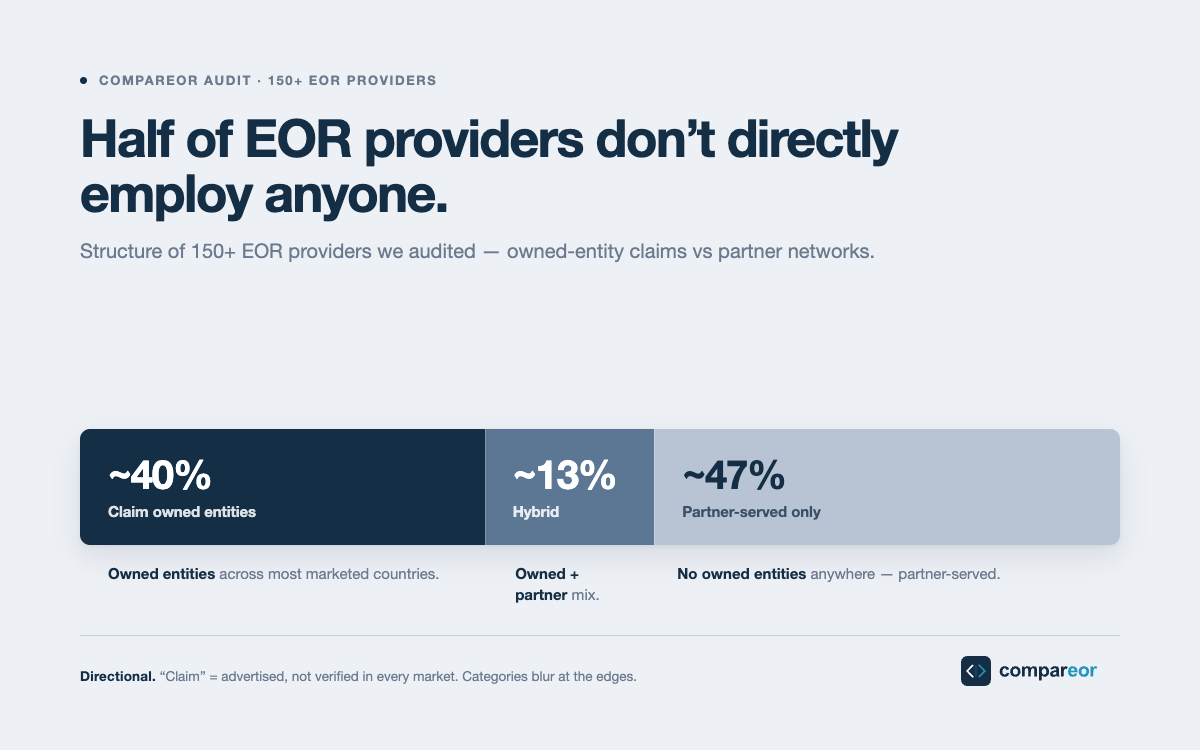
About 40% of EOR providers I audited claim and substantiate owned entities across most of their marketed countries. About 12 to 15% run an honest hybrid. About 45 to 50% are partner-served only, with no owned entities anywhere. The numbers, the methodology, the one honest caveat, and what they mean for buyers.


June 3, 2026
6 min read
Every EOR contract has an expiration date
The EOR model has a built-in expiration date, somewhere between 15 and 20 employees in one country. Past that threshold, the EOR stops being the cheapest option and starts being a tax on growth. Most companies miss it for a year or more, because the contract doesn't mention it and nobody inside is responsible for noticing.

May 25, 2026
5 min read
Why "150+ countries" is the most misleading number in global employment
Every EOR homepage leads with a country count, and after auditing 150+ providers it's the number most likely to lead you to the wrong choice. Coverage comes in three forms, and depth in your countries matters more than breadth across 185 of them.
Stay Updated on Global Hiring
Get weekly insights on EOR trends, compliance updates, and cost-saving strategies

Find a better EOR — without risk
Compare EOR providers to gain insights on cost, coverage, and contract flexibility, ensuring compliance and payroll continuity.


.png)
.png)



