
The 10 Fastest Countries to Onboard an Employee Through EOR
Onboarding speed varies enormously by country. Here are the 10 fastest — and what makes them quick.


.png)
Why onboarding speed matters
When you've found the right candidate, delay is expensive. Each extra week of onboarding increases the probability the candidate accepts a competing offer, delays the ramp-up of revenue-generating work, and creates frustration for the hiring manager — who has already spent 40–80 hours running the search. For revenue-bearing roles in particular, the hidden cost of slow onboarding typically runs five to ten times the cost of the EOR itself.
Onboarding speed through an Employer of Record (EOR) varies enormously by country. In the fastest markets — UAE, Singapore, the UK, the US — a well-prepared hire can be on payroll in 1–3 working days. In the slowest — China, Brazil, France, India — the same hire can take 2–6 weeks end-to-end. Knowing where in that spectrum your target country sits is the difference between a credible "start Monday" offer and a painful four-week delay that can lose you the candidate.
This guide ranks the ten fastest EOR onboarding markets in 2026, explains what makes each fast, and flags the slower markets to plan around. For a shortlist of providers that specialise in quick starts, see the top 10 EOR providers with fastest onboarding.
What actually determines onboarding speed
Onboarding speed is not a pure function of the provider. Five variables interact:
- Statutory registration timelines: how long the tax and social security authorities need to register a new employment relationship. In digitally mature markets this is near-instant; in paper-based systems it can take weeks.
- Employment contract complexity: some jurisdictions mandate multi-party approval, collective agreement alignment, or mandatory medical examinations before start date.
- Document collection: passport, right-to-work evidence, bank details, qualifications. The candidate's responsiveness here is a major swing factor.
- Provider readiness: whether the EOR has an owned entity in the country (fast) or relies on a local partner (slower), and how automated their onboarding workflow is.
- Visa or work permit: if the candidate is a foreign national needing sponsorship, the visa timeline dominates and often doubles or triples the end-to-end timeline regardless of the onshore onboarding speed.
The rankings below assume a local candidate with the right to work in their country of employment. Visa-sponsored hires follow a different clock.
The 10 fastest EOR onboarding markets in 2026
1. United Arab Emirates — 1–3 days
The UAE combines a well-developed EOR provider ecosystem, the Ministry of Human Resources and Emiratisation (MOHRE) digital worker registration system, and an employer-friendly legal framework. Most providers can onboard a standard role in three business days, and in Dubai and Abu Dhabi free zones same-day employment contracts are common once the visa is live. Post-January 2025, the federal health insurance mandate adds a certificate step, but experienced providers run this in parallel with the rest of onboarding. See the UAE country guide and the UAE 2025 health insurance update.
2. Singapore — 2–3 days
Singapore's Ministry of Manpower (MOM) systems and the CPF Board's digital employer registration enable very fast onboarding for citizens and permanent residents — typically 2–3 business days. For Employment Pass (EP) or S Pass foreign-national hires, the end-to-end timeline extends to 2–4 weeks because the work pass approval sits with MOM's processing queue. For providers with strong visa support, see the top EOR providers for visa and immigration support and the Singapore country guide.
3. United States — 1–3 days
For EOR providers with existing state payroll registrations, US onboarding is among the fastest globally. Federal identifiers (EIN, I-9, W-4) and state payroll accounts are typically pre-established, leaving only the candidate-specific onboarding. In states where the provider has not previously registered, add 1–2 weeks for state account setup on top of the 1–3 day baseline. For provider shortlists see the top 10 EOR providers for the US and the US country guide.
4. United Kingdom — 2–4 days
HMRC PAYE registration is fast, the Real Time Information (RTI) filing system accepts new employees within hours, contracts follow well-established statutory templates, and all major EOR providers have mature UK operations. For IR35-driven contractor-to-employee conversions, the conversion itself is typically same-week. See the UK country guide and IR35 in 2026.
5. Canada — 2–4 days
Similar to the US, Canada's provincial payroll registration and CRA payroll account setup are fast when the provider is already registered in the province. Quebec adds extra steps (CNESST, Quebec-specific payroll deductions via Revenu Québec), which can extend the timeline by 1–2 days for first-time Quebec hires. English-language contracts are standard outside Quebec.
6. Kenya — 3–5 days
Kenya is the fastest EOR onboarding market in Africa. KRA (Kenya Revenue Authority) PAYE employer registration, NSSF (National Social Security Fund), NHIF (now SHIF) registration, and HELB contribution setup are all digital and fast. The Employment Act framework is clear, English-language contracts are standard, and experienced providers can onboard in 3–5 business days. See the Kenya country guide.
7. Philippines — 3–5 days
BIR (Bureau of Internal Revenue) tax registration and SSS / PhilHealth / Pag-IBIG social contribution filings are well-understood by experienced providers, and the semi-monthly payroll cycle is standard. Labour Code compliance — 30-day notice, 13th-month bonus accrual, statutory 5-day incentive leave — is baked into provider templates. See the Philippines country guide.
8. South Africa — 3–5 days
SARS PAYE registration, UIF (Unemployment Insurance Fund), and SDL (Skills Development Levy) setup are fast and fully digital. Employment contracts are straightforward in English, the Basic Conditions of Employment Act provides a clear statutory baseline, and the bargaining council layer (where applicable) is well-documented. See the South Africa country guide.
9. Netherlands — 3–5 days
Belastingdienst loonheffingen (wage tax) registration is fast, the employment framework is clear and employee-protective without being procedurally heavy, and experienced providers operate local Dutch entities. For EU-national hires, no visa step is required, so the 3–5 day end-to-end timeline holds consistently. This makes the Netherlands the fastest EU onboarding market alongside the UK and Ireland.
10. Poland — 4–7 days
Polish ZUS (Zakład Ubezpieczeń Społecznych) social insurance registration, PIT-4R payroll tax setup, and the mandatory occupational health examination (BHP badanie lekarskie) combine to a 4–7 day baseline. Contracts must be in Polish, but provider templates are well-established and dual-language versions are standard. For larger tech talent plans, see the Poland country guide.
The slowest markets to plan for
At the other end of the spectrum, four markets regularly produce 2–6 week onboarding timelines. Factor this into offer letters and start dates:
China — 2–4 weeks
Foreign company hiring in China almost always runs through an EOR or FESCO partner (direct employment is not permitted without a wholly-owned entity). Written contracts are mandatory within one month of work commencement under PRC Labour Contract Law. Social insurance registration varies city-by-city, hukou considerations can affect benefits, and data localisation restrictions complicate cross-border HR processes. See the China country guide.
Brazil — 2–4 weeks
Brazilian onboarding runs through eSocial (the unified federal digital payroll system), CLT employment contract drafting (in Portuguese), and mandatory occupational health examination (ASO) before start date. Every step is well-defined but cumulative — a full onboarding rarely completes under two weeks. See why Brazil's CLT makes EOR essential and the Brazil country guide.
India — 1–2 weeks
EPFO (Employees' Provident Fund) registration, ESIC (Employees' State Insurance Corporation) enrolment, state-specific Professional Tax registration, and PAN/UAN linkage combine to a 7–14 day baseline in most states. Some states (Karnataka, Maharashtra, Delhi) are faster; others (West Bengal, Tamil Nadu) run longer. Document collection for Indian hires also tends to run slower than comparable markets. See the India country guide.
France — 1–2 weeks
France's Déclaration Préalable à l'Embauche (DPAE) is fast, but the Déclaration Sociale Nominative (DSN) setup, the mandatory pre-employment medical visit (visite d'information et de prévention), and collective bargaining agreement alignment combine to a 1–2 week timeline. For senior hires with equity or complex comp structures, add another week. See the France country guide and the true cost of hiring in France.
Germany — 1–2 weeks
Germany's social insurance registration (krankenkasse, pension, unemployment), Lohnsteuer tax card issuance, and works-council consultation (where applicable — see the works-council guide) combine to a 1–2 week baseline. For hires joining an existing team with a Betriebsrat, add the consultation window.
How to accelerate onboarding in any market
Even in the slower markets, preparation materially shrinks the timeline. Five practical levers:
- Collect candidate documents in parallel with the offer. Passport scan, bank account, right-to-work evidence, tax identifiers, educational certificates where required. The single biggest source of slippage is waiting on one missing document.
- Confirm the provider has an owned entity in the country. Owned-entity markets onboard faster than partner-operated ones because the provider owns the entire registration chain. Ask explicitly during evaluation — see the 12 evaluation questions.
- Pre-clear the compensation structure. Complex equity, bonus, or commission structures generate multiple rounds of contract review. Agree the total comp structure before asking the EOR to draft.
- Schedule the pre-employment medical early. In France, Germany, Poland, and Brazil, the mandatory medical is a common critical-path step. Book it the day the candidate signs the offer.
- Align the start date with payroll cut-off. Starting two days after payroll cut-off creates a full-cycle delay in the first paycheque. Align start dates with the provider's payroll calendar to avoid the artificial delay.
Choosing an EOR provider for speed
All EOR providers claim fast onboarding; few deliver it consistently across 10+ markets. When speed is a top-three criterion, probe the following during evaluation:
- Median onboarding time, not headline time. Ask for the 90th percentile, not the best-case — the tail is where candidate-loss happens.
- Owned-entity coverage for your target countries. Partner-operated markets carry handoff friction that adds 2–5 business days on average.
- Document automation. Leading providers use in-app workflows that collect candidate documents asynchronously and trigger downstream registrations automatically. Manual email back-and-forth adds days.
- Dedicated onboarding specialist. Tier-1 providers assign a named onboarding owner per hire. Tier-2 providers route each step through a ticket queue that slows escalations.
- Same-day payroll addition for late cases. Ask whether the provider can add an employee to an existing payroll cycle mid-month, or only at the start of the next cycle.
For the curated shortlist, see the top 10 EOR providers with fastest onboarding, and benchmark candidates side-by-side using the comparison tool and the EOR selection checklist.
Speed in context: the broader EOR landscape
Onboarding speed is one of several dimensions to weigh. For the broader view of what EOR actually costs, see how much EOR really costs by country and hidden fees in EOR contracts. For structuring a multi-country team, see how to build a remote team across 5 countries without setting up entities. For the broader 2026 regulatory context, see the 7 labor law changes in 2026 that affect global hiring.
Frequently asked questions
What's the absolute fastest possible EOR onboarding?
Same-day onboarding is achievable in UAE free zones, Singapore for citizens/PRs with all documents pre-collected, and some US states for providers with established payroll registration. The 24-hour figure quoted in marketing typically refers to contract signing, not first paycheque — the payroll cycle adds up to two additional weeks depending on cut-off dates.
Does onboarding speed depend on the EOR provider or the country?
Both. Country-level statutory timelines set the floor. Provider-level infrastructure (owned entities, automation, document workflows) determines whether the real-world timeline hits the floor or runs 2–3x longer. The gap between the fastest and slowest providers in the same country is typically 3–10 business days.
Are visa-sponsored hires slower?
Yes, significantly. Visa processing sets the dominant timeline — 2–8 weeks depending on the country and visa class. The UAE (1–3 weeks for employment visas) and Singapore (2–4 weeks for Employment Pass) are among the fastest; the UK Skilled Worker visa, US H-1B, and most European work permits run 4–12 weeks.
Can I start an employee before the formal onboarding completes?
Generally no. In most jurisdictions, the employee must be registered with the tax and social security authorities before the first day of work, or the employer risks backdated contribution penalties, fines, and employee claims for unregistered work. The narrow exceptions are US states where the employee can start on day one with payroll registration completed in parallel.
What's the cost of a week of onboarding delay?
For a revenue-bearing role, typically 2–5% of annual total cost — salary plus opportunity cost of delayed ramp. For a €100K-salary role in Europe, a one-week delay is €3K–€5K of real cost, not counting the increased probability of candidate loss to a competing offer.
Bottom line
Onboarding speed is a country-level question first and a provider-level question second. If your hiring plan includes the UAE, Singapore, the US, the UK, Canada, or the Netherlands, expect to be on payroll inside a week. If it includes China, Brazil, India, France, or Germany, plan for two to four weeks and set candidate expectations accordingly.
Choose a provider with owned-entity coverage in your target countries, strong document automation, and a named onboarding owner per hire. Benchmark options on the Compareor comparison tool, start the fastest-onboarding provider shortlist, and work through the selection checklist before you sign.
Get your shortlist
Takes ~3 minutes. No account needed.
June 3, 2026
6 min read
I checked the structure of 150+ EOR providers. Here's how many actually own their entities.
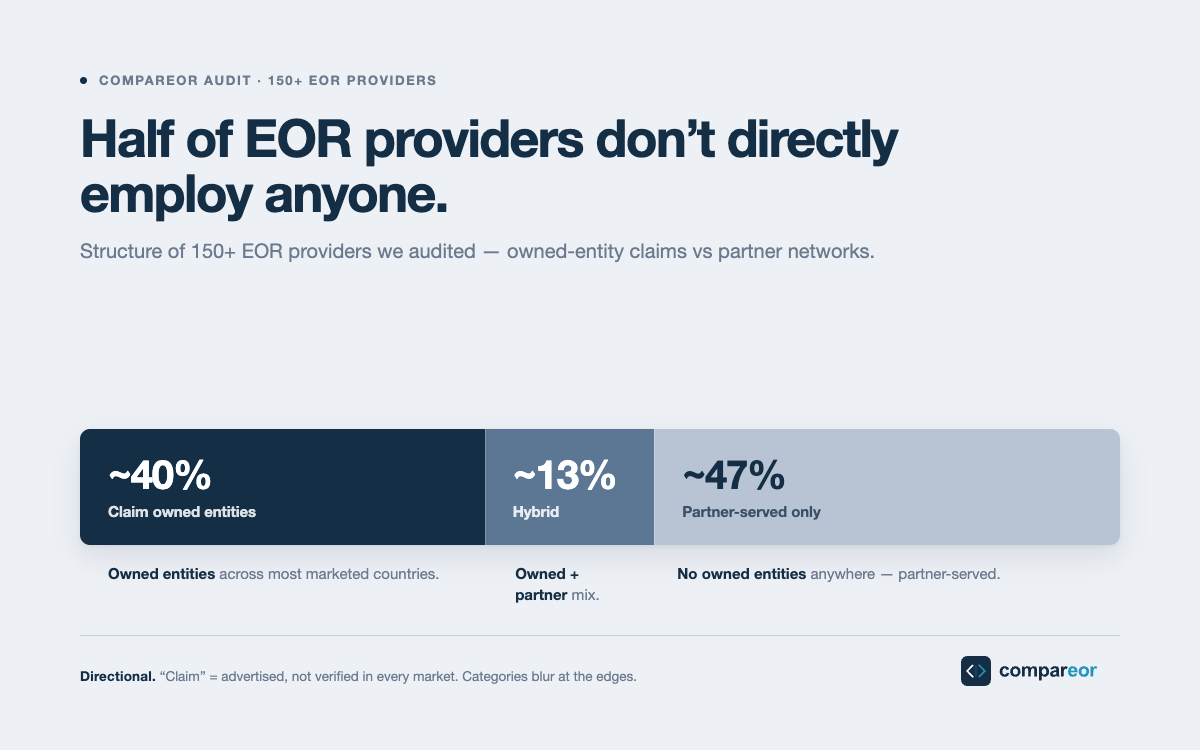
About 40% of EOR providers I audited claim and substantiate owned entities across most of their marketed countries. About 12 to 15% run an honest hybrid. About 45 to 50% are partner-served only, with no owned entities anywhere. The numbers, the methodology, the one honest caveat, and what they mean for buyers.


June 3, 2026
6 min read
Every EOR contract has an expiration date
The EOR model has a built-in expiration date, somewhere between 15 and 20 employees in one country. Past that threshold, the EOR stops being the cheapest option and starts being a tax on growth. Most companies miss it for a year or more, because the contract doesn't mention it and nobody inside is responsible for noticing.

May 25, 2026
5 min read
Why "150+ countries" is the most misleading number in global employment
Every EOR homepage leads with a country count, and after auditing 150+ providers it's the number most likely to lead you to the wrong choice. Coverage comes in three forms, and depth in your countries matters more than breadth across 185 of them.
Stay Updated on Global Hiring
Get weekly insights on EOR trends, compliance updates, and cost-saving strategies

Find a better EOR — without risk
Compare EOR providers to gain insights on cost, coverage, and contract flexibility, ensuring compliance and payroll continuity.


.png)
.png)



