
How to Evaluate an EOR Provider — 12 Questions to Ask Before Signing
Most EOR contracts have traps in the fine print. Here are the 12 questions every buyer should ask before committing to a provider.


.png)
Why provider selection matters more than price
The wrong Employer of Record (EOR) provider doesn't just cost more — it creates real operational damage: compliance gaps, payroll errors, slow terminations, unresponsive support in the specific jurisdictions that matter most to you, and switching costs that can reach six figures if you need to migrate mid-contract. Across the hundreds of procurement conversations we've tracked on Compareor, the single biggest determinant of a good EOR engagement is not headline price — it's the quality of the diligence before signing.
Most buyers anchor on the monthly fee and ask maybe three or four questions beyond it. That's the wrong approach. Headline prices across the top 10 global providers in 2026 cluster tightly in the $500–$800/month range; the structural differences that define your 3-year experience sit elsewhere — in entity coverage, liability allocation, FX policy, termination process, support model, and contract exit terms.
This guide walks through the 12 questions that actually matter in EOR procurement. Take them into every demo, require written answers to the ones that carry contract weight, and compare answers side by side on the Compareor comparison tool. For structural cost framing, pair this with our EOR pricing models explained guide; for contract-level audit, use the EOR Contract Audit Checklist.
Coverage and entity model
1. Do you own entities in my target countries, or do you use local partners?
This is the single most important coverage question. Owned-entity providers generally offer higher compliance certainty, faster onboarding, cleaner handoffs on terminations, and direct liability with the provider rather than a third-party partner. Partner-reliant providers are often cheaper but add a layer of risk and typically slower dispute resolution.
What a good answer looks like: a clear per-country split ("we have owned entities in X, Y, Z countries on your list; partner coverage in A and B; here are the specific partners we use"). Red flag: vague answers, inability to produce the entity model per country in writing, or a provider that describes all coverage as "owned" when the operating reality is partner-based.
2. What percentage of your business comes from the countries most important to me?
A provider that does 90% of its volume in the US may not be the right fit for Southeast Asia hiring, even if the headline country count is impressive. Concentration is a better signal of operational depth than total country count.
What a good answer looks like: specific volume indicators per country — number of active employees, tenure of the local team, length of operating history in that specific market. Ask to speak to a customer reference in your two most important countries.
3. Can you show me a sample employment contract for my target country before I sign?
The sample contract is the single most useful artifact you can pull during diligence. It reveals the provider's local compliance depth, contract quality, and translation discipline. Strong providers will share redacted samples willingly; weaker providers stall or share generic templates that haven't been localised.
What a good answer looks like: same-day delivery of a country-specific sample, properly translated, reflecting local statutory requirements. Red flag: a generic global template with the country name pasted in the header.
Pricing and hidden costs
4. Is your fee a flat rate or a percentage of salary?
Percentage-of-salary models become structurally expensive as salaries scale. On a $15,000/month senior engineer, a 10% percentage fee is $1,500/month — nearly 3x a flat-fee equivalent for the same service. Flat fees are the modern default for good reason. See our dedicated guide to EOR pricing models for the full breakdown and breakeven math.
What a good answer looks like: flat per-employee-per-month fee with clear volume tiers. Red flag: percentage-of-salary pricing on senior hires; hybrid models with undefined uplifts.
5. Do you charge a markup on FX conversion?
This is the largest hidden cost in most EOR contracts. A 2% markup on a $5,000/month employee is $1,200/year. Multiply across 20 employees and that's $24,000/year in cost that never appears on an invoice line item.
What a good answer looks like: mid-market interbank conversion with no markup, in writing. Benchmark against the EOR providers with best multi-currency payroll and the EOR providers with transparent pricing. Red flag: "prevailing exchange rate" language with no reference benchmark.
6. What are your offboarding fees, and have your rates changed year-over-year?
Offboarding fees of $200–$500 per employee are common. In complex termination markets (Germany, France, Brazil) some providers add $500–$1,500 in local compliance management fees. Pricing history is an equally useful signal — providers that consistently raise rates 5–8% annually are expensive customers to stay with.
What a good answer looks like: explicit offboarding schedule, country-by-country, and a pricing history showing CPI-linked or flat renewals over the last 2–3 years. Red flag: "at our discretion" language on escalators; undefined local compliance charges. See the full checklist in our hidden fees in EOR contracts guide.
Compliance and liability
7. Who bears liability if an employment claim is filed?
The answer should be the EOR — not you. Employment claims (wrongful termination, unpaid wages, misclassification, discrimination) should sit with the legal employer, which is the EOR. Your liability should be limited to reimbursement obligations defined in the contract, not primary exposure.
What a good answer looks like: primary liability for employment claims sits with the EOR, with specific carve-outs clearly defined. Red flag: broad indemnification language pushing employment claim liability back to you; vague "mutual liability" framing.
8. How do you handle terminations, and what is your disputed dismissal track record?
Terminations are the highest-risk moment in any EOR engagement. Process quality varies materially — particularly in high-severance jurisdictions (Germany, France, Brazil, Mexico, Colombia) where mis-executed terminations can trigger reinstatement claims or multi-year litigation exposure.
What a good answer looks like: documented process per country, typical timelines (including statutory notice and consultation windows), and transparent disclosure of disputed dismissal volume. Strong providers will share aggregated data on termination outcomes; weaker providers deflect. For country-specific context see our Germany works council guide and Brazil CLT guide.
9. How do you communicate changes in local labour law to clients?
Labour law changes constantly — the UK raised employer NI from 13.8% to 15% in April 2025, France revises URSSAF rates annually, the UAE extended mandatory health insurance across all emirates from 2025. Your EOR should be the early-warning system for these changes, not the source of a surprise invoice six months later.
What a good answer looks like: documented regulatory update process, client-facing communication cadence (typically monthly or quarterly), and named compliance leads per country. Red flag: reactive "we'll tell you when there's a change" framing. For current regulatory shifts see our 2026 labour law changes overview.
Service and technology
10. What is your average onboarding time in my target countries?
Time-to-first-payroll is the most concrete SLA signal an EOR can give. In owned-entity markets, best-in-class providers deliver 1–3 business days (UAE: 1 day; Singapore: 2 days; UK: 2 days). In partner-coverage markets, 5–10 business days is typical. Providers with much longer quoted times usually have operational friction you should surface early.
What a good answer looks like: country-specific onboarding times, ideally backed by customer reference verification. See EOR providers with fastest onboarding and the 10 fastest countries to onboard through EOR.
11. Do I have a dedicated account manager, or is support ticket-based?
Support model is where the experience gap between providers opens up most visibly. Above ~10 seats, a dedicated CSM should be standard. Below that, support is typically ticket-based — which is fine if response SLAs are strong and weak if they aren't. Benchmark against the EOR providers with best customer support ranking.
What a good answer looks like: named CSM at your contract size, documented SLA (e.g. "same-day response for priority 1 issues, 24 hours for priority 2"), and a clear escalation path. Red flag: "support portal only" framing for a contract above 5 seats.
12. What is your notice period if I want to leave, and what are the offboarding terms?
Exit terms are where the worst surprises hide. Many EOR contracts require 60–90 days notice to cancel, some require 180 days, and all auto-renew if the notice window is missed. Minimum commitments and per-employee offboarding fees stack on top. Exit friction is the single best predictor of provider quality — strong providers make it easy to leave because they don't need to lock you in.
What a good answer looks like: 30–60 day notice, no minimum commitment, transparent per-employee offboarding fees, and a documented transition process. Benchmark against the EOR providers with no annual contract. For the transition playbook itself see how to switch EOR providers without disrupting payroll.
How to use the answers
Collect written answers to all 12 questions from every provider on your shortlist, then compare side-by-side. Three structural tips that materially improve evaluation quality:
- Score on consistency, not just content. Providers that give the same answer across demo, contract, and customer reference are operationally reliable. Providers whose demo answers don't match their contract language are the ones who will surprise you at scale.
- Test on your two most important countries, not all of them. Deep diligence on your top-priority markets beats shallow diligence on all 15 countries. Concentrate your effort.
- Ask for one customer reference per country that you get to pick from a list, rather than one reference the provider chooses. This is the single most useful data point in EOR diligence.
Red flag patterns across the 12 questions
Certain answer patterns should trigger a deeper look or a different provider:
- "We can get back to you on that" appearing on coverage, FX, or liability questions. These are table-stakes questions that every competent provider has rehearsed answers for.
- Verbal commitments that don't match the contract draft. The contract is the source of truth — if the sales team is promising above the paper, expect the paper to rule.
- "Confidential" as an answer to pricing history, termination volume, or disputed dismissal outcomes. These are reasonable diligence topics at enterprise scale.
- Pressure tactics to sign inside a limited window. Strong providers don't need to force the timeline.
Frequently asked questions
How long should EOR procurement take?
For a single-country first-hire use case, 2–3 weeks is realistic — enough time to run 2–3 demos, pull sample contracts, and close terms. For a multi-country deployment (3+ countries), plan on 4–8 weeks including reference calls and legal review. Anything faster than two weeks typically means something was skipped.
Should I issue a formal RFP or is a structured diligence enough?
For contracts under 25 seats, a structured diligence using these 12 questions is typically sufficient. Above 25 seats or for enterprise deployments, a formal RFP helps standardise responses across multiple providers and creates the paper trail that procurement teams need. Either way, the 12 questions above should form the spine of the evaluation.
How many EOR providers should I evaluate?
Three is the right number for most teams — one global incumbent, one strong alternative, and one regional specialist if relevant to your country mix. More than three adds evaluation time without usually improving the outcome; fewer than three leaves you without real comparison.
What's the biggest red flag during an EOR sales process?
Inability to produce a sample employment contract for your target country within 48 hours. That single data point correlates more strongly with operational quality than any headline feature claim. Competent providers produce this artifact same-day.
Should I sign a longer contract to get a better rate?
Usually not, unless you have strong conviction about your country strategy for the full commitment term. The cost saving on a 2-year commitment is typically 5–15% off the 1-year rate; the switching cost if the provider underperforms in year one can easily exceed that. Prefer flexibility at the start of the relationship — then extend once you have real operating data.
Bottom line
Good EOR procurement is a 12-question diligence, not a price comparison. Ask every question on the list above, require written answers to the ones that carry contract weight, and compare side-by-side. The provider that gives the best answers on coverage, liability, FX, termination, and exit terms will deliver a materially better 3-year experience than the provider that gives the cheapest headline price.
Run your shortlist side-by-side on the Compareor comparison tool, and walk through the EOR Contract Audit Checklist the day you receive a draft agreement. Sixty minutes of structured diligence at signing saves tens of thousands of dollars — and significantly more operational pain — over the life of the contract.
Get your shortlist
Takes ~3 minutes. No account needed.
June 3, 2026
6 min read
I checked the structure of 150+ EOR providers. Here's how many actually own their entities.
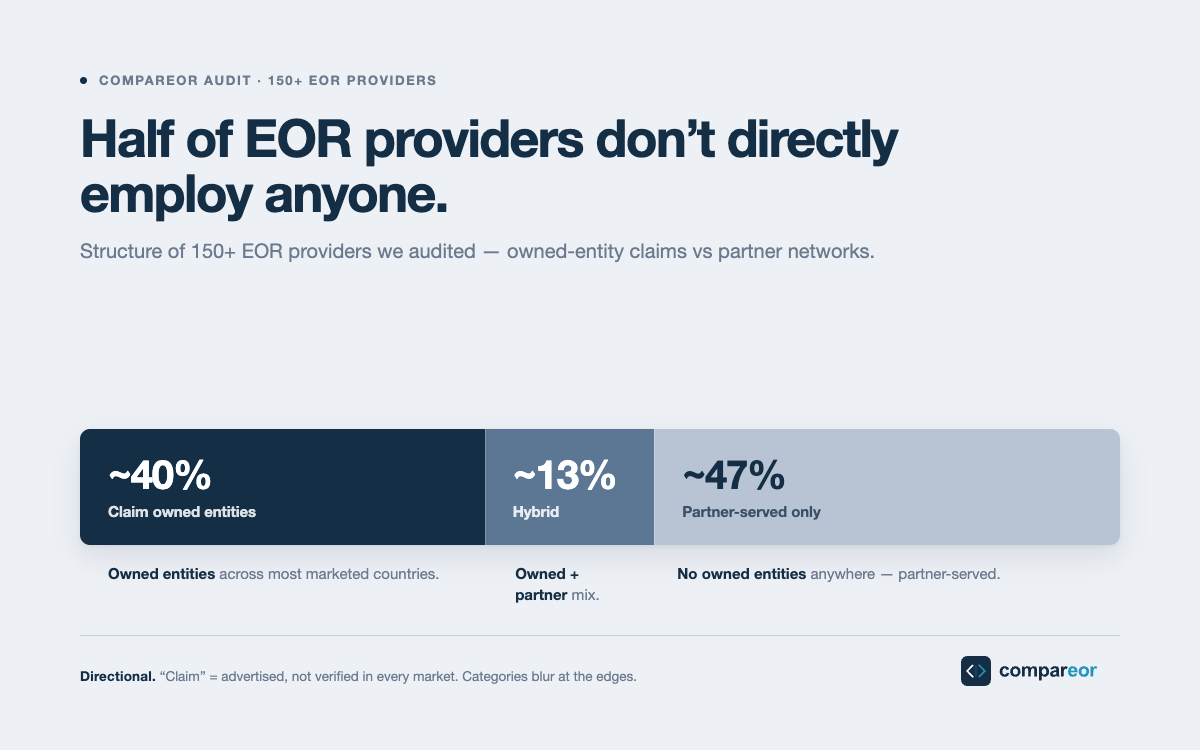
About 40% of EOR providers I audited claim and substantiate owned entities across most of their marketed countries. About 12 to 15% run an honest hybrid. About 45 to 50% are partner-served only, with no owned entities anywhere. The numbers, the methodology, the one honest caveat, and what they mean for buyers.


June 3, 2026
6 min read
Every EOR contract has an expiration date
The EOR model has a built-in expiration date, somewhere between 15 and 20 employees in one country. Past that threshold, the EOR stops being the cheapest option and starts being a tax on growth. Most companies miss it for a year or more, because the contract doesn't mention it and nobody inside is responsible for noticing.

May 25, 2026
5 min read
Why "150+ countries" is the most misleading number in global employment
Every EOR homepage leads with a country count, and after auditing 150+ providers it's the number most likely to lead you to the wrong choice. Coverage comes in three forms, and depth in your countries matters more than breadth across 185 of them.
Stay Updated on Global Hiring
Get weekly insights on EOR trends, compliance updates, and cost-saving strategies

Find a better EOR — without risk
Compare EOR providers to gain insights on cost, coverage, and contract flexibility, ensuring compliance and payroll continuity.


.png)
.png)



