
Every EOR contract has an expiration date
The EOR model has a built-in expiration date, somewhere between 15 and 20 employees in one country. Past that threshold, the EOR stops being the cheapest option and starts being a tax on growth. Most companies miss it for a year or more, because the contract doesn't mention it and nobody inside is responsible for noticing.


.png)
The choice nobody flags
Most people think the choice with an EOR is which provider to use. The bigger choice, and the one nobody flags, is how long to use one.
The EOR model has a built-in expiration date. It's a headcount threshold in a specific country, not a date on the contract. On one side of the threshold, the EOR is the cheapest way to employ people. On the other side, you're paying a meaningful premium versus just opening your own entity. The threshold sits somewhere between 15 and 20 employees in one country for most markets, and most companies pass it without noticing.
This post is about that threshold. Why it exists, why nobody flags it, and what actually happens when you decide to cross.
The math is more mechanical than it looks
EOR fees are per employee per month, fixed. Your EOR cost scales linearly with your headcount in a country. Twenty people in one country costs twenty times what one person in that country costs.
Entity costs work the opposite way. Setting up your own legal entity has a high fixed cost (legal, registration, accounting setup, banking) and a low marginal cost per employee after that. Whether you have ten employees in the entity or fifty, the entity itself costs about the same to run.
At low headcount, the EOR wins. The fixed entity costs don't amortize. At high headcount, the entity wins. The per-employee EOR fees compound.
Where does the crossover sit? It varies by country, but for most markets, around 15 to 20 employees. In heavy-statutory markets where EOR fees run higher, the crossover can be as low as 10 to 12. In light-friction markets where entity setup is faster and ongoing overhead is lower, it can be closer to 25 or 30.
I won't put exact numbers on every country, because the math depends on which provider you're with and which entity setup partner you'd use. But the directional pattern holds across the audits I've run. Somewhere between 10 and 30 in any given country, the line crosses.
Why most companies pay an EOR longer than they should
Three reasons.
The EOR contract doesn't mention the crossover. The provider has no incentive to flag the moment you've outgrown them. Quite the opposite. The longer you stay past the crossover, the more revenue they collect.
The operational pain of transitioning feels bigger than the financial cost of staying. Setting up an entity, hiring a local accountant, moving employees onto new contracts, all of that feels like a project. The monthly EOR invoice feels like a recurring expense you've already absorbed.
And nobody inside the company is responsible for noticing. HR sees the EOR as a vendor that's working. Finance sees the invoices but doesn't usually model the alternative cost of running an entity. The decision to leave never makes it onto anyone's plate until someone runs the math or a budget pressure forces it.
The result is that a lot of companies are paying an EOR for headcount that, on a fully-loaded basis, has been past the crossover for a year or more.
The transition is harder than it looks
This is where the work actually is.
Entity setup is the visible part. It takes four to six months in most markets, longer in some. Legal registration, tax registration, bank account, payroll vendor, local accounting. Each step is sequential and country-specific. You can't run them all in parallel without a local advisor.
The harder part is what happens to the people. Your employees are currently employed by the EOR, not by you. Moving them onto your direct payroll is a legal transfer. In some countries, it requires explicit employee consent. In others, the transfer is treated as a termination by the old employer and a new hire by the new one, which has severance implications. Get the structure wrong and you create severance liabilities where none existed before.
Then there's continuity. Benefits, payroll dates, tenure for severance purposes, statutory contributions. All of it has to carry across the transition without gaps. A bad transfer triggers labor disputes and tax issues that cost more than the EOR savings would have.
This is why most companies don't try. The math says move. The risk says stay. So they pay the EOR another year.
This is where depth becomes a strategic input
There's a thread here that connects to a broader point about how to think about EORs.
The country count on EOR homepages tells you breadth. The headcount you have in any one country tells you depth. The breadth number drives the procurement conversation up front. The depth number drives the exit conversation later. Both matter at different stages.
A company with one or two people across thirty countries will probably stay on an EOR forever, and rightly so. The math never crosses. A company building real teams in its top three or four markets will hit the crossover in those markets within a couple of years, and the EOR model that worked at the start will quietly stop being the right structure.
The countries you should be most thoughtful about are the countries you have depth in, not the breadth count on the homepage.
The signals that say it's time to model the move
A short list to keep on hand.
Headcount in one country has crossed 15.
Your hiring plan in that country shows continued growth for the next 12 to 18 months.
The fully-loaded per-employee cost (gross plus statutory plus benefits plus EOR service fee plus FX spread) is above 7,000 to 8,000 dollars a year, and rising.
You expect to be in that market for years, not quarters.
If three or four of those are true for a specific country, you're past the cost crossover, and the next move is to build the model. Three years of EOR fees against three years of running your own entity, including the migration cost. The model takes a couple of days. The decision flows from the model.
The takeaway
The EOR model is a great place to start. It's a worse place to stay in any country where you've built real depth.
I'll have more to say about how the migration actually goes in a follow-up, including what gets miscoded in the transfer and how the better operators handle it. For now, the question worth asking inside your company is simple. Which countries have we crossed 15 in, and have we modeled the alternative.
I run Compareor, an independent comparator for EOR providers. Increasingly we also help people figure out when to leave their EOR, and how to handle the transition without breaking things. If that's where you are, that's what we're for.
Get your shortlist
Takes ~3 minutes. No account needed.
June 3, 2026
6 min read
I checked the structure of 150+ EOR providers. Here's how many actually own their entities.
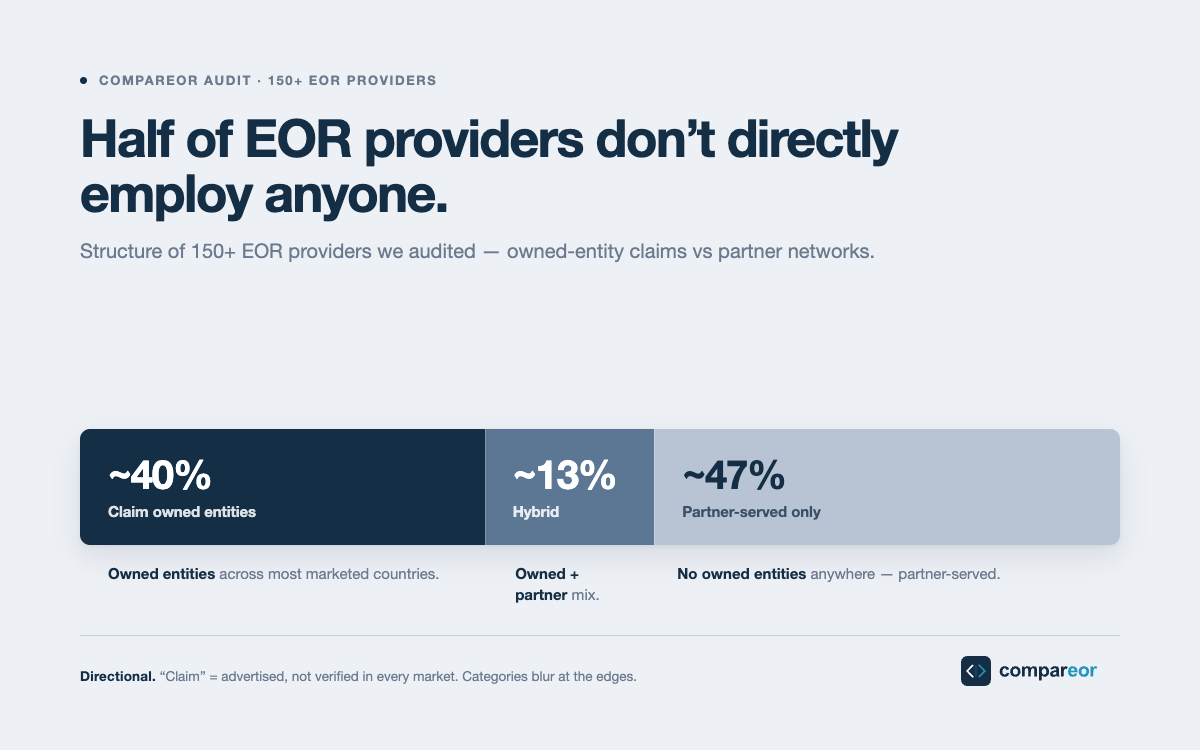
About 40% of EOR providers I audited claim and substantiate owned entities across most of their marketed countries. About 12 to 15% run an honest hybrid. About 45 to 50% are partner-served only, with no owned entities anywhere. The numbers, the methodology, the one honest caveat, and what they mean for buyers.


May 25, 2026
5 min read
Why "150+ countries" is the most misleading number in global employment
Every EOR homepage leads with a country count, and after auditing 150+ providers it's the number most likely to lead you to the wrong choice. Coverage comes in three forms, and depth in your countries matters more than breadth across 185 of them.

May 14, 2026
13 min read
FX Markup: The EOR Fee No One Discloses on Sales Calls
Of the seven cost layers in a typical EOR contract, FX markup is the most opaque — and on a 20-employee team, it costs more per year than the negotiated service-fee discount. Provider benchmarks from Deel (0%) to legacy providers (5%+), plus the contract redline that locks the spread.
Stay Updated on Global Hiring
Get weekly insights on EOR trends, compliance updates, and cost-saving strategies

Find a better EOR — without risk
Compare EOR providers to gain insights on cost, coverage, and contract flexibility, ensuring compliance and payroll continuity.


.png)
.png)



