
Globalization Partners vs Oyster — Compliance or Cost?
Two of the market's most established mid-tier EOR providers compared — G-P's compliance depth versus Oyster's cost accessibility.


.png)
Two different market positions
Globalization Partners (G-P) and Oyster are both credible choices in the mid-market Employer of Record (EOR) category — and in most shortlists we see, they sit side-by-side. But the two providers were built in different eras, for different buyers, and the gap between them shows up exactly where buying decisions are made: compliance depth vs pricing transparency, enterprise infrastructure vs modern UX, negotiated contracts vs self-serve. The right answer depends far less on feature parity than on which of those axes matters most for your team.
This head-to-head compares G-P and Oyster on pricing, country coverage, platform experience, compliance posture, and who each provider is genuinely best for in 2026. For a broader benchmark, you can pull both providers into the Compareor side-by-side comparison tool alongside Deel, Remote, or Multiplier. And if you're still at the stage of pressure-testing the EOR decision itself, start with 12 questions to ask before signing any EOR.
Globalization Partners at a glance
G-P was one of the first EOR providers to operate at global scale and has been in-market for over a decade. It operates in 180+ countries, with owned entities in the vast majority of high-volume jurisdictions, and has processed hundreds of thousands of employment relationships — a compliance track record that remains a differentiator against newer entrants. The company serves a large share of the Fortune 500 and positions itself squarely as the enterprise-grade choice. It holds a 4.4/5 rating on the Compareor editorial scorecard — see the full profile on the G-P provider page.
Pricing and contract model
G-P's published starting rate is $699/month per employee, but in practice most G-P contracts are custom-priced for volume, country mix, and specific compliance requirements. The model is built around enterprise procurement — longer-term commitments, negotiated MSAs, and dedicated account coverage. That's a strength for large buyers with the volume to command favourable terms, and a weakness for smaller teams who want a simple self-serve price.
The line items to surface early in any G-P negotiation — same as with any enterprise EOR — are minimum commitment terms, annual escalators, benefits administration on top of the headline rate, FX markup, and offboarding fees. None of these are unusual, but all are negotiable above 10 seats. Our guide to hidden fees in EOR contracts covers the full checklist, and for the structural pricing framing see EOR pricing models explained.
Platform and compliance posture
G-P Meridian, the company's platform, is feature-rich and compliance-heavy. It includes country-level playbooks, audit-ready documentation, benefits configuration, equity workflows, and a dedicated compliance layer that surfaces requirements per jurisdiction. It is more complex than newer UX-first platforms — but the complexity maps directly onto what enterprise compliance teams actually use. For buyers who need SSO, SOC 2 documentation, custom SLAs, and dedicated CSM coverage, G-P fits naturally. G-P appears in our ranking of the top 10 EOR providers for enterprise companies.
Oyster at a glance
Oyster launched in 2020 with a modern, remote-first thesis: transparent pricing, clean platform UX, and accessibility for companies that didn't want to sit through an enterprise sales cycle to hire one person in Portugal. The strategy worked — Oyster has scaled to 180+ countries and is one of the most-recommended EOR providers in the startup and scale-up segment. It is B Corp certified, with a strong brand around ethical employment and benefits equity. It also sits at 4.4/5 on the Compareor scorecard — full profile on the Oyster provider page.
Pricing and contract model
Oyster publishes its pricing publicly: $699/month per employee for EOR and $29/month per contractor, with no minimum commitments and straightforward offboarding terms. The transparency is the point — you can build a 12-month EOR budget from Oyster's website without a sales call, which is rare in this category. Oyster appears in our ranking of the EOR providers with the most transparent pricing.
That $699/month rate is the same headline number as G-P's starting price — but the contract shape is fundamentally different. Oyster's self-serve model suits teams hiring 1–20 people who want speed and simplicity. It is less negotiable at scale than G-P's enterprise contracts, so for 100+ seat deployments the total cost gap often reverses.
Platform and product experience
Oyster's platform is consistently rated among the best-designed EOR platforms on the market — particularly for teams under 100 employees, who are closer to the product archetype Oyster built for. Onboarding is fast, the employee-facing experience is clean, and the self-serve admin console keeps day-to-day operations simple. Oyster ranks in the EOR providers for remote-first companies and the EOR providers for startups.
Head-to-head comparison
The five dimensions that matter most in practice, scored directly against each other.
- Compliance depth and track record. G-P wins. A decade-plus of operation, hundreds of thousands of employment relationships processed, and deeper owned-entity coverage in complex enterprise markets. For heavily-regulated industries or very high-risk jurisdictions, G-P carries more institutional weight.
- Pricing transparency. Oyster wins. Public rates, no minimums, self-serve onboarding, and straightforward offboarding terms. G-P's enterprise model is not opaque — but it requires a sales cycle to get to a number.
- Platform UX. Oyster wins, particularly for teams under 100 employees. G-P Meridian is more powerful; Oyster is faster to use.
- Enterprise support and governance. G-P wins. Dedicated account management, SLA-backed response times, audit-ready compliance documentation, and procurement flexibility are all native to the G-P model.
- Startup and scale-up fit. Oyster wins. Self-serve onboarding, no minimums, transparent contracts, and a platform that doesn't over-index on enterprise complexity.
Pricing — how the $699 headline rates actually compare
Both providers publish a $699/month starting rate, so the headline is a wash. The real comparison is the fully-loaded 12-month cost across your specific country mix, salary levels, bonus cadence, and any benefits administration uplift. A few structural points to pressure-test during procurement:
- Volume leverage. Above ~10 seats, G-P typically negotiates meaningfully off the $699 headline. Oyster is less flexible at volume. If you're deploying 25+ seats, it is worth pulling a custom quote from each and running a real side-by-side.
- FX markup. Ask both providers to confirm in writing whether they apply an FX spread on payroll conversion. A 1–2% markup on a $5,000/month employee is $600–$1,200/year — larger than most line items people focus on. Both providers appear in our multi-currency payroll ranking.
- Benefits administration. In several markets, both providers layer benefits admin fees on top of the headline EOR rate. Get the benefits-inclusive rate per country in writing before signing.
- Minimum commitment and offboarding. Oyster's month-to-month flexibility is a real cost lever for smaller teams. G-P's longer commitments come with offboarding clauses worth reviewing — walk through the EOR Contract Audit Checklist line-by-line before signing either.
Country coverage and entity model
On raw country count, the two providers are close — 180+ countries each, with the usual mix of owned entities in high-volume markets and vetted partner coverage elsewhere. The meaningful difference is in the operational depth behind those numbers. G-P has been running entity infrastructure for over a decade and has accumulated more case-law experience in complex markets (Germany's Works Council, France's CSE, Brazil's CLT). Oyster has caught up on coverage breadth but has a shorter track record in those same markets.
For most Tier-1 countries (US, UK, Western Europe, Singapore, Australia), the experience is effectively equivalent. Where G-P's depth advantage materialises is in the hardest jurisdictions — high-severance markets, strong labour courts, specialist compliance requirements. If your hiring plan is concentrated in those markets, it's worth weighting the G-P compliance track record more heavily. For specific country-level shortlists, browse the enterprise EOR ranking or the country-specific pages (e.g. Germany, France, Brazil) from the Compareor provider directory.
Who Globalization Partners is best for
- Enterprises with 100+ international hires or the pipeline to get there, where dedicated CSM coverage and procurement flexibility matter more than headline price.
- Companies in regulated industries (financial services, healthcare, defence) that need deep compliance infrastructure and audit-ready documentation.
- Teams hiring in complex, high-severance jurisdictions (Germany, France, Brazil, Mexico) where G-P's operating history is a genuine risk-reduction.
- Buyers with the scale to negotiate off the $699 headline and turn the enterprise model into a cost advantage.
- See the full enterprise competitive set on our top 10 EOR providers for enterprise companies ranking, and review G-P alternatives before signing.
Who Oyster is best for
- Remote-first startups and scale-ups making their first international hires, where self-serve onboarding and transparent pricing are worth real money in procurement time.
- Teams under 100 employees prioritising platform UX, speed of onboarding, and simple month-to-month contracts. Oyster appears in our fastest onboarding ranking.
- Companies that want B Corp-aligned vendor relationships and a strong benefits-equity posture across distributed teams.
- Mixed contractor + EOR workforces where the $29/month contractor rate and the on-platform conversion path reduce compliance friction.
- See the remote-first EOR ranking, the startup EOR ranking, and Oyster alternatives before signing.
Decision framework — choosing between G-P and Oyster
The cleanest decision rule we use in procurement conversations:
- If your primary buying criteria are compliance depth, enterprise support, and procurement flexibility — G-P.
- If your primary buying criteria are transparent pricing, platform UX, and self-serve flexibility — Oyster.
- If you're scaling from 20 to 100 seats in the next 18 months, run a quote from both plus at least one third option (Deel, Remote, or Multiplier) and model the 12-month fully loaded cost — see the scaling EOR ranking.
- If you're in regulated industries or hiring in high-severance markets, weight the G-P compliance track record more heavily.
- If you're making your first 1–5 international hires, weight the Oyster self-serve experience more heavily.
Alternatives to consider alongside G-P and Oyster
Three providers show up most often in competitive shortlists alongside these two:
Deel — $599/month starting rate, mid-market flat-fee leader with the broadest platform coverage across EOR, contractors, and global payroll. Usually the lowest-friction option for buyers who want a single platform. Read our deeper G-P vs Oyster primer for how Deel compares against both on the same scorecard.
Remote — $599/month, 100% owned-entity model, stronger IP protection positioning. The typical counter-choice to G-P when a buyer values owned-entity coverage but wants modern platform UX.
Multiplier — from $400/month, the best-value option in the global mid-market. The usual choice when Oyster's $699 headline is the blocker and the use case doesn't need G-P's enterprise infrastructure.
Run a live four-way or five-way benchmark on the Compareor side-by-side tool — the answer usually clarifies inside 10 minutes.
Frequently asked questions
Is Globalization Partners or Oyster cheaper?
The headline rates are the same — $699/month per employee for both. The real answer depends on volume. Above ~10 seats, G-P typically negotiates off the headline and can come out meaningfully cheaper. Below 10 seats, Oyster's transparent, self-serve model is usually cheaper in total cost once you include procurement and onboarding time.
Which one is better for enterprise compliance?
G-P — without qualification. The decade-plus operating history, deeper owned-entity coverage in complex markets, dedicated compliance infrastructure, and audit-ready documentation are all geared for enterprise procurement. Oyster is compliant, but it is not the right tool for a Fortune 500 compliance organisation.
Which one is better for a first international hire?
Oyster. The self-serve onboarding, transparent pricing, no-minimum model, and modern platform UX are all designed for the first-five-hires use case. G-P is over-specified for that profile and will take longer to contract with.
Do both providers use owned entities?
Both use a hybrid model: owned entities in high-volume markets, vetted local partners in lower-volume jurisdictions. G-P has a longer operating history behind its entity network. If owned-entity coverage in a specific country is decision-critical, ask both providers to confirm the entity model for that market in writing.
Is Oyster's $699 rate negotiable?
Less than G-P's, but some movement is available at volume (25+ seats) and in specific country combinations. The bigger cost levers with Oyster are typically on benefits administration, FX markup, and contractor-to-EOR conversion terms rather than the headline EOR fee. Run through the hidden fees checklist before signing.
Bottom line
G-P and Oyster are not substitutes — they are two distinct answers to two distinct buying profiles. G-P is the safer call for enterprise compliance, procurement-led buying, and hiring in complex jurisdictions. Oyster is the safer call for remote-first startups, self-serve buyers, and teams where platform UX and pricing transparency compound into real operational savings.
Before signing either, pull both providers plus at least one third option into the Compareor side-by-side comparison tool and model the 12-month fully loaded cost against your specific country mix. The right answer is usually obvious within a single session — and the worst outcome in this category is locking into an enterprise contract your team doesn't need, or a self-serve contract that can't scale with you.
Get your shortlist
Takes ~3 minutes. No account needed.
June 3, 2026
6 min read
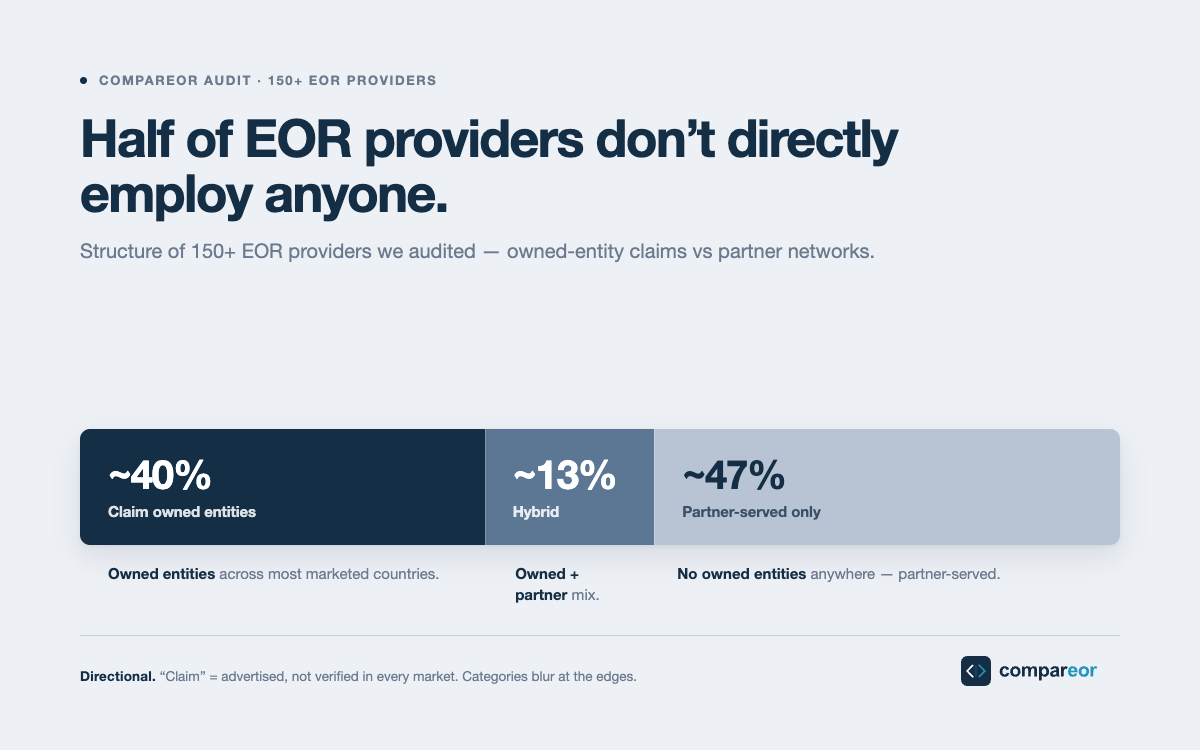
I checked the structure of 150+ EOR providers. Here's how many actually own their entities.
About 40% of EOR providers I audited claim and substantiate owned entities across most of their marketed countries. About 12 to 15% run an honest hybrid. About 45 to 50% are partner-served only, with no owned entities anywhere. The numbers, the methodology, the one honest caveat, and what they mean for buyers.


June 3, 2026
6 min read
Every EOR contract has an expiration date
The EOR model has a built-in expiration date, somewhere between 15 and 20 employees in one country. Past that threshold, the EOR stops being the cheapest option and starts being a tax on growth. Most companies miss it for a year or more, because the contract doesn't mention it and nobody inside is responsible for noticing.

May 25, 2026
5 min read
Why "150+ countries" is the most misleading number in global employment
Every EOR homepage leads with a country count, and after auditing 150+ providers it's the number most likely to lead you to the wrong choice. Coverage comes in three forms, and depth in your countries matters more than breadth across 185 of them.
Stay Updated on Global Hiring
Get weekly insights on EOR trends, compliance updates, and cost-saving strategies

Find a better EOR — without risk
Compare EOR providers to gain insights on cost, coverage, and contract flexibility, ensuring compliance and payroll continuity.


.png)
.png)



