
Remote vs Rippling — Which EOR Wins for European Hiring?
Both Remote and Rippling are strong EOR options for European hiring. Here's how they compare on what actually matters.


.png)
A comparison defined by two different product bets
Remote and Rippling are often short-listed side-by-side for European hiring, but they are not actually the same kind of product. Remote is a compliance-first EOR built on a global network of owned entities, with payroll, benefits, and employment contracts as the core deliverable. Rippling is a platform-first workforce system — HR, IT, finance, and EOR on a single stack — where the EOR is one module among many. For European hiring specifically, the gap between those two philosophies produces materially different experiences in onboarding speed, works-council handling, termination support, and total cost.
This comparison focuses on how each performs in the European markets where buyers most frequently deploy an EOR in 2026 — the UK, Germany, France, the Netherlands, Spain, and Poland. For the broader provider landscape, see the Remote alternatives and Rippling alternatives rankings, and for a second well-known Europe-focused matchup see Globalization Partners vs Oyster.
Two very different philosophies
Remote was founded in 2019 with a narrow focus: build an EOR business that owns its own local entities, employs workers directly on compliant local contracts, and wins on the quality of the employment experience rather than the breadth of the feature set. The consequence of that focus is a product that feels deliberately simple — hire, pay, terminate, in country X — and a compliance team that has accumulated deep institutional knowledge of each market they own.
Rippling launched in 2016 as a workforce-management platform. EOR is part of a broader bundle that includes HRIS, US payroll, IT provisioning (device management, SaaS account lifecycle), and finance tooling (expense management, corporate cards). The pitch is consolidation: one system of record for the whole workforce, with international employees ingested via the EOR module. For companies already running Rippling HRIS for a US workforce, the marginal lift of adding EOR is small.
Those two philosophies show up everywhere in the product. Remote's UI is lean and employment-centric. Rippling's UI is broader and workflow-centric. Neither is wrong — but they optimise for different buyers.
Country coverage across Europe
Coverage is where the "owned entity vs partner network" distinction matters most. For the highest-volume EOR markets in Europe, Remote operates through its own local legal entities — the UK, Germany, France, the Netherlands, Spain, Ireland, Poland, and several Nordic markets. Owned entities produce three practical advantages: faster compliance issue resolution (no partner-to-partner handoff), consistent payroll processing, and cleaner liability in the event of a dispute.
Rippling covers Europe through a mix of owned entities and local partners. The owned footprint has expanded substantially since 2023, but in several mid-size European markets Rippling still operates via a licensed partner model. For straightforward engagements, this is typically invisible to the customer. For complex cases — contested termination, works-council consultation, statutory severance calculation under local case law — the partner layer adds latency and can produce inconsistent outcomes.
Tier 1 markets — where both excel
UK, Ireland, and the Netherlands are the markets where the coverage gap is smallest. Both providers operate owned entities, both handle English-language documentation well, and both onboard quickly. For a UK-only engagement in particular, the practical difference is narrow — pricing and platform preference drive the decision rather than compliance depth. See the UK country guide and the IR35 guide for the UK-specific considerations that matter across both providers.
Tier 2 markets — where Remote pulls ahead
Germany and France are the markets where the compliance-first philosophy produces the clearest differentiator. Germany in particular — with its statutory works-council consultation thresholds, Kündigungsschutzgesetz dismissal protection, and employer-funded social contribution stack that adds roughly 20–22% above gross salary — rewards providers with deep local counsel on retainer and a track record of resolving disputes at the first stage. See the Germany guide and the works-council explainer for the statutory detail.
France is similarly demanding. Employer social charges hover in the 42–45% range on top of gross salary (see the true cost of hiring in France), collective bargaining agreements shape minimum compensation and notice terms, and termination case law routinely produces requalification rulings when contract form and working reality diverge. Remote has built substantial muscle here; Rippling is competent but typically needs deeper customer success involvement to match.
Tier 3 markets — the partner question
Smaller or more specialised European markets — the Baltics, Greece, Portugal, the Balkans — are covered by both providers, but the underlying operational model varies. For hires into these markets, ask both providers explicitly: "Is this entity owned by you or operated by a local partner?" and "Who is the legal employer on the contract?" The answer matters for compliance, escalation path, and pricing consistency. The 12-question evaluation framework walks through the exact diligence script.
Compliance approach
Both providers clear the basic compliance bar — local employment contracts, correct payroll tax operation, statutory benefits, pension/social security enrolment. The compliance discussion is really about edge cases: what happens when something goes wrong.
Remote's compliance posture
Remote leans into its compliance-first positioning. Contracts are drafted locally by in-market counsel and reviewed centrally. Terminations are handled through a defined escalation ladder that routes contested cases to senior counsel before any notice is issued. In Germany, Remote has a documented works-council consultation process. In France, Remote is known for strong defence against requalification claims. In the UK, Remote maintains current IR35 advisory and moves contractors onto direct employment cleanly.
The operational trade-off is that Remote's process is more structured — customers occasionally describe it as "slower to flex" on non-standard requests. For off-cycle bonus runs, bespoke equity structuring, or unusual termination timing, Remote typically insists on compliance review before execution. That is a feature if you value risk posture; it can be friction if you are used to a more accommodating vendor.
Rippling's compliance posture
Rippling's compliance is solid in the highest-volume markets and automated heavily at the administrative layer. Where the platform shines is standardising the onboarding workflow — document collection, background checks, right-to-work verification, equipment provisioning — across a mixed global workforce.
In complex European dispute scenarios, Rippling's response quality varies more by market. In Tier 1 and some Tier 2 markets, response is strong. In Tier 3 markets operated via partners, the response can be slower and more dependent on the partner's bandwidth. For enterprises with meaningful European contractor conversion volume, probe this specifically during evaluation. See hidden fees in EOR contracts for the compliance-related line items that frequently get surfaced late.
Pricing and cost transparency
The two providers publish pricing differently, which makes head-to-head comparison more work than it should be.
Remote pricing
Remote publishes a headline rate of $599 per employee per month for EOR, matching Deel's published rate. Remote explicitly advertises no FX markup — payroll is processed in local currency without a spread added to the salary conversion, which is a meaningful cost point over a 12-month engagement at senior-salary levels. Contractor management is available as a separate, lower-priced product (from $29/month per contractor).
The published price is a solid starting point, but procurement should still audit the invoice structure. Ask about deposits (typically one month held as payroll float), country-specific surcharges (some markets include statutory pass-throughs), and termination-event fees. See EOR pricing models explained for the full flat-fee versus percentage discussion.
Rippling pricing
Rippling's EOR pricing is quoted on request and varies based on workforce size, country mix, and which modules are in scope. For customers using Rippling purely as an EOR, the effective per-employee rate tends to be in the same range as Remote. For customers consolidating HRIS, IT, finance, and EOR onto Rippling, the blended cost can be meaningfully lower than running separate best-of-breed tools — but only if the adjacent modules are actually replacing existing spend. For the integrated-platform angle, the top EOR providers with built-in HRIS list is useful context.
Total cost of ownership
The TCO comparison varies by buyer type. If you are hiring 5–20 employees in Europe and already have best-of-breed HRIS, IT, and finance tools, Remote's standalone EOR is typically the cleaner economic fit. If you are consolidating your core HR stack and hiring internationally at the same time, Rippling's platform bundle can be more efficient despite a higher EOR line item — the savings live in the adjacent modules, not the EOR itself.
Platform and integrations
Rippling's platform is the single biggest structural advantage it carries into any comparison. Native IT provisioning (automatically create and de-provision email, Slack, GitHub, Salesforce, and 600+ other SaaS accounts from the same system that hires the employee), native device management (ship and wipe laptops), integrated expense management, and an HRIS system of record all sit in one place. For companies running on Rippling for their US workforce, adding a European hire via Rippling EOR slots into the existing workflow with almost no additional setup.
Remote's platform is focused — hire, pay, manage benefits, offboard — and integrates via API and pre-built connectors with the major HRIS systems (Workday, BambooHR, HiBob, Rippling itself). If your HRIS is already set, Remote slots in cleanly; if you need the full workforce stack, Remote is not trying to be that.
Implementation and onboarding speed
Both providers onboard employees fast in the Tier 1 European markets — typically 2–5 business days once documents are collected. Differences emerge in two places:
First, customer onboarding — the initial setup of the client organisation on the platform. Rippling's setup is more involved because you are onboarding onto a workforce platform, not just an EOR account. Remote's client onboarding is lighter-touch: contract signed, first employee can typically be added within 48 hours.
Second, complex-market onboarding. Germany and France add statutory pre-employment steps (social security registrations, works-council notifications where applicable, sometimes mandatory medical checks in France). Remote's owned-entity workflow tends to compress these into a tighter timeline. Rippling is competitive but can run longer where partners are in the chain.
Customer support and escalation
Both providers offer tiered support. Remote's support model is employment-specialist-led — your dedicated point of contact is typically someone whose core expertise is EOR compliance. Rippling's support is platform-specialist-led — your CSM covers the full Rippling stack. For a pure-EOR deployment, Remote's model is typically the better fit for escalations; for a consolidated deployment, Rippling's unified support is more efficient. For the broader customer-experience angle see the remote hiring playbook for US companies expanding to Europe.
Head-to-head: European hiring
A condensed view of where each wins:
- Owned-entity coverage in Europe: Remote ahead, particularly in Tier 2 markets (Germany, France, Spain, Italy).
- Compliance depth in complex markets: Remote ahead on works-council handling, French requalification defence, and UK contractor-to-employee conversions.
- Platform breadth beyond EOR: Rippling ahead by a wide margin — the IT, HRIS, and finance stack is the category-defining differentiator.
- Headline pricing transparency: Remote ahead — published rate, no-FX-markup commitment.
- Total cost of ownership (multi-tool consolidation): Rippling ahead for buyers replacing 3+ existing tools.
- Speed of Tier 1 European onboarding: roughly equivalent (2–5 business days).
- Speed of Tier 2 European onboarding: Remote ahead, typically by 2–5 business days.
- Fit for enterprise global workforce: Rippling ahead if HRIS/IT consolidation matters; Remote ahead if compliance specialisation matters. The top EOR providers for enterprise companies ranking covers both.
Who should choose Remote
Remote is the stronger choice if any of the following apply:
- Your hiring is concentrated in Europe and particularly in Germany, France, the Netherlands, or Spain.
- You already have an HRIS you trust and do not want to consolidate.
- Compliance certainty is the top-tier decision criterion.
- You value published pricing and a no-FX-markup commitment.
- You are converting UK contractors onto direct employment (IR35-driven migrations).
Who should choose Rippling
Rippling is the stronger choice if any of the following apply:
- You are already running Rippling HRIS, IT, or finance modules for a US workforce — the marginal cost of EOR is low and the unified workflow is a real productivity gain.
- You are actively consolidating 3+ workforce tools (HRIS, IT management, expense, payroll).
- Your European hiring is concentrated in Tier 1 markets (UK, Ireland, Netherlands) where the compliance gap versus Remote is narrow.
- Your workforce model emphasises automated onboarding, device management, and SaaS account lifecycle across a large mixed population.
Alternatives worth considering
Remote and Rippling are not the only serious options for European hiring. Two comparators worth running in parallel:
- Deel. Matches Remote on published per-employee pricing, has broader country coverage (150+ countries), and is the typical third horse in a Remote/Rippling evaluation. See the Deel review for a direct comparison.
- Globalization Partners and Oyster. Europe-capable EORs with different specialisations — G-P is historically enterprise-led, Oyster is design-led for lower-touch teams. See Globalization Partners vs Oyster.
For a comprehensive side-by-side of these providers on the specific criteria that matter to your hiring plan, use the Compareor comparison tool and walk through the EOR selection checklist before signing.
Frequently asked questions
Can I use Remote for some countries and Rippling for others?
Yes — multi-EOR operations are common in growing companies. The main operational cost is reconciling two different data models into your own HRIS and maintaining two sets of contractual terms. For >30 employees across both providers, the admin overhead becomes material and most teams eventually consolidate.
How long does it take to migrate from one to the other?
Plan 6–10 weeks for a 10–30 employee migration within Europe. Statutory notice periods in Germany (4 weeks + per-year-of-service increments) and France (1–3 months) often set the critical path. For the full migration playbook see the EOR evaluation and switching framework.
Which is better for hiring a single senior European employee?
Remote — for a single-hire engagement, the compliance specialisation matters more than platform consolidation, and the published pricing removes a round of negotiation. If you are already on Rippling, the marginal benefit of adding EOR is real, but for a first European hire without the adjacent modules in place, Remote is the cleaner call.
Do either of them handle UK IR35 properly?
Both operate UK payroll compliantly through PAYE and HMRC. Remote has a more mature advisory layer for IR35-driven contractor-to-employment conversions. See the IR35 guide for the mechanics of the conversion.
Does Rippling EOR require me to use the full Rippling platform?
Technically no — the EOR module can be used standalone — but the pricing and the product value are both stronger when the adjacent modules are in use. Most standalone-EOR buyers end up choosing Remote or Deel instead.
Bottom line
If you are hiring primarily in Europe and compliance certainty tops your criteria, Remote is the stronger choice — owned-entity coverage in the Tier 2 markets, battle-tested works-council and termination handling, and published no-markup pricing. If you are consolidating a workforce stack and already using Rippling HRIS, IT, or finance, Rippling's platform leverage makes the EOR module a cost-effective fit — particularly for Tier 1 European markets.
Run both through the comparison tool on your specific country mix, and use the selection checklist to surface the procurement questions that matter before you sign.
Get your shortlist
Takes ~3 minutes. No account needed.
June 3, 2026
6 min read
I checked the structure of 150+ EOR providers. Here's how many actually own their entities.
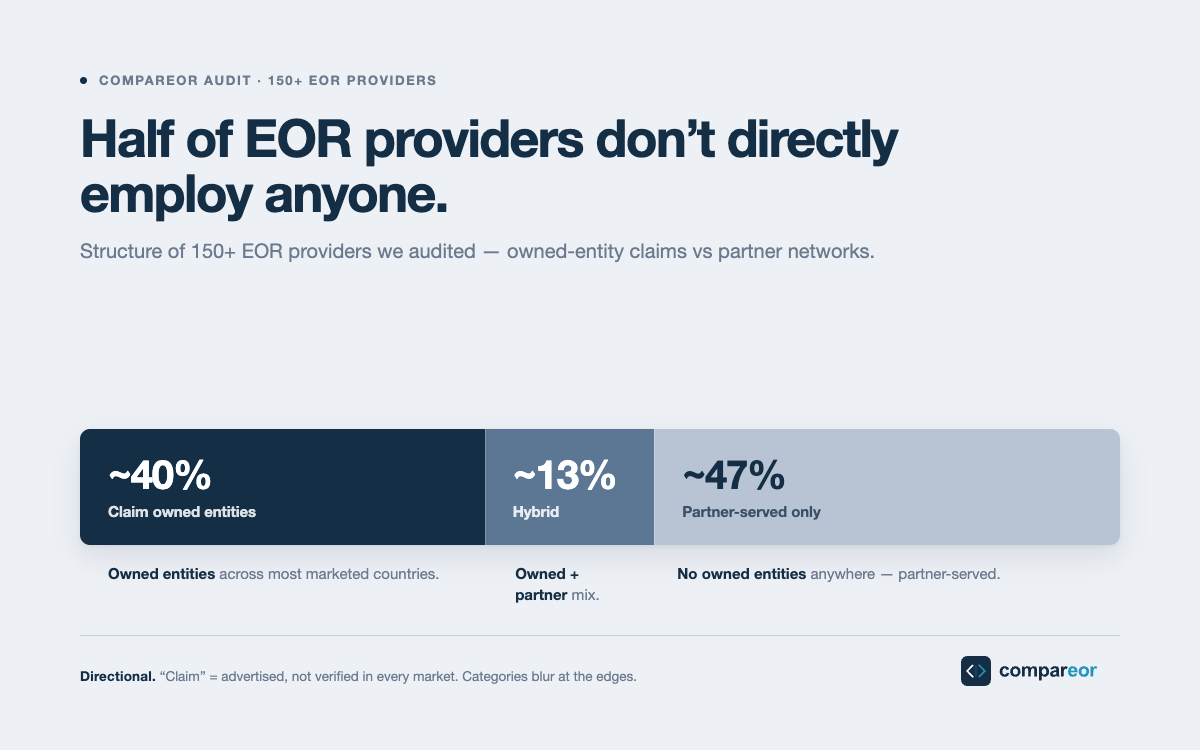
About 40% of EOR providers I audited claim and substantiate owned entities across most of their marketed countries. About 12 to 15% run an honest hybrid. About 45 to 50% are partner-served only, with no owned entities anywhere. The numbers, the methodology, the one honest caveat, and what they mean for buyers.


June 3, 2026
6 min read
Every EOR contract has an expiration date
The EOR model has a built-in expiration date, somewhere between 15 and 20 employees in one country. Past that threshold, the EOR stops being the cheapest option and starts being a tax on growth. Most companies miss it for a year or more, because the contract doesn't mention it and nobody inside is responsible for noticing.

May 25, 2026
5 min read
Why "150+ countries" is the most misleading number in global employment
Every EOR homepage leads with a country count, and after auditing 150+ providers it's the number most likely to lead you to the wrong choice. Coverage comes in three forms, and depth in your countries matters more than breadth across 185 of them.
Stay Updated on Global Hiring
Get weekly insights on EOR trends, compliance updates, and cost-saving strategies

Find a better EOR — without risk
Compare EOR providers to gain insights on cost, coverage, and contract flexibility, ensuring compliance and payroll continuity.


.png)
.png)



