
The EOR Migration Checklist: What to Do Before, During, and After
A practical checklist for every stage of switching EOR providers — so nothing falls through the cracks.


.png)
Why a checklist matters
EOR migrations do not usually fail because the playbook is wrong. They fail because a small number of discrete steps get skipped — a notice period that was not checked, a pension enrolment that was not transferred, an equity grant that was not reissued, a works-council notification that was not filed. Each of those is a one-line task in isolation; missed, any one of them can produce a month of remediation, a disgruntled employee, or a compliance breach.
This checklist takes the full migration workflow and breaks it into three phases — before, during, and after — with the decisions, communications, and compliance artefacts that belong in each. Use it alongside the narrative playbook in how to switch EOR providers without disrupting payroll and the field-tested lessons from the 50 companies that switched EOR and what they learned.
Understand what you're actually migrating
Before the checklist starts, size the migration correctly. An EOR switch is not just a change of vendor — it is a change of the legal employer of record for each in-scope employee. That one structural fact drives every downstream step:
- Every employee needs a new employment contract with the new EOR entity, co-signed before the transfer date.
- Every statutory registration (tax, social security, pension, health insurance) needs to be ported to the new entity.
- Every benefit enrolment (group health, life, pension) needs to be transferred or reissued.
- Every equity grant under an employment-based plan needs to be reviewed — in some jurisdictions the grant terms reference the employer entity by name.
- Every payroll, invoice, and reporting cycle needs to cut cleanly on a defined effective date.
If any of the above is not yet mapped, do that mapping first. The checklist below presumes you have the inventory of in-scope employees, countries, and benefit plans in hand.
Before the migration — 4–6 weeks out
Provider selection and contract readiness
- Document your reasons for switching — cost, service quality, country gap, compliance incident, or strategic consolidation. Written requirements prevent the new-provider evaluation from drifting into feature-shopping.
- Shortlist 2–3 alternative providers using the Compareor comparison tool. Benchmark on your actual country mix, not marketing coverage numbers. For the structured diligence walkthrough, use the 12 questions to ask before signing.
- Pull your current contract and find the notice period. 30 days is common; 60 and 90 days are not unusual. Calendar the notice date the day you decide to switch — this is the single most common source of overlapping-vendor-cost surprises flagged in the migrations we've seen.
- Check for termination fees, early-exit penalties, and minimum-term clauses. Walk through hidden fees in EOR contracts to catch less obvious charges.
- Verify new-provider entity and compliance readiness in every target country before signing. Get the legal entity name, the payroll licence reference, and confirmation they can support any jurisdiction-specific obligations (works council in Germany, CLT registration in Brazil, UAE health insurance certificate).
- Identify the transfer date. The first working day of a new payroll cycle — typically the 1st of a month — is the cleanest. Avoid year-end migrations (December 20 to January 15 overlaps holidays, bonus payment windows, and the annual tax-year close in most jurisdictions).
- Align the new contract start with the old contract end. Ideally a 1–5 business day overlap for handover, not a 2–4 week parallel-run that doubles your costs.
Employee-side preparation
- Draft the employee communication before signing the new contract. Writing it forces you to confirm what you're actually promising (no net-pay change, no benefit loss, continuity of seniority) and surfaces any gaps.
- Inventory benefits by country. Health insurance (including any dependent cover), pension / retirement plan, life insurance, disability, equity, bonus plans, allowances, meal vouchers. For each, identify the carrier, the enrolment process, and whether it moves with the contract or needs reissuing.
- Inventory statutory leave balances and seniority. Accrued vacation, accrued sick leave, continuous-service date for termination-notice purposes. These must transfer intact — loss of accrued leave is one of the most visible employee-facing problems post-migration.
- Pre-flag equity grants. Grants issued under a "subsidiary of parent" structure may need amendment if the employer-of-record name changes. Loop in whoever administers your cap table.
During the migration — 2–4 weeks
Employee notification and contracts
- Notify all affected employees in writing at least 4 weeks before the transfer. 6 weeks is better. The 50-company study consistently flagged short notice as the single biggest source of employee anxiety and post-transfer churn.
- Frame the change accurately. "You are moving to a new legal employer of record as of [date]. Your role, manager, compensation, and benefits continue without change. Your seniority, accrued leave, and equity are preserved." Avoid corporate-speak; lead with the employee's experience.
- Issue new employment contracts well before the transfer date. Aim for 2 weeks of review time. In jurisdictions requiring translated contracts (France, Germany, Brazil, Spain, Poland), confirm the translated version is the one being signed.
- Collect signed contracts before the transfer date — not after. Contracts signed after the start of the new employment relationship create ambiguity about contract effective date and, in Brazil and parts of the EU, can create back-pay liability.
- Handle country-specific consultation requirements. Germany: notify the works council (see the works-council guide). France: consult the CSE if applicable. These consultations can add 1–3 weeks to the critical path.
Payroll, benefits, and system continuity
- Confirm the final payroll run date with the outgoing provider. Ask for a written reconciliation covering all outstanding expenses, bonus accruals, and any leave pay-outs.
- Verify benefits continuity before the transfer date. Pension auto-enrolment (UK, Netherlands, Spain), group health insurance (UAE, Germany, US), and group life cover must not lapse. A lapse of even one day produces coverage gaps and audit findings.
- Test the first payroll run. Where possible, run a parallel or dry-run payroll on the new provider covering 1–3 employees the week before go-live. Discrepancies found in a dry run cost nothing to fix; discrepancies found in the first live run cost trust.
- Update IT access and expense tooling. If the new provider integrates with your HRIS, Slack, Okta, expense tool, and equity platform, schedule the handover. If not, document the manual workflows required for each affected system.
- Reissue corporate cards and expense accounts if they reference the old EOR legal entity. Some jurisdictions require card-issuer paperwork that references the legal employer.
- Confirm invoice and payment mechanics with finance. Who pays the final invoice to the outgoing provider? When does the first invoice from the new provider arrive, and at what expected amount? Match the invoice calendar to the payroll calendar to avoid cashflow surprises.
After the migration — 30–90 days
Verification and reconciliation
- Verify the first full payroll run line-by-line. For each employee, compare net pay to the previous pay period. Flag any variance above 1% and trace it to source (tax-code change, benefit deduction, FX rate).
- Resolve discrepancies within 24 hours. Communicate proactively. A corrected pay slip sent on day 2 lands very differently from a corrected pay slip sent on day 15.
- Obtain a termination certificate and final invoice from the outgoing provider. The termination certificate is the legal artefact that closes the employment relationship with the prior entity. Without it, some jurisdictions will treat the employee as still registered under the prior employer for tax/social security purposes.
- Reconcile statutory filings for the crossover month. Tax and social security filings for the transition month need to be cleanly split between the two providers — each files for its portion. Document which provider files what, and keep copies.
- Archive all employee records from the previous provider. Payslips, employment contracts, benefit statements, tax filings, compliance certificates. Retention periods vary by jurisdiction (5–10 years is the common range) and the outgoing provider's portal access typically expires 30–90 days post-termination.
Documentation and governance
- Update internal documentation. Employee handbook, onboarding guide, country-specific policy pages, integration lists, ops runbook. Anywhere the old provider was referenced needs to be updated.
- Update equity plan and cap table records to reflect the new employer entity where grants are linked to employment status.
- Schedule a 30-day review with the new provider. Agenda: payroll accuracy, employee feedback, any compliance issues, open items. Document actions owned by the provider.
- Schedule a 90-day review. Agenda: first-quarter performance, FX rate review, invoice reconciliation, any country-specific compliance cycle events handled (filings, payroll tax year-end, statutory bonus payouts).
- Capture lessons learned. A half-page internal memo covering what went smoothly, what required extra work, and what you would do differently next time — invaluable the next time a migration comes up.
Country-specific additions to the checklist
Five jurisdictions routinely add items beyond the core checklist. Add these if relevant:
Germany
- Works council consultation (if a Betriebsrat exists at the client entity) — see the works-council guide.
- Krankenkasse (health fund) membership continuity — each employee's Krankenkasse must be updated with the new employer registration.
- Social insurance ID (Sozialversicherungsnummer) linkage to the new entity.
France
- Collective bargaining agreement alignment — confirm the new provider codes the correct Convention Collective.
- Mutuelle (supplementary health insurance) and prévoyance (death/disability) continuity.
- CSE consultation if the client crosses the 50-employee threshold. See the France country guide.
Brazil
- Homologação process for any employee whose prior CLT contract is being terminated as part of the switch.
- FGTS account continuity and 13th-month salary accrual split between providers.
- eSocial re-registration on the new EOR's CNPJ. See why Brazil's CLT makes EOR essential.
UK
- HMRC PAYE closing notice from the outgoing provider and RTI opening filing with the new one.
- Pension auto-enrolment continuity — NEST or private scheme.
- IR35 posture review if the migration includes contractor-to-employee conversions (see IR35 in 2026).
UAE
- Mandatory health insurance certificate transfer or reissue — the 2025 federal mandate applies across all seven emirates. See the UAE 2025 health insurance update.
- Residency visa re-sponsorship under the new EOR entity — the most time-sensitive step. Plan 2–4 weeks.
- WPS (Wage Protection System) bank reconfiguration.
Common mistakes this checklist catches
Across the migrations we've reviewed, the same handful of mistakes recur. A well-run checklist process catches each before it becomes a problem:
- Missed notice periods producing 1–2 months of overlapping vendor cost. Caught at step 1 (contract review).
- Benefit lapse between providers. Caught during the benefits-continuity verification step.
- Employees left on the old system for a cycle. Caught during the first-payroll verification.
- Seniority reset to the new contract date. Caught during the seniority-inventory step and confirmed in the employment-contract language.
- Works-council non-consultation in Germany. Caught by the country-specific consultation step and prevents a void termination downstream.
- Unreturned deposits from the outgoing provider. Caught during the final-invoice reconciliation and termination certificate step.
For the companion cost/service angles, see 5 signs you're paying too much for your EOR and what happens when your EOR gets it wrong.
Frequently asked questions
How long does a typical EOR migration take end-to-end?
For a 5–15 employee migration, 6–10 weeks is typical. For 15–50 employees, 10–14 weeks. The critical path is usually set by the outgoing provider's notice period plus country-specific consultation/registration timelines, not by the new provider's readiness.
Can I migrate during an active pay cycle?
Avoid it. Transitioning mid-cycle requires both providers to split the payroll calculation, which creates reconciliation complexity and employee-facing confusion. Target the first working day of a month with a full cycle under the new provider.
What happens if an employee refuses to sign the new contract?
In most jurisdictions, the employment continuity is contractual — the employee has a real choice. Preparation is the remedy: clear communication, early engagement, and a contract whose terms are no worse than the existing one. In the rare case of refusal, options are to maintain the existing employment (if the prior provider will extend) or treat it as a termination of the existing role under local law. Take legal advice.
Should I run parallel payroll with both providers?
For complex migrations (50+ employees, highly regulated sectors), a one-cycle parallel run catches discrepancies before they affect employees. For smaller migrations, a dry-run on 1–3 employees plus a careful line-by-line verification of the first live run is usually sufficient — and avoids the doubled cost of a full parallel month.
How do I pick a replacement provider that will not need replacing again in 18 months?
Match provider strengths to your actual operating profile — country mix, seniority profile, integration needs, compliance risk level. Use the 12 evaluation questions and the selection checklist. Reviewer bias: providers with strong customer support and transparent pricing (see the best-customer-support ranking) are substantially less likely to trigger another switch within 18 months.
Bottom line
EOR migrations go wrong one checklist item at a time. The good news is the failure modes are predictable and the checklist is stable: confirm notice, confirm entity readiness, plan the transfer date, communicate early, issue contracts before the cutover, verify benefits continuity, verify the first payroll, reconcile final invoices, archive the records.
Shortlist replacement providers on the Compareor comparison tool, run each through the 12-question evaluation, and use this checklist to stay on top of the operational detail. Companion reading: how to switch EOR providers without disrupting payroll and what 50 companies learned switching EOR.
Get your shortlist
Takes ~3 minutes. No account needed.
June 3, 2026
6 min read
I checked the structure of 150+ EOR providers. Here's how many actually own their entities.
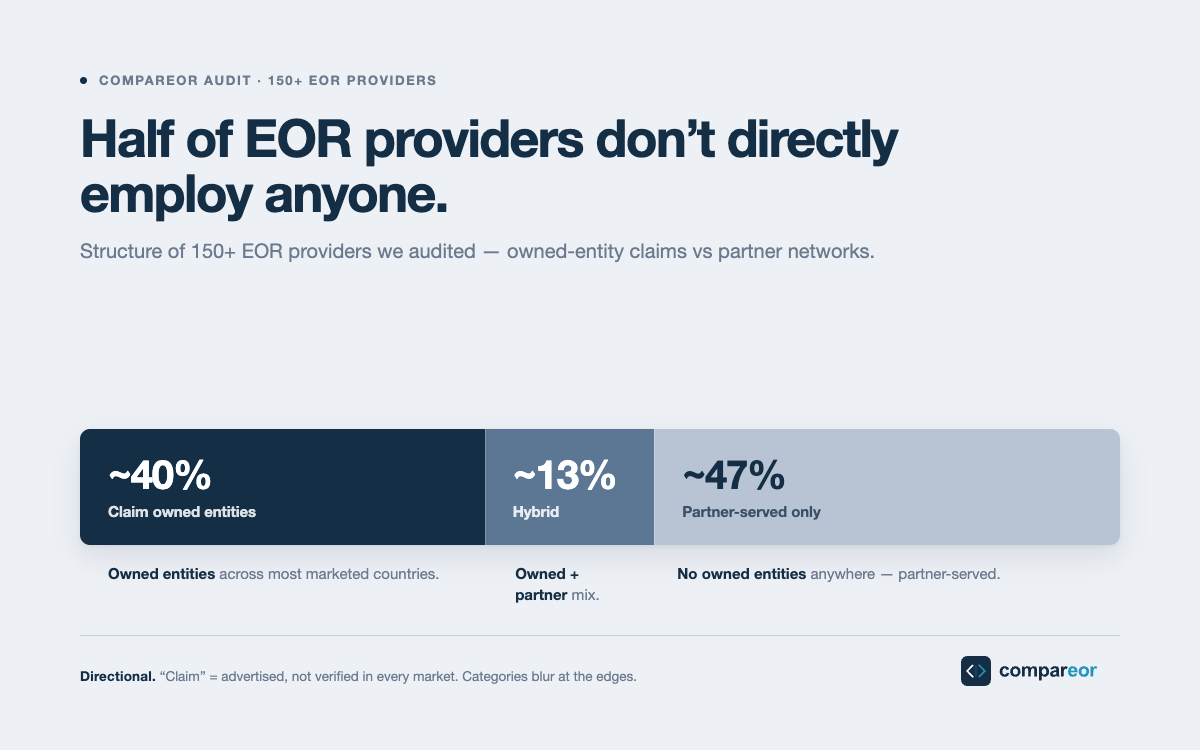
About 40% of EOR providers I audited claim and substantiate owned entities across most of their marketed countries. About 12 to 15% run an honest hybrid. About 45 to 50% are partner-served only, with no owned entities anywhere. The numbers, the methodology, the one honest caveat, and what they mean for buyers.


June 3, 2026
6 min read
Every EOR contract has an expiration date
The EOR model has a built-in expiration date, somewhere between 15 and 20 employees in one country. Past that threshold, the EOR stops being the cheapest option and starts being a tax on growth. Most companies miss it for a year or more, because the contract doesn't mention it and nobody inside is responsible for noticing.

May 25, 2026
5 min read
Why "150+ countries" is the most misleading number in global employment
Every EOR homepage leads with a country count, and after auditing 150+ providers it's the number most likely to lead you to the wrong choice. Coverage comes in three forms, and depth in your countries matters more than breadth across 185 of them.
Stay Updated on Global Hiring
Get weekly insights on EOR trends, compliance updates, and cost-saving strategies

Find a better EOR — without risk
Compare EOR providers to gain insights on cost, coverage, and contract flexibility, ensuring compliance and payroll continuity.


.png)
.png)



