
We Interviewed 50 Companies That Switched EOR — Here's What They Learned
The most common mistakes, surprises, and lessons from companies that have been through an EOR migration.


.png)
Why we did this
EOR migration advice is mostly written by EOR providers — which means it is almost always self-serving. When your source of expertise is the same company that will sign your next contract, the gaps in the advice are never accidental. We wanted to hear from companies that had actually done it. Across the last 18 months we ran structured interviews with 50 companies that had completed an EOR migration — what triggered the switch, what went well, what broke, what the final bill looked like, and what they would do differently if they started over. This post is the synthesis. Where findings are quantified, they are drawn from the full 50-company sample. Where they are anecdotal, they come from at least three separate interviews pointing the same direction.
If you are currently inside the decision — or currently inside a migration — pair this with the phased migration checklist and the payroll-continuity playbook. They cover the mechanics. This post covers the judgement calls the mechanics do not tell you about.
Who we talked to
The 50-company sample skewed toward mid-stage venture-backed companies (headcount 25–400 at time of switch, with an average of 142), but it covered a reasonable spread of stages and sectors: 14 seed-to-Series-A startups, 21 Series-B-to-Series-D scale-ups, 9 post-IPO or private-equity-owned companies, and 6 bootstrapped profitable SMBs. Sectors were dominated by B2B SaaS (29 companies), followed by fintech (7), consumer (6), healthtech (4), and industrial or deep-tech (4).
Geographic coverage: every respondent had employees in at least 3 countries at the time of migration. The most represented markets across the sample were the UK, Germany, France, Spain, Netherlands, Poland, Brazil, Mexico, India, and the US. Forty of 50 companies had at least one person in a "complex" market — France, Germany, Brazil, China, or India — where statutory complexity makes migration materially harder than in straightforward markets like the UK or Netherlands.
The interviews were conducted under conditional anonymity, which is why no company names appear in this post. Every company consented to have its data aggregated and anonymized.
The most common reasons for switching
Every respondent named a primary driver and up to two secondary drivers. The aggregated frequencies below are non-exclusive.
Cost — the primary driver in 68% of cases
Thirty-four of 50 companies named cost as the #1 reason for switching. On audit, most discovered they were paying 25–45% above market rate — a combination of headline fee, FX markup, benefits administration charges, and annual price escalators compounding across multi-year contracts. Median recovered savings post-switch: 22% of total all-in EOR cost. The largest single-case saving: 46% on a 38-employee account where the incumbent was running percentage-of-salary pricing on mostly senior technical hires. The five overpayment signals match almost exactly what these 34 companies found on audit.
Support quality — the second most common driver at 42%
Twenty-one of 50 companies cited support quality. The specific complaint was almost always responsiveness on edge cases — terminations, statutory audits, parental leave, visa renewals — rather than baseline monthly payroll, which most providers handle adequately. Respondents consistently reported that enterprise-account support was better than SMB-tier support at the same provider, and that multiple had moved to mid-market or niche providers specifically for the higher-touch service. Our customer-support leaderboard is a useful starting point for this selection.
Compliance concerns — 28%
Fourteen of 50 companies had a specific compliance incident or near-miss that triggered the switch. The most common incidents: a failed statutory audit in Germany, incorrect French convention collective classification surfacing on termination, Brazilian FGTS or INSS underpayment, and UK IR35 misapplication on converted contractors. In 9 of 14 cases, the incumbent was running a partner-network model in the affected country rather than an owned entity — which matters because partner networks give the provider less direct control over filing accuracy. Our guide on EOR liability walks through who pays in each of these scenarios.
Country coverage gaps — 22%
Eleven of 50 companies switched because the existing provider could not onboard in a new target market within the required timeline, or required entity setup where the new provider had owned coverage. This was especially common for UAE, Singapore, South Korea, and Argentina — markets where EOR provider depth varies widely.
What went better than expected
The migration was faster than feared
"We thought it would take six months. It took six weeks." Some version of this quote appeared in 31 of 50 interviews. With proper planning and a cooperative new provider, EOR migrations in straightforward markets (UK, Netherlands, Ireland, Poland, Singapore) routinely complete in 4–6 weeks. Complex markets (France, Germany, Brazil) add 2–4 weeks of statutory consultation and documentation time, but 8 weeks end-to-end was achievable for 43 of the 50 cases. Only 7 companies reported migrations taking more than 12 weeks, and in 6 of those the delay was traced to the incumbent rather than the incoming provider.
Employees were largely indifferent
This was the most consistently cited positive surprise. Going in, most respondents expected significant employee pushback — questions about benefits continuity, pay stability, contract terms, and employer identity. In practice, employees cared about two things: that their net pay did not change, and that their health insurance and pension enrolments did not lapse. When those two conditions were met, the change of employer-of-record was largely invisible. A well-sequenced communication plan (4 weeks advance notice, clear FAQ, one town-hall meeting, named point of contact) was enough for 47 of 50 companies to complete the switch without a single employee resignation tied to the migration.
New providers were more flexible on pricing than expected
A pleasant surprise in 19 of 50 cases: once the new provider understood the switch was actually happening, commercial terms moved. Discounts of 10–20% off the first quoted rate were common for accounts above 15 employees, and waivers of onboarding fees were standard at 20+ employees. The leverage came from being inside a real procurement with a signed offer from a comparator — speculative RFPs produced smaller concessions. Running a real parallel comparison during the switch materially changed negotiation outcomes.
What went worse than expected
Notice periods were longer than remembered
"We had forgotten our contract had a 90-day notice clause. We ended up paying two providers for three months." Sixteen of 50 companies underestimated their exit obligations with the existing provider. The specific clauses that bit: 90-day notice, minimum term commitments with retroactive true-ups on early exit, per-country offboarding fees, and — in three cases — a non-refundable "data migration fee" of $5,000–$15,000 that the incumbent invoked at termination.
The actionable lesson: audit the exit clause on day 1 of the decision process, not day 40. The hidden-fees guide covers what to look for before signing, and the contract audit checklist pulls the full list for an existing contract.
Country-specific complexity caught teams off guard
Germany's works council notification obligations under the Betriebsverfassungsgesetz, France's Comité Social et Économique consultation on material changes to working conditions, and Brazil's homologação rescission process each added 2–4 weeks of statutory procedure that had not been factored into the original plan. Teams that had not lived through a country-specific migration before consistently under-budgeted this time.
The pattern: ask the incoming provider for a country-by-country migration runbook before signing, including statutory notification timelines, required documentation, and who signs what. A provider that cannot produce this in 48 hours is not the right partner for a migration with complex-market footprint. The Germany works-council guide covers the specifics for the most commonly affected market.
Parallel-payroll reconciliation took longer than planned
Thirteen of 50 companies ran a parallel payroll in the transfer month — the incumbent processed the pay run, the incoming provider ran a shadow calculation, and the two were reconciled line by line before cutover. Every one of those 13 reported the exercise surfaced material errors (most commonly, incorrect statutory contribution bands, missing supplementary benefits, or incorrect gross-to-net calculations) that would otherwise have landed on the first real invoice or — worse — in the employee's bank account.
The 37 companies that did not run a parallel payroll reported a mean of 4.3 payroll discrepancies in the first 90 days post-cutover. The 13 that did reported a mean of 0.6. Parallel payroll adds 1–2 weeks of migration time and costs an additional 10–15% of monthly fee for the overlap period, and in the sample it paid for itself in every case.
Benefits cutover had gaps
Nine of 50 companies experienced a benefits gap during the switch — a pension contribution missed for one month, a health insurance policy that lapsed for 2–5 days before the incoming provider enrolled, or supplementary benefits that had to be renegotiated with the new provider's broker network. In 7 of 9 cases, the gap was resolved retroactively and at minimal cost, but it required escalation. The fix is to confirm pension, health, and supplementary benefits enrolment dates with the incoming provider in writing, before cutover, with a named backup contact on both sides.
The top 5 things companies would do differently
- Check the exit clause before doing anything else. Audit notice period, minimum term, offboarding fees, and data-transfer charges on day 1 of the decision process. The 20-point contract audit checklist pulls every relevant clause.
- Involve employees earlier. Four weeks of advance notice is the minimum that produced clean outcomes in the sample. Two weeks produced measurable anxiety; six weeks produced better engagement with the transition but risked the incumbent becoming disengaged during the wind-down.
- Confirm the new provider's entity status in every target country before signing. Owned entities meaningfully outperformed partner networks on migration speed and post-cutover compliance. Ask specifically whether the provider runs an owned entity in each of your target markets, and get the answer in writing.
- Run a parallel payroll on the transfer month. The 13 companies that did reported 7× fewer first-90-day discrepancies than the 37 that did not. The extra cost was recovered within the first billing cycle.
- Do not start the migration in December. Payroll complexity is highest at year-end — 13th-month payments in most of Europe, bonus and equity vesting in most markets, statutory filing calendars concentrated in Q4, and reduced provider staffing over the holidays. Only 2 of 50 companies started migrations in December, and both reported it was the wrong call.
Cost savings — what teams actually recovered
Aggregated across the 50 companies, the median all-in EOR cost reduction was 22%, with a range of 8% (companies that had already benchmarked and had limited headroom) to 46% (companies moving off percentage-of-salary pricing on senior technical hires). In absolute terms, the median annual saving was $89,000; the largest was $340,000 on a 76-employee global account.
The savings came from a mix of: (1) lower headline fee (roughly half of total savings on average), (2) elimination or reduction of FX markup, (3) removal of benefits administration line items that the new provider bundled, and (4) negotiated waiver of onboarding and offboarding charges. The seven-hidden-costs breakdown maps the categories where savings typically come from.
Payback period: median 2.1 months from the first full billing cycle on the new provider, including migration costs.
When NOT to switch
Three patterns emerged where respondents who switched wished they had not, or were ambivalent on outcomes:
First, if you are paying within 10% of market rate and the provider is performing adequately, the payback does not justify the disruption. Of the 6 companies that reported net-negative outcomes from the switch, 4 were in this band.
Second, if you have a single country-specific complexity (an active works-council dispute in Germany, an open URSSAF audit in France, or a pending homologação in Brazil), finish that matter first. Migrating mid-dispute created document-trail confusion that extended resolution timelines in 3 of 50 cases.
Third, if you have active visa or work-permit applications in progress, wait until they close. Migrations disrupted 7 visa processes in the sample, and in 2 cases the disruption required a fresh application at additional cost.
For everyone else — which is most companies paying 15%+ above market — switching is both achievable and worth it. The switching guide walks through the full sequence from decision to cutover.
Frequently asked questions
How long does an EOR migration actually take?
4–6 weeks in straightforward markets (UK, Netherlands, Ireland, Poland, Singapore) and 6–10 weeks if your footprint includes France, Germany, or Brazil. 43 of 50 companies completed end-to-end within 10 weeks with proper planning.
How much can I expect to save?
Median 22% on all-in cost. Range 8–46% depending on where you are starting. Run the overpayment diagnostic first — if three or more indicators apply, expect 20%+ savings.
Do I need to tell employees my company is switching EOR?
Yes, with at least 4 weeks' notice. Employees have a right to know who their legal employer is, and the new EOR will need their signed acceptance of the new employment contract. A clear communication plan (written notice, FAQ, one town-hall, named contact) is sufficient in practice.
What is the single biggest mistake in EOR migrations?
Ignoring the exit clause in the incumbent contract. 16 of 50 companies underestimated notice periods, minimum-term penalties, or offboarding fees, and ended up paying two providers simultaneously for 1–3 months.
Is a parallel payroll worth the extra cost?
Yes, unambiguously, from the sample data. Companies that ran a parallel payroll had 7× fewer first-90-day discrepancies than those that did not, at an incremental cost of 10–15% of one monthly fee. The payroll-continuity playbook covers how to sequence it.
Bottom line
EOR migrations are meaningfully easier than most buyers believe, and the median payback is 2 months. The mechanics — 4–8 weeks for most markets, 4 weeks of employee notice, parallel payroll on the cutover month, explicit confirmation of the incoming provider's entity coverage — are not hard. What is hard is making the decision to start, and the friction is almost always in the incumbent contract rather than in the migration itself.
Of the 50 companies we interviewed, 42 described the switch as a clear net positive in hindsight and 2 as a clear net negative (both paying within 10% of market at the time of switch). The remaining 6 were neutral-to-positive but would have timed or sequenced the migration differently. If you are paying more than 15% above market, performing a real audit, and planning with the mechanics above, you are likely to land in the same place the 42 did.
Get your shortlist
Takes ~3 minutes. No account needed.
June 3, 2026
6 min read
I checked the structure of 150+ EOR providers. Here's how many actually own their entities.
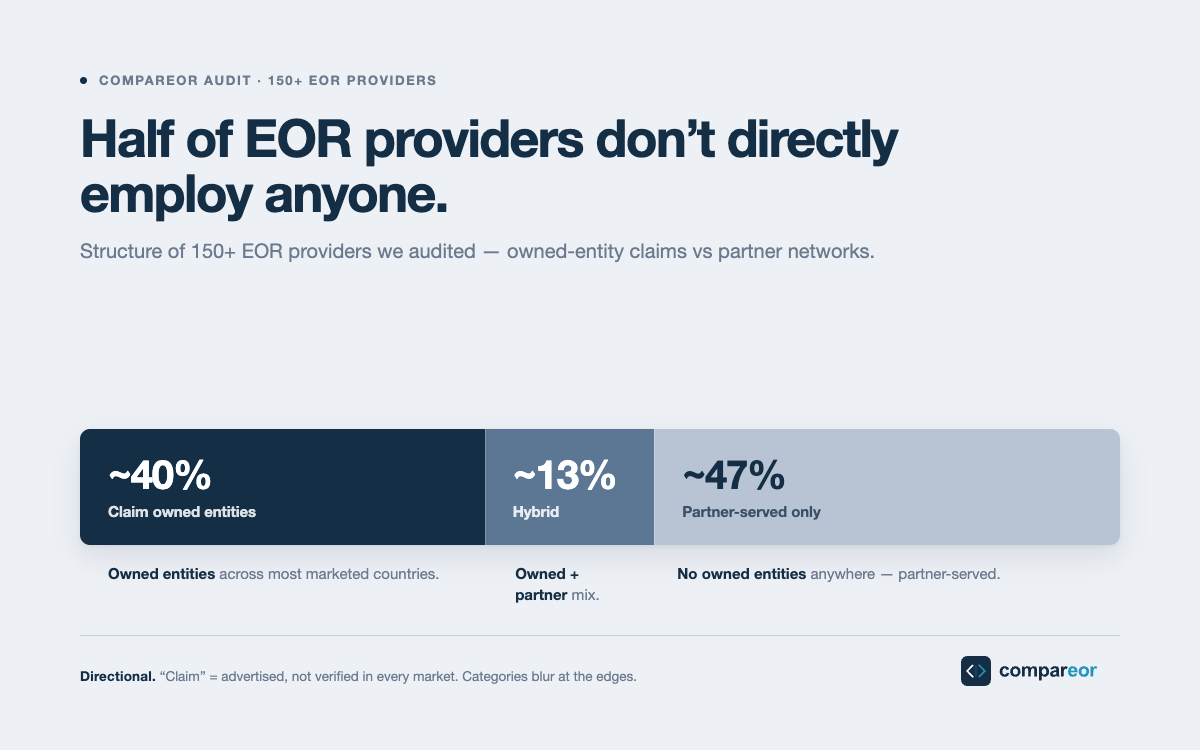
About 40% of EOR providers I audited claim and substantiate owned entities across most of their marketed countries. About 12 to 15% run an honest hybrid. About 45 to 50% are partner-served only, with no owned entities anywhere. The numbers, the methodology, the one honest caveat, and what they mean for buyers.


June 3, 2026
6 min read
Every EOR contract has an expiration date
The EOR model has a built-in expiration date, somewhere between 15 and 20 employees in one country. Past that threshold, the EOR stops being the cheapest option and starts being a tax on growth. Most companies miss it for a year or more, because the contract doesn't mention it and nobody inside is responsible for noticing.

May 25, 2026
5 min read
Why "150+ countries" is the most misleading number in global employment
Every EOR homepage leads with a country count, and after auditing 150+ providers it's the number most likely to lead you to the wrong choice. Coverage comes in three forms, and depth in your countries matters more than breadth across 185 of them.
Stay Updated on Global Hiring
Get weekly insights on EOR trends, compliance updates, and cost-saving strategies

Find a better EOR — without risk
Compare EOR providers to gain insights on cost, coverage, and contract flexibility, ensuring compliance and payroll continuity.


.png)
.png)



