
5 Signs You're Paying Too Much for Your EOR
Most companies overpay for EOR services — often without realising it. Here are the five clearest signals it's time to shop around.


.png)
The EOR market has repriced significantly since 2020
If you signed your Employer of Record (EOR) contract more than 24 months ago and haven't renegotiated since, there's a very real chance you're paying too much for your EOR. The global EOR market has repriced significantly since 2020 — flat fees are down, FX markups have quietly disappeared from top-tier contracts, and service-level expectations have risen. Yet most companies never re-benchmark their provider. They just keep paying.
Between 2020 and 2024, the entry of well-funded global providers — Deel, Remote, Rippling, Multiplier, and a wave of regional specialists — pushed flat monthly EOR fees from the old $800–$1,200 per employee per month range down to $400–$700 per employee per month for most Tier-1 and Tier-2 markets. Several providers now start as low as $99–$199/month for specific countries — see our cheapest EOR providers ranking for the current floor.
At the same time, pricing models have shifted. Percentage-of-salary contracts — once the default for enterprise deals — are now widely considered the expensive option for mid-to-senior hires. Flat-fee contracts dominate new deals. If you haven't revisited your EOR pricing model since 2022, you are almost certainly overpaying on at least one line item. Here are the five clearest signals to look for — and what a fair 2026 contract should actually look like.
Sign 1: Your fee is percentage-based and above 8% of gross salary
Percentage-of-salary EOR contracts charge you a share of the employee's gross compensation every month. They made sense a decade ago when pricing transparency was limited. Today they are the single most common cause of EOR overpayment we see in customer audits.
Do the math. If your contract is 8% of gross salary and your employee earns $4,000/month gross, you're paying at least $320/month per employee — before any add-ons. Scale that to a $6,000/month engineer and you're at $480/month. At $8,000/month, it's $640/month, with no extra service in return. Flat-fee providers charge the same $400–$600/month regardless of salary. The breakeven is clean: for any hire earning more than roughly $5,000–$7,500/month gross, a flat fee will almost always win. We break the math down by country in our guide on how much EOR really costs.
What to do: pull your last invoice and divide the EOR fee by the employee's gross monthly salary. If the ratio is above 7%, request a flat-fee quote from your existing provider first — many will move to a flat model to retain the account. Then benchmark that offer against three flat-fee providers using the Compareor comparison tool.
Sign 2: You're being charged a markup on FX conversion
Currency conversion is the most quietly expensive line on many EOR invoices. Some providers apply a 1–3% markup on the wholesale interbank rate every time they convert your funding currency (usually USD, EUR, or GBP) into the employee's local payroll currency. The markup is often buried in the exchange rate shown on the invoice rather than listed as a separate fee, which makes it easy to miss.
The math looks small until you multiply it. A 2% FX markup on a $5,000/month employee costs you $100/month — $1,200/year. Across a team of 10, that's $12,000/year paid on top of your stated EOR fee, for a service that is already commoditized by major providers. Top-tier EORs now offer mid-market rate conversion at 0% markup as a standard line in their contracts — see our ranking of the best EORs for multi-currency payroll for current market standards.
What to do: request a copy of the exchange rate used on your last three payroll runs and compare it to the wholesale rate for the same date. If the spread is above 0.5%, there's a markup. Ask your provider to confirm the FX policy in writing. For a deeper audit, use our EOR Contract Audit Checklist — FX policy is item #7.
Sign 3: Your support is ticket-only and SLAs are measured in days
At 2026 market rates, $500–$700/month per employee buys more than a generic helpdesk queue. If every payroll question goes through a ticket portal and the standard response time is 48–72 hours, you're paying a premium price for a commodity service level — and the lag compounds.
In practice, slow support creates hidden cost. Your People Ops team has to chase tickets. Employees lose trust when benefits or reimbursements stall. Onboarding a new international hire drags past the 5–7 day window that most top providers now guarantee. None of this shows up on the invoice, but it is the single most common driver of churn we see in our interviews with 50 companies that switched EOR providers.
At current market rates, you should expect a named account manager or dedicated CSM above 5 employees on the platform, same-day response on first-line payroll questions, and a real escalation path — not a generic inbox. If you want to benchmark the support tier you should be receiving, our ranking of the best EOR providers for customer support lists SLA commitments by provider.
Sign 4: You've had repeated payroll errors
One payroll error in 24 months is within operational tolerance — it happens in every system. Two or more is a pattern, and it points to a bigger problem.
Repeated payroll errors are never isolated. They almost always indicate one of three things: under-investment in local entity infrastructure (the provider is using a partner network in your country rather than an owned entity, and handoffs introduce error), a thin compliance team (the provider hasn't staffed local labor-law experts at the ratio their pricing implies), or legacy tooling (manual spreadsheets still run behind the portal, and any edit introduces risk).
Beyond the obvious impact on employee trust, repeated errors carry compliance risk — late or incorrect social contribution filings can trigger local audits, fines, and in some jurisdictions personal liability for directors. Our deep dive on what happens when your EOR gets it wrong walks through where that liability actually lands under a typical EOR contract.
What to do: pull a 24-month history of payroll tickets and categorize them by late payment, wrong amount, wrong tax, or wrong benefit. If you have two or more "wrong amount" or "wrong tax" incidents, treat it as a signal to re-tender. A clean provider in the same country is not hypothetical — it is the market norm. Use our 12-question EOR evaluation checklist when vetting replacements.
Sign 5: You haven't renegotiated or benchmarked in 2+ years
This is the single strongest predictor of overpayment. The EOR market in 2026 is not the market you bought into in 2022. Flat fees have fallen, FX markups have been eliminated by top providers, and contract flexibility — no minimum headcount, month-to-month, no termination fees — is now table-stakes at the top end.
If you have not run a formal benchmark since your original procurement process, three things are probably true at the same time: your per-employee fee is 10–30% above the best current market rate for your country mix; you are paying for at least one line item (FX, offboarding, benefits admin, expense processing) that new contracts include as standard — see our write-up on hidden fees in EOR contracts; and your contract contains terms (auto-renewal, multi-month termination notice, minimum commitment) that no new customer would sign today.
The good news: renegotiation is usually easy once you have a concrete benchmark. Most providers will either match a credible competing offer or concede on at least one expensive line item (FX markup is the first to fall). You rarely need to actually switch to save money — you just need the leverage of having shopped. Run a benchmark using the Compareor comparison tool in under 10 minutes, bring the two best competing quotes to your current provider, and request a match plus removal of any FX markup. If you do decide to move, follow our step-by-step EOR switching guide — a typical clean migration takes 22 days with zero payroll disruption.
The 10-minute EOR overpayment self-audit
If you read through the five signs and aren't sure where you stand, here's a fast way to get clarity without waiting for a sales call. Answer these five questions against your current contract. First: is your fee percentage-based at 8% or above? If yes, you are likely overpaying on hires above $5k/month gross. Second: is FX conversion itemised in your contract, and is the rate you pay within 0.5% of the wholesale rate? If not, you are paying an undisclosed markup. Third: what is your provider's committed response-time SLA in writing? If it's "best effort" or 48+ hours, you're under-serviced. Fourth: how many payroll errors have you had in the last 24 months? Two or more is the switch threshold. Fifth: when did you last benchmark your contract? If the answer is "at signing" or "never", start now.
If you scored overpayment on two or more, it's worth a full audit. The EOR Contract Audit Checklist walks you through the remaining 20 line items most commonly mispriced in legacy contracts.
How much should EOR cost in 2026?
Market-rate flat-fee EOR contracts in 2026 sit at $400–$700 per employee per month for most Tier-1 and Tier-2 countries. Specialist providers in single-country markets — India, Philippines, Vietnam — start from $99–$199/month. See our country-by-country EOR cost breakdown for specifics by market.
Is a percentage-of-salary EOR contract ever cheaper than a flat fee?
Yes — for low-wage hires. Percentage contracts at 6–8% are typically cheaper than flat-fee contracts for employees earning below roughly $4,000–$5,000/month gross. Above that threshold, flat-fee contracts are almost always cheaper. Read the full pricing model comparison.
What is a normal FX markup on EOR payroll?
In 2026, the benchmark is 0% markup at mid-market (interbank) rate. Any visible spread above 0.5% compared to the wholesale rate on the payroll date is effectively a hidden fee.
How long does it take to switch EOR providers without disrupting payroll?
A clean migration, run in parallel, typically takes 22 days. Our EOR migration checklist covers the before-during-after playbook, including employee communication templates.
Can I renegotiate my EOR contract mid-term?
Yes. Most providers will renegotiate mid-term when presented with a credible competing offer, especially on FX markup, minimum commitments, and per-seat price. The leverage is the benchmark, not the threat of churn.
Bottom line
The EOR market has repriced. Flat-fee contracts, mid-market FX, and same-day support are now the standard — not the premium. If your contract predates 2024 and you haven't benchmarked since, you should. Run a free comparison on the Compareor side-by-side tool, pull the two most competitive quotes, and either renegotiate or switch. The average customer who completes this audit with Compareor saves 28% annually on their total EOR spend — and the audit itself takes less than 10 minutes.
Get your shortlist
Takes ~3 minutes. No account needed.
June 3, 2026
6 min read
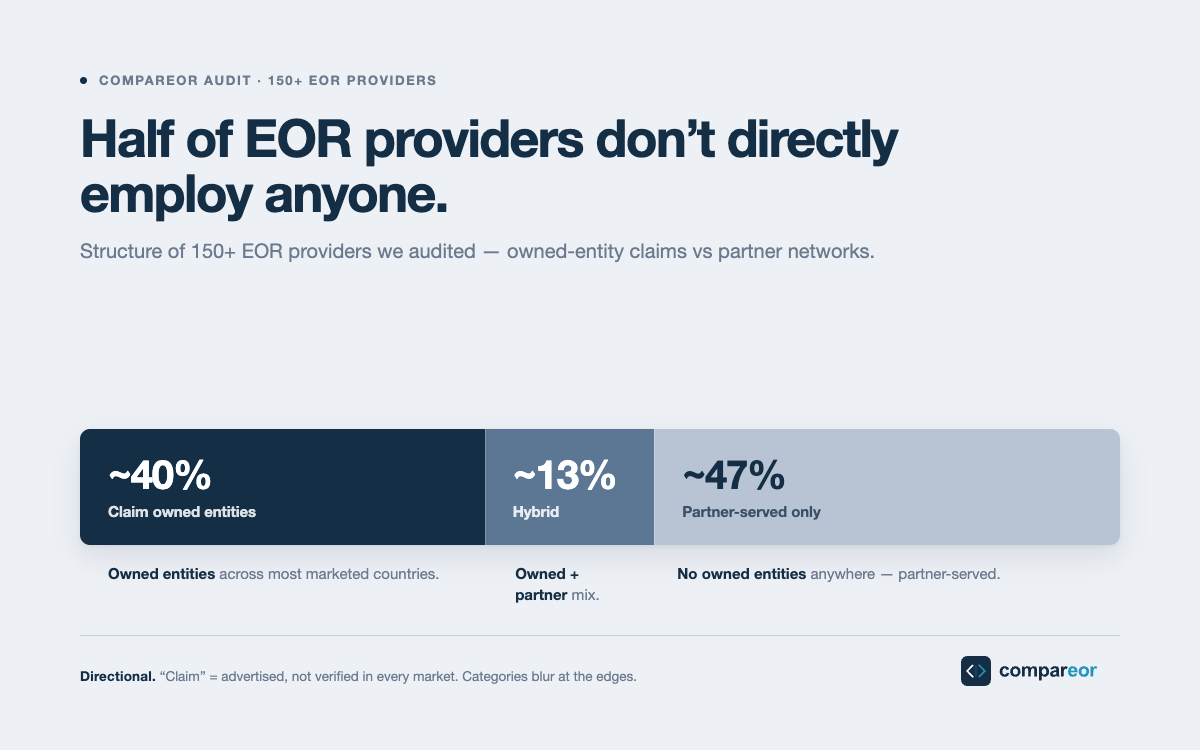
I checked the structure of 150+ EOR providers. Here's how many actually own their entities.
About 40% of EOR providers I audited claim and substantiate owned entities across most of their marketed countries. About 12 to 15% run an honest hybrid. About 45 to 50% are partner-served only, with no owned entities anywhere. The numbers, the methodology, the one honest caveat, and what they mean for buyers.


June 3, 2026
6 min read
Every EOR contract has an expiration date
The EOR model has a built-in expiration date, somewhere between 15 and 20 employees in one country. Past that threshold, the EOR stops being the cheapest option and starts being a tax on growth. Most companies miss it for a year or more, because the contract doesn't mention it and nobody inside is responsible for noticing.

May 25, 2026
5 min read
Why "150+ countries" is the most misleading number in global employment
Every EOR homepage leads with a country count, and after auditing 150+ providers it's the number most likely to lead you to the wrong choice. Coverage comes in three forms, and depth in your countries matters more than breadth across 185 of them.
Stay Updated on Global Hiring
Get weekly insights on EOR trends, compliance updates, and cost-saving strategies

Find a better EOR — without risk
Compare EOR providers to gain insights on cost, coverage, and contract flexibility, ensuring compliance and payroll continuity.


.png)
.png)



