
How to Switch EOR Providers Without Disrupting Payroll
Switching EOR providers is less risky than most companies think — if you follow the right process. Here's the complete migration playbook.


.png)
Why companies switch EOR providers
Most EOR migrations start from one of five pressure points: excessive cost (typically 30–40% above current market rate once the contract has been in place 2+ years), slow or ticket-only support that doesn't scale with the team, compliance concerns after an incident or near-miss, limited or partner-reliant country coverage that now sits on the wrong side of your hiring plan, and platform technology that lags materially behind the modern default. Staying with an underperforming or overpriced provider consistently costs more in the long run than the effort of switching — the real question is execution risk, not whether to move.
This guide walks through the three-phase migration playbook we see working across hundreds of EOR transitions tracked on Compareor. Done well, an EOR switch is invisible to employees: the same net pay, the same benefits, the same working relationship with the client company — only the payroll infrastructure behind the scenes changes. Done badly, it produces double payments, benefits gaps, broken equity vesting, and the kind of employee trust damage that takes a year to repair.
Before walking through the mechanics, test whether switching is the right call in the first place. If your contract is 2+ years old, start with 5 signs you're paying too much for your EOR. If you're pressure-testing specific providers, use the structured diligence in 12 questions to ask before signing an EOR, and compare candidates on the Compareor side-by-side tool.
Before you decide to switch — the diagnostic
Three checks before committing to a migration:
- Benchmark your current rate. Pull two fresh quotes from alternative providers for your exact country mix and headcount. If the gap is under 15% and your current experience is acceptable, a renegotiation with the incumbent often delivers more value than a full switch.
- Read your termination terms. Notice periods, auto-renewal cycles, offboarding fees, and minimum commitment clauses all shape the switch calendar. Most EOR contracts require 30–90 days notice, and some run on 24-month auto-renewal cycles that materially constrain your window.
- Model the one-time switching cost. Legal review, new-provider onboarding time, potential double-run payroll in the transition month, employee communication effort, and any benefits re-enrolment cost. On a 20-person team, a full switch typically costs $15,000–$40,000 in one-time effort and contract-overlap charges — meaningful, but usually paid back inside 6–12 months at any material rate delta.
If the diagnostic points to switching, the rest of this playbook is the execution.
The three phases of an EOR migration
Phase 1 — Preparation (4–6 weeks before go-live)
Preparation is where most migrations succeed or fail. The work here is not visible day-to-day, but the quality of scheduling, contract analysis, and employee communication at this stage determines how smoothly the transition itself runs.
- Select the new provider and negotiate terms. Ensure the new contract start date aligns with your notice period to the current provider — a mismatch here is the most common cause of overlapping payroll charges. Use the EOR Contract Audit Checklist to walk through every line item before signing.
- Review every current employment contract. Identify any non-statutory terms that need to carry over — notice periods, IP clauses, restrictive covenants, equity vesting schedules, signing bonuses, and guaranteed bonus structures. Any clause that was negotiated above the statutory minimum needs to be mirrored in the new agreement, or the employee will (rightly) notice.
- Confirm the outgoing notice period. Most providers require 30–90 days; some 60–180. Serve notice in writing with a defined termination date that aligns with the new provider's onboarding window. Calendar the notice deadline 10 days early — miss the window and you're locked in for another cycle.
- Confirm the new provider's entity readiness per country. Owned-entity markets are typically ready in 2–5 business days; partner-coverage markets can run 7–14 business days. Pressure-test this against the new provider's claims — see EOR providers with fastest onboarding.
- Map benefits continuity per employee. Private health insurance, pension contributions, life and disability cover, meal vouchers — each has to either transfer to the new provider or be re-enrolled. Vesting schedules on pension contributions are particularly important to surface here.
- Communicate the change to employees. Early, in writing, from the client company — not the EOR. Explain what is changing (legal employer, payroll provider) and what is staying the same (role, reporting line, compensation, benefits, tenure). Preempt the common question: "does this reset my tenure or vesting?" — in almost all cases, no, but say so explicitly.
Phase 2 — Transition (2–4 weeks)
Phase 2 is where the mechanical handover happens. Two weeks minimum for a single-country transition; 4 weeks for multi-country to absorb local statutory consultation and visa windows.
- New provider issues compliant employment contracts to each employee. Employees review and sign new agreements before the transfer date. Contract signing is the key gating event — no signature, no transfer.
- Final payroll run with the current provider. Confirm all accrued leave, bonus entitlements, expenses, 13th-month payments (where applicable), and outstanding reimbursements are processed on the final run. Get a final invoice in writing with line-item detail.
- New provider takes over payroll from the agreed transfer date. Ideally the first day of a new payroll cycle — a mid-cycle transfer creates pro-rata calculations on both sides that are a common source of error. First-of-month transfers are the cleanest.
- Benefits transfer or re-enrolment. Pension schemes can typically transfer with continuity; private health insurance often requires re-enrolment with potential waiting periods that must be insured against. Confirm each benefit's continuity approach in writing.
- IT access, expense systems, and HR tools updated to reflect the new provider. SSO provisioning, expense tool re-authentication, HRIS data migration — none of these are hard individually, but missed steps produce payslip delivery failures in week one.
Phase 3 — Stabilisation (first 30 days post-transfer)
The first 30 days determine whether the migration is invisible to employees (the success state) or whether it generates friction that requires months of repair work.
- Verify the first payroll run is accurate. Compare each employee's net pay against their previous payslip. The standard-case outcome is that net pay is identical — gross inputs and statutory deductions should not change with a provider change. Discrepancies need to be resolved within 24 hours.
- Resolve discrepancies immediately. Payroll errors in month one are the single biggest driver of employee anxiety in any EOR migration. Treat any error as a P1 and communicate transparently with the affected employee — "here's what happened, here's when it's fixed, here's confirmation it won't repeat".
- Obtain termination confirmation and final invoices from the previous provider. Get the closed-out status in writing, including confirmation that no further charges will be raised and that the outgoing provider has removed your employees from their systems.
- Archive all employment records from the previous provider. Employment contracts, payslips (minimum 2 years, up to 7 years in some jurisdictions), tax filings, and benefits records. Archive before the outgoing provider's data retention policy lapses.
- Check-in with each employee at day 15 and day 30. Surface any lingering issues before they compound.
Country-specific transition considerations
Multi-country migrations are not uniformly difficult — some markets transfer cleanly, others require additional local process steps that materially extend the timeline.
- Germany — if your EOR's German entity has a works council, any employment changes need to route through council consultation. Build 1–3 weeks into the timeline. See Germany works council EOR guide.
- France — employee transfer between legal employers may be treated as a contract modification requiring specific notice and information procedures. Confirm with the new provider's French counsel.
- Brazil — CLT employment changes require careful documentation; tenure-based rights (vacation, 13th-month accrual, FGTS) must transfer without gap. See the CLT EOR essentiality guide.
- UAE — residency visa is tied to the employer entity. A provider switch means a visa cancellation and re-issuance cycle, which has to be carefully timed against work continuity. See our UAE post-2025 compliance guide.
- China — employment relationship is tied to local entity licensing. Provider switches require careful coordination with FESCO/CIIC-style partners. Build a longer timeline (6–8 weeks) for China-inclusive migrations.
Employee communication playbook
The single most important input to a successful migration is how employees experience the change. A clean communication sequence:
- T-6 weeks: Client company announces the change to employees — rationale, timeline, what's changing, what isn't, who to contact with questions. Delivered by the client, not the EOR.
- T-4 weeks: New provider introduction — welcome communication, onboarding expectations, contract delivery window.
- T-2 weeks: Contract delivery to each employee for review and signature. Include a country-specific FAQ addressing tenure, vesting, benefits continuity, and notice periods.
- T-0 (transfer date): Final communication from client company confirming transfer is complete and naming the new primary contact for payroll questions.
- T+30 days: Check-in communication confirming stabilisation and inviting feedback.
Preempt the four questions every employee will have: does my tenure reset, does my vesting continue, does my net pay change, and who do I talk to about payroll questions going forward. Address all four explicitly in writing.
What to watch out for
Three migration failure modes appear disproportionately often:
- Overlapping payroll periods causing double payment. Triggered by misaligned notice periods or unclear transfer date. Avoided by writing the transfer date into both contracts and confirming the final/first payroll boundaries explicitly with both providers.
- Benefits coverage gaps during transition. Triggered by waiting periods on re-enrolment, particularly for private health insurance. Avoided by confirming day-zero coverage with the new provider in writing, or arranging interim cover.
- Employees left on the old provider's system after the transfer date. Triggered by poor data handoff and incomplete offboarding by the outgoing provider. Avoided by requiring explicit confirmation from the outgoing provider that each employee has been fully offboarded, with written closure.
All three are avoidable with proper scheduling and clear contractual handover terms. The migration calendar is the single most useful artifact you can produce — map every date, owner, and gating event to a shared document and review weekly.
When not to switch
Three patterns where the right answer is to stay and renegotiate rather than migrate:
- Your current provider's rate gap to the market is under 15% and you have no material service complaints — a renegotiation typically closes 60–80% of that gap without the one-time switching cost.
- You're mid-cycle on a complex country-specific process (ongoing termination, active work permit renewal, live equity vesting event) — wait until the process completes before migrating.
- You're within 3–6 months of a major hiring wave — stabilise the current provider's process through the wave and migrate after. Mid-wave migrations multiply operational load.
Frequently asked questions
How long does an EOR migration take end-to-end?
For a single-country transition, 6–10 weeks end-to-end (4–6 weeks prep + 2–4 weeks transition). For multi-country migrations, 10–14 weeks is typical. Specific markets (Germany, UAE, China) can extend the timeline further. Plan conservatively — compressed timelines are where errors happen.
Does switching EOR reset employee tenure?
In most cases, no — but it depends on the jurisdiction. Many countries recognise continuity of service across a change of legal employer, particularly when the working relationship with the client company is unchanged. Confirm per country with the new provider's local counsel, and communicate the outcome explicitly to employees.
Can I switch EOR providers mid-contract?
Yes, but review your current contract's termination terms carefully. Most EOR contracts allow termination with 30–90 days written notice. Early termination fees may apply; minimum commitment periods may constrain timing. Factor these into the switching cost calculation.
What happens to equity and benefits during an EOR switch?
Equity held by the client company is unaffected by an EOR change — the grants are between the employee and the client, with the EOR acting as paymaster for any taxable events. Benefits (pension, health, insurance) need to be either transferred with continuity or re-enrolled; surface the approach with both providers and communicate the outcome to employees.
What's the biggest risk in an EOR switch?
Payroll errors in the first month post-transfer. They're the most employee-visible failure mode and the hardest to recover trust from. Mitigate by running a final-payroll reconciliation with the outgoing provider, verifying the first payroll run line-by-line, and escalating any discrepancy as a P1.
Bottom line
An EOR migration is a logistics problem, not a legal one. Done well — with 4–6 weeks of preparation, a clean transfer calendar, and disciplined employee communication — it's invisible to employees and typically pays back the one-time switching cost inside 6–12 months. Done badly, it produces double payments, benefits gaps, and employee trust damage that takes a year to repair.
Before committing, confirm the rate gap is large enough to justify the effort, benchmark alternatives on the Compareor side-by-side tool, and walk through the EOR Contract Audit Checklist before signing the new agreement. Once committed, the three-phase playbook above is the repeatable operating model.
Get your shortlist
Takes ~3 minutes. No account needed.
June 3, 2026
6 min read
I checked the structure of 150+ EOR providers. Here's how many actually own their entities.
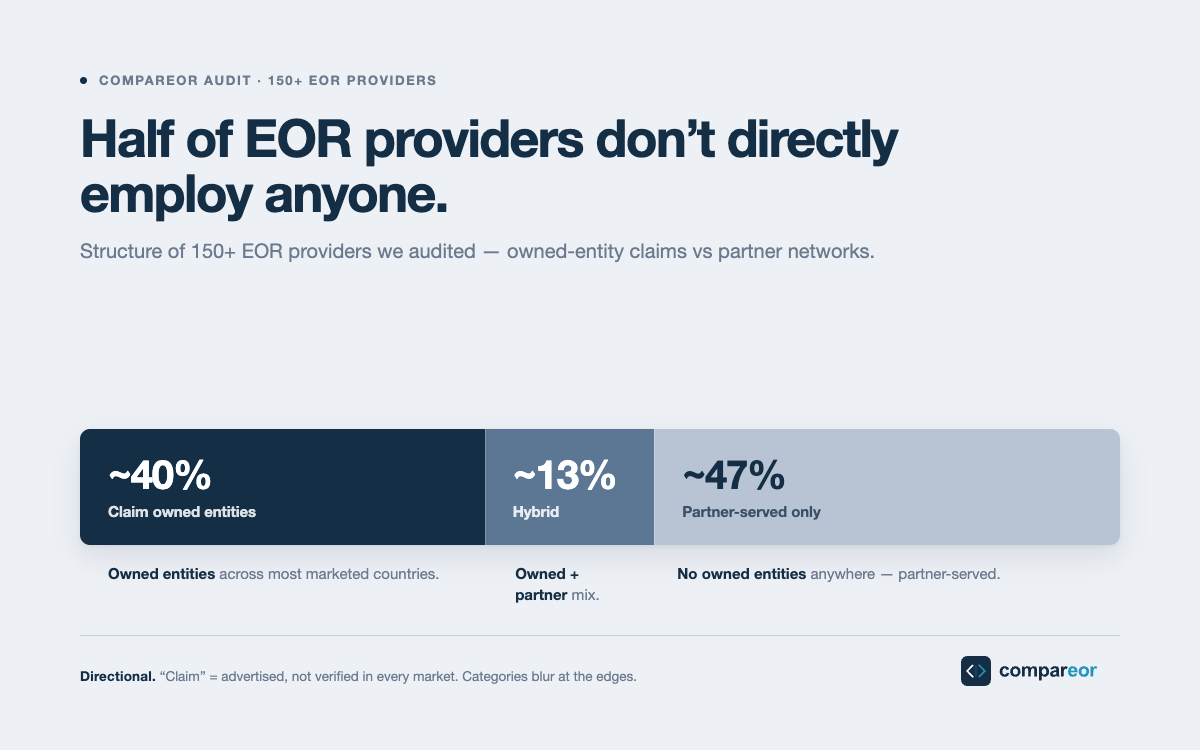
About 40% of EOR providers I audited claim and substantiate owned entities across most of their marketed countries. About 12 to 15% run an honest hybrid. About 45 to 50% are partner-served only, with no owned entities anywhere. The numbers, the methodology, the one honest caveat, and what they mean for buyers.


June 3, 2026
6 min read
Every EOR contract has an expiration date
The EOR model has a built-in expiration date, somewhere between 15 and 20 employees in one country. Past that threshold, the EOR stops being the cheapest option and starts being a tax on growth. Most companies miss it for a year or more, because the contract doesn't mention it and nobody inside is responsible for noticing.

May 25, 2026
5 min read
Why "150+ countries" is the most misleading number in global employment
Every EOR homepage leads with a country count, and after auditing 150+ providers it's the number most likely to lead you to the wrong choice. Coverage comes in three forms, and depth in your countries matters more than breadth across 185 of them.
Stay Updated on Global Hiring
Get weekly insights on EOR trends, compliance updates, and cost-saving strategies

Find a better EOR — without risk
Compare EOR providers to gain insights on cost, coverage, and contract flexibility, ensuring compliance and payroll continuity.


.png)
.png)



