
The Best EOR Providers for Startups Under 20 Employees
Small teams have different EOR needs than enterprises. Here's which providers are actually built for early-stage companies.


.png)
Why startup EOR needs are different
Enterprise buyers of Employer of Record (EOR) services optimise for coverage breadth, HRIS integration depth, dedicated customer success, and procurement-grade contracts. Startups under 20 employees need a different product: fast self-serve onboarding, flat-fee pricing that does not balloon as you hire senior talent, minimal contract commitment, and a no-touch workflow that does not require an HR team to operate.
The mismatch between enterprise-optimised providers and early-stage needs is one of the most common procurement mistakes we see. Startups that sign long-dated enterprise contracts spend two to three times what they should, lock themselves into pricing models that punish seniority-heavy hiring, and build operational habits (ticketing queues, manual email add-employee flows) that do not scale. This guide maps what startups actually need, the providers that match, and the pitfalls to sidestep.
For the broader shortlist in adjacent categories, see the top 10 EOR providers for startups, the top 10 EOR providers for a first-time global hire, and the top 10 EOR providers for small businesses.
What to prioritise at under 20 employees
Five criteria matter more than anything else at this stage. If a provider falls short on any of them, the cost or the operational overhead will eventually bite.
Flat monthly fee pricing
Percentage-of-salary pricing (typically 5–15% of gross monthly salary) looks cheaper on junior roles but becomes materially more expensive as you hire senior technical or go-to-market talent. A 10% provider on a €120,000-salary engineer is €1,000/month — almost 2x the flat-fee benchmark. For the side-by-side maths, see EOR pricing models explained. At under 20 employees you want predictability; flat-fee delivers it.
No minimum employee commitments
Some providers require a minimum of 3, 5, or even 10 employees to unlock their published pricing — a structure that makes sense for mid-market buyers and is a landmine for a founder hiring their second international contractor-to-employee conversion. Benchmark explicitly against the top EOR providers with no minimum headcount.
Short or no lock-in periods
A 12-month EOR contract at a 20-person company is a commitment to the provider's roadmap, pricing, and customer success model — three things you cannot reliably forecast a year out. Month-to-month or 90-day rolling arrangements preserve optionality. See the top EOR providers with no annual contract.
Self-serve onboarding
At early stage, hiring does not run through an HR ops team — it runs through the founder or ops lead. Adding a new employee should take 10–15 minutes of portal work, not a back-and-forth email chain with a named account manager. Self-serve platforms compound: each added employee is marginal effort, not a fresh procurement cycle.
Transparent offboarding costs
Termination fees, statutory severance pass-throughs, notice-period payroll, and deposit return policies are where small-scale hires routinely get surprised. Ask explicitly before signing: "What does it cost me to offboard an employee in each target country?" See hidden fees in EOR contracts for the full line-item audit and benchmark against the top EOR providers with transparent pricing.
The economics — why flat-fee wins at startup scale
A simple worked example. A startup hires a senior engineer in Portugal at €90,000 gross salary. Employer social charges are roughly 24% (€21,600/year). Two pricing structures:
- Flat fee at $599/month: ~€7,200/year in EOR fees. Total fully loaded cost: ~€118,800/year.
- Percentage fee at 10% of gross: ~€9,000/year in EOR fees — 25% higher than the flat-fee equivalent. Total fully loaded cost: ~€120,600/year.
The gap widens at higher salary levels. For a €150,000 role, the percentage model runs €15,000/year vs €7,200/year for flat-fee — more than 2x. For startups hiring the first five to twenty employees in expensive talent categories (engineering, design, go-to-market), flat-fee is almost always the right structural choice. See how much EOR really costs country-by-country for cross-market benchmarks.
Top picks for startups
Deel
Deel's flat $599/month per employee pricing, no minimum commitment, self-serve platform, and 150+ country coverage make it the default choice for the majority of early-stage companies hiring internationally. The onboarding flow is among the fastest in the market, the contractor management product (from $49/month) gives you a single pane of glass across contractor and employee relationships, and the contractor-to-employee conversion tool is genuinely useful when IR35 or European reclassification risk pushes you to convert.
Where Deel is weaker: complex European termination cases, works-council-heavy markets (though it has improved here), and large multi-entity consolidation plays — but those are not typical under-20-employee problems. For a deeper look, see the Deel review and the Deel alternatives.
Remote
Remote matches Deel's $599/month per employee headline with an explicit no-FX-markup commitment — a meaningful cost point at senior salary levels. Its compliance-first positioning, backed by owned entities across the major European markets, is particularly valuable for startups without in-house legal teams. Remote also runs a low-cost contractor management tier from $29/month, which is the lowest entry point among tier-1 providers.
For startups hiring in Germany, France, the Netherlands, Spain, or the UK, Remote is often the stronger choice. See the Remote alternatives for comparators.
Multiplier
Multiplier is the stand-out for startups hiring in Asia-Pacific. Deep presence in India, Singapore, the Philippines, Vietnam, and Indonesia combined with competitive pricing often makes it the most cost-effective option for the first APAC hire. The platform is self-serve and onboarding is fast in its strongest markets. For non-APAC hires, other providers typically outperform Multiplier — but for a Mumbai or Manila engineer, it's frequently the right call.
See the India country guide, Singapore country guide, Philippines country guide, and the Multiplier alternatives.
Rippling (with a caveat)
If your startup is already running Rippling HRIS for your US workforce, adding Rippling EOR for international hires has low marginal friction and the unified data model is a real operational win. Standalone-EOR-only buyers, though, typically pay a premium relative to Deel or Remote without capturing the platform benefit. The rule of thumb: Rippling EOR is great if you are already on Rippling; otherwise, Deel or Remote is usually the cleaner call.
Borderless AI
The fastest-rising alternative to the incumbents. Published $579/month pricing, a no-minimum policy, AI-native platform, and strong G2 ratings position Borderless as a legitimate challenger at startup scale. Country coverage is narrower than Deel or Remote but expanding rapidly. Worth an evaluation for US-headquartered startups hiring in the top 20–30 markets.
Country-specific fit at startup scale
Your country mix often determines the optimal provider. A few common patterns:
- Europe-heavy (UK, Germany, France, Spain, Netherlands): Remote is the most common best-fit. See the remote hiring playbook for US companies expanding to Europe.
- APAC-heavy (India, Singapore, Philippines, Vietnam): Multiplier or a regional specialist tends to win on price and onboarding speed.
- LatAm-heavy (Mexico, Brazil, Colombia, Argentina): Deel has the strongest published coverage, though local specialists can be cheaper for high-volume single-country hiring.
- Mixed global footprint (5+ countries across continents): Deel or Remote for coverage breadth — pick based on whether you lean toward price/UX (Deel) or compliance depth (Remote).
- Single-country first hire: A country specialist can out-price the generalists on a single engagement. Benchmark via the Compareor comparison tool.
What to avoid
Five anti-patterns that routinely trap early-stage buyers:
- Minimum billing commitments of 3+ employees. Walk away. At 2–3 hires, the minimum equates to a 50–100% price premium. For the right shortlist see the no-minimum-headcount rankings.
- Percentage-of-salary pricing on senior technical hires. The model optimises for the provider, not you. See 5 signs you're paying too much for your EOR for the broader cost-posture check.
- Long-form RFP processes. At under 20 employees you should be able to evaluate, negotiate, and sign in under a week. Any provider that insists on multi-stakeholder diligence, security reviews, and legal negotiation for a sub-$10K/year deal is optimised for a different customer.
- FX markup on international payroll. A 1–3% spread on currency conversion compounds across a full year at senior salary levels into thousands of dollars. Ask explicitly, and get the answer in writing.
- Termination-event surcharges. Statutory severance is a pass-through; provider termination fees on top are a red flag. Confirm the offboarding cost structure before signing.
For the full pitfalls list, see hidden fees in EOR contracts and the cheapest EOR providers ranking.
How to evaluate an EOR in under a week
A 5-day procurement cycle is achievable at startup scale. A workable timeline:
- Day 1 — scope. Confirm target countries, expected headcount, seniority profile, and any must-have integrations (HRIS, accounting). Write one page.
- Day 2 — shortlist. Use the Compareor comparison tool to surface 3–5 providers matching your profile. Pull published pricing and verify no-minimum and no-lock-in policies.
- Day 3 — demos. 30-minute walkthrough with 2–3 shortlisted providers. Ask them to add a test employee live in the demo.
- Day 4 — quotes. Request written quotes including any country-specific surcharges, offboarding cost, FX markup, and platform fee. Walk through the 12 evaluation questions and the EOR selection checklist.
- Day 5 — decide and sign. Pick based on total fully-loaded cost, country fit, and platform UX. Sign a month-to-month contract unless there's a compelling reason to lock in longer.
When to revisit your EOR choice
At under 20 employees, the right provider at hire 3 may not be the right provider at hire 30. Triggers to re-evaluate:
- You cross into a new major region (e.g., first European hire on top of a US-only baseline).
- Senior hiring pushes your average salary materially upward — re-run the flat-fee-vs-percentage maths.
- You encounter a complex case (contested termination, works-council consultation, cross-border dispute) and the provider's response falls short.
- You consolidate tooling and want a unified HRIS+EOR stack (the moment Rippling becomes more compelling).
Switching EOR providers at 10–20 employees is operationally manageable — typically 6–8 weeks end-to-end. For companies planning multi-country distribution from the start, how to build a remote team across 5 countries without entities models the full decision framework.
Frequently asked questions
Can I use a contractor platform instead of an EOR at startup scale?
For genuinely project-based, under-6-month engagements with a worker who has multiple clients — yes. For long-term operational roles, no. The misclassification risk in Brazil, France, Germany, the UK, and China is high enough that a multi-year contractor engagement is more expensive in expected-value terms than converting to EOR employment. See should you hire contractors or employees internationally.
What's the minimum EOR cost I should expect per employee?
For the tier-1 providers (Deel, Remote, Borderless), expect $579–$599/month per employee plus statutory employer contributions (ranging from ~8% in the Philippines to 45% in France). Country specialists can come in meaningfully lower in specific markets — $99–$350/month in some APAC and African markets. See the cheapest EOR providers ranking.
Do I need a lawyer to review an EOR contract at startup scale?
Usually not, if you're signing a standard template from a tier-1 provider with published pricing. You should read the termination, liability, and indemnity clauses carefully, but a full legal review is rarely necessary under 20 employees. If the provider is insisting on bespoke terms or has non-transparent pricing, that's a signal to either walk away or get the lawyer involved.
How fast can I actually onboard a first international employee?
Varies by country. UAE, Singapore, UK, and US can complete end-to-end in 1–4 business days with a self-serve provider. Germany, France, Brazil, and India run 1–4 weeks. See the fastest-onboarding providers.
Should I switch from Deel to Remote (or vice versa) as I scale?
Only if you have a concrete reason — a compliance case that went poorly, a country where the other provider has materially better coverage, or a cost structure that no longer fits. Switching at 5–15 employees for the sake of switching is more overhead than benefit. Switching because you've hit a real operational wall is worth the 6–8 week migration.
Bottom line
For most startups under 20 employees, Deel or Remote is the right call, and the decision between them comes down to whether you prioritise platform UX and country coverage (Deel) or compliance depth in Europe (Remote). For APAC-concentrated hiring, Multiplier is typically the better fit. For US-heavy stacks already on Rippling, adding Rippling EOR is frictionless. Borderless is the credible challenger worth a 30-minute evaluation.
Run the top three through the Compareor comparison tool, cross-reference against the top startup EOR rankings, and walk through the selection checklist before signing. Month-to-month unless there's a compelling reason otherwise, flat-fee unless you're only hiring junior talent, and self-serve unless you already have an HR ops team in place.
Get your shortlist
Takes ~3 minutes. No account needed.
June 3, 2026
6 min read
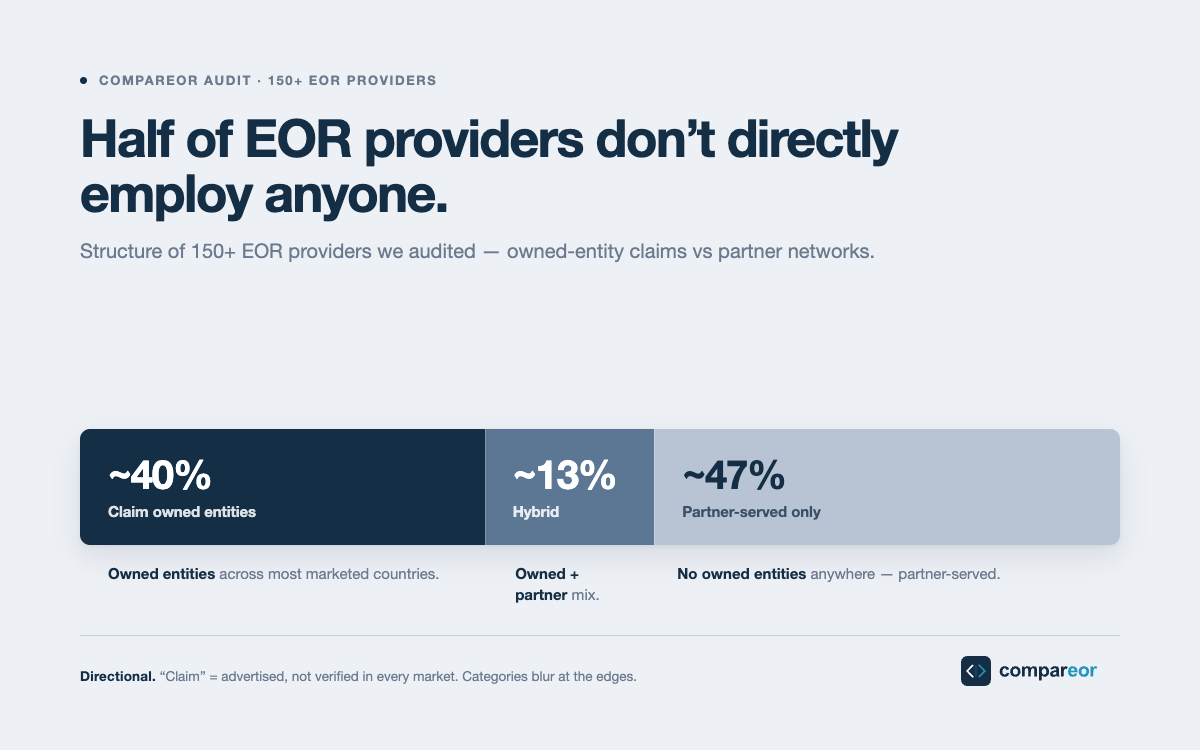
I checked the structure of 150+ EOR providers. Here's how many actually own their entities.
About 40% of EOR providers I audited claim and substantiate owned entities across most of their marketed countries. About 12 to 15% run an honest hybrid. About 45 to 50% are partner-served only, with no owned entities anywhere. The numbers, the methodology, the one honest caveat, and what they mean for buyers.


June 3, 2026
6 min read
Every EOR contract has an expiration date
The EOR model has a built-in expiration date, somewhere between 15 and 20 employees in one country. Past that threshold, the EOR stops being the cheapest option and starts being a tax on growth. Most companies miss it for a year or more, because the contract doesn't mention it and nobody inside is responsible for noticing.

May 25, 2026
5 min read
Why "150+ countries" is the most misleading number in global employment
Every EOR homepage leads with a country count, and after auditing 150+ providers it's the number most likely to lead you to the wrong choice. Coverage comes in three forms, and depth in your countries matters more than breadth across 185 of them.
Stay Updated on Global Hiring
Get weekly insights on EOR trends, compliance updates, and cost-saving strategies

Find a better EOR — without risk
Compare EOR providers to gain insights on cost, coverage, and contract flexibility, ensuring compliance and payroll continuity.


.png)
.png)



