
Deel Review 2026: Pricing, Coverage, and What Customers Actually Say
Deel is the world's largest EOR provider. Here's an honest assessment of its pricing, coverage, platform, and where it falls short.


.png)
Deel at a glance
Deel is the market leader in Employer of Record (EOR) services in 2026, with operations in 150+ countries and a reported customer base of 35,000+ companies. Founded in 2019, the platform serves everyone from two-person startups to Fortune 500 enterprises and has raised over $680 million in venture funding, reaching unicorn status in 2021 and crossing $1B in annual recurring revenue in 2025. On the Compareor editorial scorecard it rates 4.8/5, the highest among global EOR providers.
The short version: Deel is the safest default choice for multi-country hiring in 2026, especially if you want a single platform covering EOR, contractor management, and global payroll. It is not always the cheapest option, and it is not the strongest choice if you are concentrated in a single region where a specialist provider has deeper local entity coverage. See the full Compareor profile and ratings on the Deel provider page.
Deel pricing in 2026
Deel uses a flat per-employee-per-month fee structure — no percentage-of-salary component, which is a structural advantage for any hire earning above ~$5,000/month gross. The public starting rate is $599/month per employee for EOR services in most markets, with custom pricing available for volume commitments and specific country combinations. Contractor management starts at $49/month per contractor. We unpack the flat-fee vs percentage math in our guide to EOR pricing models.
On FX, Deel converts at the mid-market interbank rate with no markup for most currencies — a genuine differentiator against providers that still charge 1–3% conversion spreads. For a $5,000/month employee, a 2% FX markup costs $1,200/year, so the zero-markup policy is material. Deel is listed in our top 10 EOR providers with transparent pricing and in the ranking of best EORs for multi-currency payroll.
The line items to watch on any Deel contract — same as with any EOR — are offboarding fees, benefits administration on top of the headline rate, annual escalators, and minimum commitment terms. None of these are unusual for Deel, but all are negotiable, especially above 10 seats. Our guide to hidden fees in EOR contracts covers the full checklist; if your current EOR contract is 2+ years old, also run through the 5 signs you're overpaying before your next renewal.
Country coverage and entity model
Deel operates through a hybrid model: ~250 owned legal entities in its highest-volume markets (including the US, UK, Germany, Netherlands, Singapore, Australia, and most of Western Europe) and vetted local partners in lower-volume jurisdictions. Coverage spans 150+ countries for EOR and 180+ for contractor management.
The entity model matters for two reasons. First, owned-entity coverage generally means faster onboarding, cleaner compliance handoffs, and direct liability sitting with Deel rather than a third-party partner. Second, the gap between owned-entity markets and partner markets is where experience tends to diverge — support quality, termination speed, and local employment law nuance are all tighter in owned-entity countries. This is a pattern across the market, not unique to Deel.
If your hiring is concentrated in Deel's owned-entity footprint, coverage is a non-issue. If you're hiring primarily in APAC (outside Singapore and Australia) or Africa, it's worth comparing against regional specialists — Deel still covers those markets, but you may get deeper local expertise elsewhere. See the full alternatives comparison at Best Deel alternatives (2026).
Platform and product experience
Deel's platform is consistently rated as best-in-class for usability among EOR providers, and this is the single most common reason customers pick it over cheaper competitors. The onboarding flow (contract generation, country-specific right-to-work, benefits enrollment) is the fastest in the market — typical time-to-first-payroll is 2–3 business days in owned-entity countries, which lands Deel in our ranking of the EOR providers with the fastest onboarding.
Day-to-day the platform handles contracts, payslips, PTO, expense management, benefits, and document storage in a single interface. The employee-facing mobile app is widely adopted and generally well-reviewed. For HR leaders, the admin console provides country-level compliance views, cost breakdowns per hire, and audit-ready documentation.
Integrations
Deel publishes 300+ native integrations covering the major HRIS systems (Workday, BambooHR, HiBob), chat and collaboration (Slack, MS Teams), accounting (QuickBooks, Xero, NetSuite), SSO (Okta, Azure AD), and expense management platforms. For most mid-market tech stacks, Deel is already pre-integrated — which matters more in practice than headline country coverage for teams that manage payroll cycles through an existing HRIS.
Customer support — the real picture
Deel's support is a mixed signal in customer reviews and in our own interviews. In owned-entity markets and for customers above ~10 seats, dedicated CSM support is the norm and response times are same-day. In lower-volume countries and for single-hire accounts, support is ticket-based and response times can stretch to 48–72 hours. Termination processes in complex markets (France, Germany, Brazil) are also slower than the platform's default UX suggests — not because of Deel specifically, but because those countries simply take longer to execute compliantly.
If support responsiveness is a top-three priority for you — common for companies that have been burned by a previous provider — benchmark Deel against the full ranking of EOR providers with the best customer support. The specialist providers on that list often win on SLA, at the tradeoff of narrower country coverage.
What customers actually say
Across public reviews (G2, Trustpilot) and our direct customer interviews, the signal is consistent.
Positive themes: the platform UX is best-in-class; onboarding is fast in owned-entity countries; the zero-markup FX policy is a real cost advantage; integrations cover the major tech stack without custom work; contractor-to-EOR conversion is straightforward on-platform; and the breadth of covered jurisdictions means one vendor relationship scales with most expansion plans.
Negative themes: support quality varies by market and account size; termination execution in complex markets is slower than the UX implies; the partner-country experience can feel different from the owned-entity one; and for very small or very price-sensitive customers, cheaper providers exist for single-country hiring.
Who Deel is best for
- Companies hiring in 3+ countries that want a single platform rather than a stack of regional providers.
- Startups and scale-ups that prioritise speed of onboarding and platform UX — see the EOR providers for startups ranking for the competitive set.
- Tech and SaaS companies that need HRIS, SSO, and developer-platform integrations out of the box. Deel ranks in the best EOR providers for tech and SaaS.
- Companies hiring primarily in Deel's owned-entity markets (US, UK, Western Europe, Singapore, Australia).
- Enterprise teams that want dedicated CSM coverage and are large enough to command it — see the enterprise EOR providers shortlist.
- Mixed contractor + EOR workforces where on-platform conversion matters for compliance hygiene.
Who should look elsewhere
- Companies hiring primarily in APAC (outside Singapore and Australia) or Africa, where regional specialists often offer deeper local entity coverage and higher-touch local compliance expertise.
- Very cost-sensitive single-country hires where a cheaper specialist may be 30–50% less per seat — see the cheapest providers ranking and the Deel alternatives page.
- Companies whose primary buying criterion is high-touch support with guaranteed same-day SLA in every country — the smaller, specialist providers often win on that dimension.
- Mid-market teams that specifically need bundled HR + IT provisioning (device management, identity) as a single platform — that's where Deel's closest platform rival is stronger. See our Rippling review.
Top Deel alternatives to compare
If Deel is on your shortlist, it's worth benchmarking against at least two comparable providers before signing. The three we see most often in head-to-head comparisons:
Remote — 100% owned-entity model, same $599/month starting point, stronger IP protection framework and a more compliance-first positioning. Often chosen by tech companies with IP concerns hiring in Europe.
Multiplier — from $400/month, positioned as the best value in the global EOR mid-market. Often chosen when Deel's $599 rate is the blocker and the use case doesn't require Deel's full platform breadth.
Rippling — bundles EOR with HRIS and IT provisioning (device management, identity, app access). Often chosen by tech companies that want a single platform for both people and IT ops, not just payroll.
Run a live benchmark against all three on the Compareor side-by-side comparison tool, or browse the full field in the EOR providers directory.
Frequently asked questions
How much does Deel cost in 2026?
Deel's public starting rate is $599/month per employee for EOR in most markets, with custom pricing above 10 seats and for volume commitments. Contractor management starts at $49/month. There is no percentage-of-salary component, which makes Deel competitive for mid-to-high-salary hires.
Does Deel charge FX markup on payroll conversion?
No — Deel converts at the mid-market interbank rate with no markup for most currencies. This is the current best-practice standard among top-tier EOR providers and meaningfully cheaper than providers still applying 1–3% spreads.
How fast can Deel onboard a new employee?
Typical time-to-first-payroll is 2–3 business days in Deel's owned-entity markets (US, UK, Western Europe, Singapore, Australia). In partner-coverage countries, onboarding runs closer to 5–7 business days, in line with market norms for those jurisdictions.
Does Deel use owned entities or third-party partners?
Both. Deel operates roughly 250 owned entities in its highest-volume markets and uses vetted local partners in lower-volume jurisdictions. If owned-entity coverage in a specific country is material to your decision, ask Deel to confirm the entity model for that market in writing.
Is Deel worth the $599/month price tag?
For most multi-country hires above roughly $5,000/month gross salary, yes — the flat fee plus zero FX markup is competitive, and the platform UX saves material People Ops time. For single-country hires in a market with a strong specialist provider, or for very cost-sensitive customers under 5 seats, a cheaper alternative often wins. See the 12-question EOR evaluation checklist for a structured comparison framework.
Bottom line
Deel is the default pick for multi-country EOR in 2026, and the platform has earned that position through consistent execution on onboarding speed, UX, FX policy, and integration breadth. It is not the cheapest option, and it is not always the best option in partner-coverage countries. If your hiring is concentrated in Deel's owned-entity footprint and you value a single platform across EOR, contractors, and payroll, Deel is very hard to beat. If you're price-sensitive, single-country, or heavy in APAC-ex-Singapore or Africa, benchmark before you sign.
Run the comparison on the Compareor side-by-side tool — pull Deel alongside two alternatives and the answer usually clarifies itself within 10 minutes.
Get your shortlist
Takes ~3 minutes. No account needed.
June 3, 2026
6 min read
I checked the structure of 150+ EOR providers. Here's how many actually own their entities.
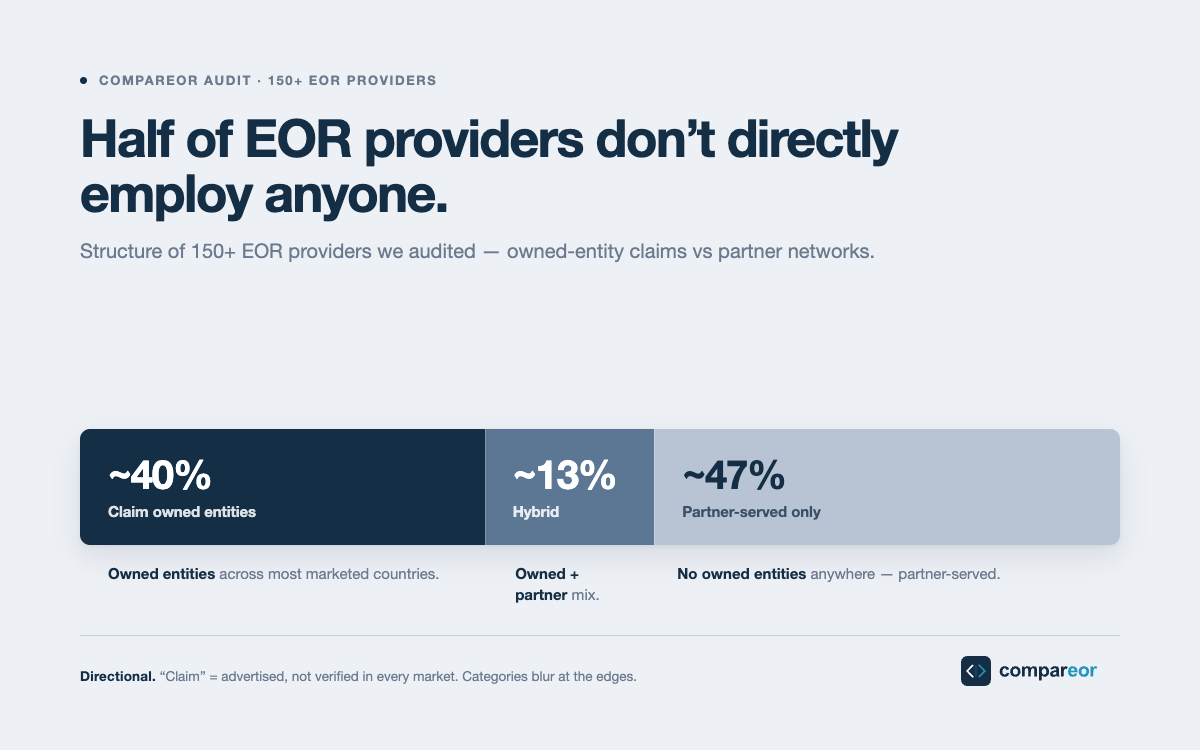
About 40% of EOR providers I audited claim and substantiate owned entities across most of their marketed countries. About 12 to 15% run an honest hybrid. About 45 to 50% are partner-served only, with no owned entities anywhere. The numbers, the methodology, the one honest caveat, and what they mean for buyers.


June 3, 2026
6 min read
Every EOR contract has an expiration date
The EOR model has a built-in expiration date, somewhere between 15 and 20 employees in one country. Past that threshold, the EOR stops being the cheapest option and starts being a tax on growth. Most companies miss it for a year or more, because the contract doesn't mention it and nobody inside is responsible for noticing.

May 25, 2026
5 min read
Why "150+ countries" is the most misleading number in global employment
Every EOR homepage leads with a country count, and after auditing 150+ providers it's the number most likely to lead you to the wrong choice. Coverage comes in three forms, and depth in your countries matters more than breadth across 185 of them.
Stay Updated on Global Hiring
Get weekly insights on EOR trends, compliance updates, and cost-saving strategies

Find a better EOR — without risk
Compare EOR providers to gain insights on cost, coverage, and contract flexibility, ensuring compliance and payroll continuity.


.png)
.png)



