
EOR vs Hiring Locally: A Full Cost Comparison for 10 Key Markets
When does EOR cost more than setting up locally? A market-by-market comparison with real numbers.

.png)
The question every finance leader asks
Employer of Record (EOR) services are almost always the right answer for your first international hire in a country. What finance leaders want to know is when that stops being true — at what headcount does the monthly EOR fee outgrow the cost of setting up and running a local entity? The answer varies dramatically by market. In the UAE or Singapore, entity setup becomes cost-competitive above 2–3 employees. In Brazil or France, EOR remains the better economic choice well past 5 employees because entity setup and maintenance are materially more expensive.
This guide runs the break-even math across 10 key markets — United Kingdom, Germany, France, Spain, India, Mexico, Brazil, UAE, Singapore, and the United States — so you can see where your specific hiring plan lands. It then covers the factors the pure cost math leaves out: compliance complexity, time-to-productive-headcount, and risk. For the foundational framing on when to pick each model, see our comparison of EOR vs PEO vs entity setup.
How to read the break-even math
The break-even calculation is deceptively simple on its surface. Add the first-year cost of entity setup (legal formation, registration, banking, initial tax registration) to the annualised cost of running it (accounting, payroll, tax filings, mandatory audits). Divide by the annual EOR cost per employee. The quotient is the employee count at which entity economics start winning.
In practice, three adjustments matter. First, entity setup takes 4–16 weeks depending on the country, during which time you still need EOR (or no hires at all). Second, the ongoing entity running cost is a fixed floor — whether you have 1 or 10 employees under that entity, it costs roughly the same to run. Third, local entities carry liability and compliance management overhead that doesn't appear in the spreadsheet but does appear on the GC's desk. See our complete guide to Employer of Record for what an EOR actually takes off your plate.
The entity setup cost baseline
Across most Tier-1 and Tier-2 markets, setting up a local entity costs $5,000–$40,000 in legal formation, registration, banking, and compliance setup fees. Ongoing maintenance (accounting, tax filing, statutory audits, payroll admin, registered agent) runs $4,000–$25,000 per year. In the most complex markets — Germany, France, Brazil — total first-year cost frequently reaches $30,000–$60,000. The EOR comparable across these same markets is $400–$700 per employee per month, so the math swings hard on how many employees you intend to hire.
Break-even analysis by market
United Kingdom
EOR cost: approximately £500/month × 12 = £6,000/year. UK Ltd setup: £8,000–£15,000 legal/accounting + £5,000–£8,000/year ongoing (accounting, payroll, Companies House filings, PAYE registration). Break-even: roughly 3–4 employees. The UK is among the easier entity markets — 2–4 week setup, mature professional services infrastructure, English-language compliance — so entity economics improve quickly once break-even is reached. See current providers in the UK hiring guide.
Germany
EOR cost: approximately $650/month × 12 = $7,800/year. GmbH setup: $15,000–$25,000 legal/notary/banking + $8,000–$15,000/year ongoing (Steuerberater accounting, payroll, statutory audits above thresholds). Break-even: roughly 3–4 employees on pure cost. In practice, most companies extend EOR to 8–10 employees in Germany because the compliance complexity — Works Council thresholds, strict dismissal protections after six months, data-protection obligations — materially raises the cost of running the entity beyond the spreadsheet figures. See the Germany hiring guide and the top 10 EOR providers for Germany.
France
EOR cost: approximately $650/month × 12 = $7,800/year. SARL/SAS setup: $12,000–$20,000 legal/accounting + $8,000–$15,000/year ongoing (URSSAF registration, expert-comptable, social audits, CSE obligations at 11+ employees). Break-even: roughly 4–5 employees. France's employer charges (42–47% on top of gross) and collective bargaining framework mean the non-cost overhead of running an entity is unusually high — EOR often remains the better operational choice past break-even for teams under 15 employees. See the France hiring guide.
Spain
EOR cost: approximately $550/month × 12 = $6,600/year. SL setup: $8,000–$15,000 legal/notary + $6,000–$10,000/year ongoing (gestoría, payroll, Social Security filings, collective bargaining compliance). Break-even: roughly 3–4 employees. Spain sits in the mid-complexity band — collective bargaining agreements cover most sectors, and indefinite contracts carry strong protections, but entity setup itself is straightforward. See the Spain hiring guide.
India
EOR cost: approximately $400/month × 12 = $4,800/year. Private Limited Company setup: $5,000–$12,000 legal/CA + $4,000–$8,000/year ongoing (CA/CS compliance, statutory audits, PF/ESI filings, GST). Break-even: roughly 2–3 employees. India entity setup is accessible and the ongoing cost structure is favourable relative to most markets — companies with 3+ sustained hires in India should evaluate a Pvt Ltd or LLP seriously. For companies not ready to commit to an entity, see our ranking of the top 10 EOR providers for India and the India hiring guide for the employer cost stack.
Mexico
EOR cost: approximately $500/month × 12 = $6,000/year. SA de CV setup: $10,000–$20,000 legal/notary + $6,000–$10,000/year ongoing (Mexican contador, IMSS filings, SAT monthly reporting, profit-sharing (PTU) calculations). Break-even: roughly 3–4 employees. Mexico's employer-cost structure (IMSS ~35% on top of gross, aguinaldo, PTU) makes the running cost of entity operation non-trivial, so many US nearshore teams stay on EOR even past the break-even point. See the Mexico hiring guide.
Brazil
EOR cost: approximately $600/month × 12 = $7,200/year. Brazilian Ltda setup: $20,000–$40,000 legal/notary/translation + $15,000–$25,000/year ongoing (contador, eSocial reporting, CLT compliance, FGTS/INSS monthly filings, annual statutory audits). Break-even: roughly 5–6 employees. Brazil has the highest running-cost floor of any market on this list — the CLT framework is complex enough that most foreign employers extend EOR coverage well past break-even. We cover the structural drivers in why Brazil's CLT makes EOR essential for foreign employers and list current options in the Brazil hiring guide.
United Arab Emirates
EOR cost: approximately $650/month × 12 = $7,800/year. Free zone company setup: $10,000–$25,000 licensing + $5,000–$10,000/year ongoing (licence renewal, PRO services, WPS compliance, mandatory health insurance admin). Break-even: roughly 2–3 employees. The UAE is one of the fastest entity-setup markets globally — free-zone licensing typically completes in 6–8 weeks, and the ongoing admin load is lower than most Tier-1 markets. Entity economics become competitive early. See the UAE hiring guide.
Singapore
EOR cost: approximately $600/month × 12 = $7,200/year. Pte Ltd setup: $5,000–$10,000 legal/ACRA filings + $4,000–$8,000/year ongoing (corporate secretary, accounting, CPF filings, annual return). Break-even: roughly 2–3 employees. Singapore has the most efficient entity-setup process of any market on this list — incorporation typically completes in days, and the professional services market is highly commoditised. Entity economics are attractive early. See the Singapore hiring guide.
United States
EOR cost: approximately $599/month × 12 = $7,188/year. Delaware C-Corp / state LLC setup: $5,000–$15,000 formation + $6,000–$15,000/year ongoing (state filings, registered agent, multi-state payroll tax registration, workers' comp). Break-even: roughly 2–3 employees for single-state hiring. Multi-state hiring changes the math — each additional state you hire in adds registration and ongoing compliance overhead, which can push effective break-even higher. See the US hiring guide.
What the pure cost math leaves out
The break-even numbers above are the starting point, not the answer. Three factors consistently move the real decision away from the spreadsheet outcome.
Compliance complexity. Running an entity in Brazil, France, or Germany is not the same thing as running one in the UK or Singapore. Local employment law, social security reporting, statutory audits, works councils, and sector-specific collective bargaining create a permanent management burden that does not show up in accounting fees. Most companies that leave EOR in these markets underestimate this overhead by 30–50% in the first year.
Time to productive hire. Entity setup takes 4–16 weeks in most markets — longer with banking and work-permit complications. During that window, you either cannot hire at all or you hire on EOR anyway. For companies with an active expansion plan, EOR is often the right answer for the first 12 months even in markets where long-run economics favour an entity.
Exit cost and flexibility. Entities carry wind-down cost when you exit a market. Closing a subsidiary in France, Germany, or Brazil can run to tens of thousands of dollars and take 12–18 months. If there is any chance the country is a 2–3 year experiment rather than a permanent hub, EOR preserves optionality that an entity does not.
A simple decision framework
- Fewer than 3 employees per country, or still validating the market: EOR always wins. The flexibility and speed dominate the cost math in every jurisdiction on this list.
- 3–8 employees in simple-setup markets (UK, Singapore, UAE, India): evaluate entity setup. Pure cost economics start to favour the entity, and the operational overhead is manageable.
- 3–8 employees in complex markets (Germany, France, Brazil, Mexico): stay on EOR unless the commitment is long-term. The compliance overhead usually outweighs the pure cost saving in the early years.
- 8+ employees in any single country, with a 3+ year horizon: entity setup is almost always worth modelling seriously. The monthly EOR fees compound, and you gain direct IP ownership and local hiring brand control.
- Mixed cross-country hiring (5+ countries, few per country): EOR is almost always the answer. Setting up 5 entities is prohibitively expensive in both money and management overhead; see our guide to building a remote team across 5 countries without setting up entities.
For the full country-by-country view of EOR fees and the employer charges layered on top, pair this guide with our country-by-country EOR cost breakdown. To benchmark current providers for a specific country, use the Compareor side-by-side comparison tool.
Frequently asked questions
At what headcount does entity setup become cheaper than EOR?
Break-even varies from 2–3 employees in simple markets (Singapore, UAE, UK, India) to 5–6 employees in complex markets (Brazil, France). The one-line rule: EOR wins decisively below 3 employees per country; entity setup is worth modelling above 5; between 3 and 5 it depends on country and horizon.
How much does it cost to set up a local entity?
Entity setup ranges from $5,000–$40,000 depending on market and legal structure. Add $4,000–$25,000 per year in ongoing maintenance (accounting, tax filings, statutory audits). Germany, France, and Brazil sit at the upper end of both ranges; the UK, Singapore, UAE, and India at the lower end.
How long does entity setup take?
Singapore and UAE are among the fastest at 2–8 weeks. UK, Netherlands, and India sit in the 4–8 week range. Germany, France, Brazil, and Mexico typically require 8–16 weeks end-to-end, including banking and local director appointments. EOR typically covers the hiring window during setup.
Is EOR always cheaper for the first hire in a country?
Yes, in every market. The one-time cost of entity setup alone (typically $5,000+) exceeds the annual EOR cost of a single employee in every country on this list. EOR is the universally correct choice for a market's first hire and almost always for the second.
What happens if we set up an entity and then exit the market?
Wind-down costs range from $3,000–$5,000 in simple markets (UK, Singapore) to $20,000+ and 12–18 months of elapsed time in complex markets (France, Germany, Brazil). Factor exit cost into the modelling for any country that is not a confirmed long-term hub.
Bottom line
For most companies, EOR is cost-efficient up to 5–8 employees per country — and materially past that threshold in markets where entity compliance complexity is highest (Brazil, France, Germany, Mexico). Beyond that headcount, in simpler markets (UK, Singapore, UAE, India, US single-state), entity setup becomes the stronger economic and strategic choice.
Before modelling either path, get the underlying numbers right. Run a live benchmark on the Compareor side-by-side comparison tool to see current EOR pricing for your specific country mix across 23 providers, or browse the full field in the EOR providers directory.
Get your shortlist
Takes ~3 minutes. No account needed.
June 3, 2026
6 min read
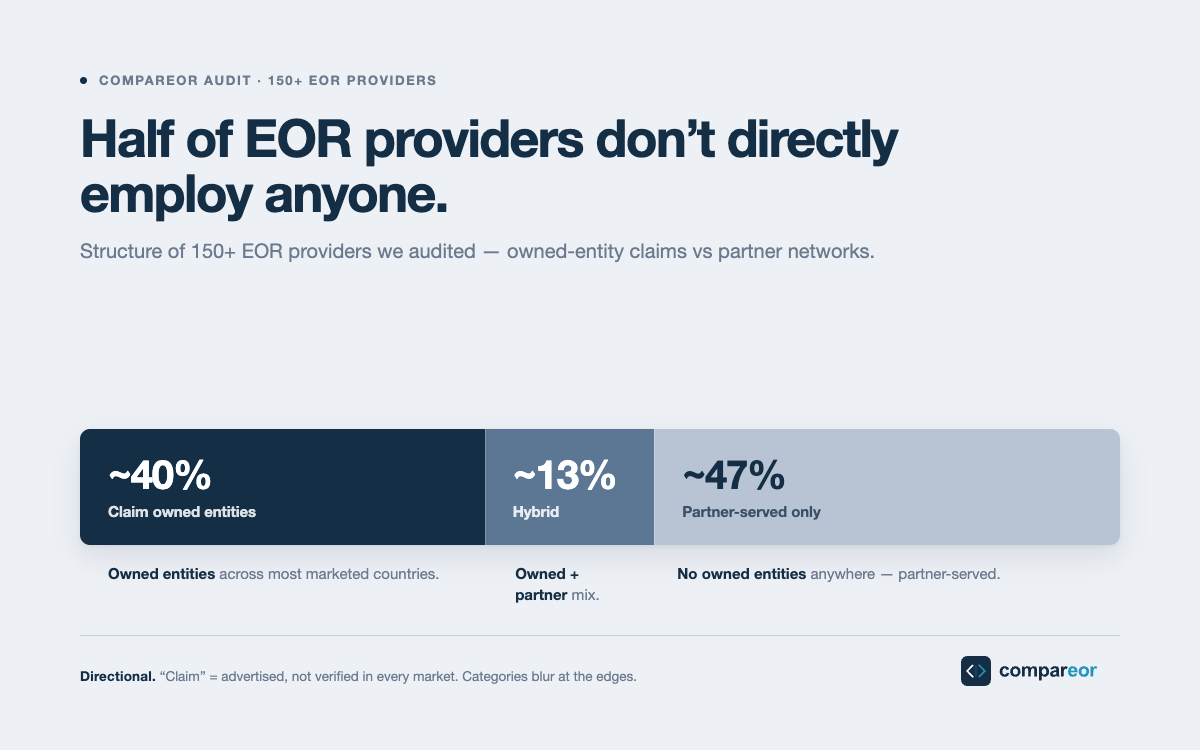
I checked the structure of 150+ EOR providers. Here's how many actually own their entities.
About 40% of EOR providers I audited claim and substantiate owned entities across most of their marketed countries. About 12 to 15% run an honest hybrid. About 45 to 50% are partner-served only, with no owned entities anywhere. The numbers, the methodology, the one honest caveat, and what they mean for buyers.


June 3, 2026
6 min read
Every EOR contract has an expiration date
The EOR model has a built-in expiration date, somewhere between 15 and 20 employees in one country. Past that threshold, the EOR stops being the cheapest option and starts being a tax on growth. Most companies miss it for a year or more, because the contract doesn't mention it and nobody inside is responsible for noticing.

May 25, 2026
5 min read
Why "150+ countries" is the most misleading number in global employment
Every EOR homepage leads with a country count, and after auditing 150+ providers it's the number most likely to lead you to the wrong choice. Coverage comes in three forms, and depth in your countries matters more than breadth across 185 of them.
Stay Updated on Global Hiring
Get weekly insights on EOR trends, compliance updates, and cost-saving strategies

Find a better EOR — without risk
Compare EOR providers to gain insights on cost, coverage, and contract flexibility, ensuring compliance and payroll continuity.


.png)
.png)



