
How to Read an EOR Quote: A Line-by-Line Decoder (2026)
A typical EOR quote has 10–15 line items, and 60% of overpayment hides in the 3 buyers don't read carefully. Here's the line-by-line decoder — plus how a human advisor differs from a self-serve calculator.


.png)
The EOR quote is designed to look simple. It isn't.
A typical EOR quote arrives as a one- or two-page PDF with a clean monthly total at the bottom — usually $4,500–$7,500 for a single mid-level engineer in most markets — and a smaller line for the EOR's service fee. It looks like an invoice. It is not. Behind those two totals are 10–15 line items that determine the actual cost over the life of the contract, and roughly 60% of EOR overpayment happens because the buyer focuses on the totals and skips the lines.
The quote is also designed for a specific buyer behaviour: comparing the total monthly cost across two or three providers and picking the lowest. That comparison is the wrong unit of analysis. Two providers can quote the same headline total and have wildly different cost structures underneath — one passing benefits through at cost with a 5% FX spread, the other applying a 20% benefits markup with a 0% FX spread. The total looks the same. The cost over five years is not.
This post is a line-by-line decoder of what each section of a typical EOR quote contains, what the numbers actually mean, what calculation method should sit behind them, and where the hidden costs live. Pair this with our seven-layer negotiation playbook and the overpayment diagnostic — or, once you have a quote in hand, request a Compareor advisor to walk through it with you on a call. Several providers offer self-serve cost calculators; Compareor offers a human advisor who reads the specific quote you have and tells you whether it is right for your situation.
The two-part structure of every EOR quote
Every quote breaks into two sections: employment cost and service cost. Understanding which section each line belongs to is the first step in reading the quote correctly.
The employment cost section is mostly a pass-through. Gross salary, employer-side statutory contributions, mandatory benefits, 13th-month or holiday-pay accruals where applicable. These are real costs the EOR pays to the local tax authority, the benefits provider, the pension fund. The EOR's margin in this section is small or zero in most contracts. The confusion is in presentation — how the numbers are rolled up, what is itemised versus bundled, and whether the percentages cited match the actual statutory rates.
The service cost section is where the EOR earns. Monthly service fee, setup fee, benefits administration markup, FX spread, float requirement, termination fee, renewal uplift. Every line in this section is negotiable, and every line is a margin lever for the provider. Reading the service cost section requires asking what each line is actually charging for, not just whether the number looks reasonable.
SectionWhat it includesNegotiable?Provider marginEmployment costGross salary, statutory contributions, mandatory benefits, 13th-month accrualMostly no (statutory)Low or zeroService costMonthly service fee, setup, benefits markup, FX spread, float, termination, renewal upliftYes, every lineHigh
A well-structured quote separates these two sections explicitly and labels every line. A poorly structured quote bundles them into a single Total monthly cost with a footnoted breakdown that obscures the margin layers. The latter is more common than it should be — and the structure itself is a signal about how the provider operates.
Line 1 — Gross monthly salary
The first line on every quote, and the one buyers usually verify quickly. The employee's gross monthly salary in local currency, agreed between you and the candidate before the quote was issued. The number itself should match exactly what you offered.
Three things to verify. First, currency — is it stated in local currency (BRL, MXN, INR) or in your billing currency (USD, EUR, GBP)? If the latter, an implicit FX rate is already baked in and you cannot audit it without the local-currency reference. Always ask for both. Second, period — is the salary monthly, annual, or some other frequency? Brazilian and Indian quotes typically use monthly; European and US quotes vary. Third, gross versus net — gross is the standard and what the quote should show, but quotes occasionally use net, especially in markets where net negotiation is cultural (parts of France, Italy). If the line shows net, ask for the gross equivalent and verify the implied employer tax assumptions.
Line 2 — Employer statutory contributions
This is the employer-side payroll burden — social security, pension, unemployment insurance, workers' compensation, and any country-specific employer levies. The number varies dramatically by country: 7.65% in the US (FICA), 13.8% in the UK (employer National Insurance), 30–35% in France, 35–42% in Brazil (covered in detail in our Brazil hiring guide), 20–25% in Mexico, 16–24% in India depending on state.
What to verify. First, the percentage rate should match the published statutory rate for the country. The major sources are the local social security authority's website (INSS in Brazil, URSSAF in France, HMRC in the UK, IMSS in Mexico). If the quote applies a higher rate than the statutory baseline, ask why. Second, this line should be pass-through, not marked up. There is no defensible margin in employer contributions — the EOR is collecting and remitting to the government. If the quote bundles statutory contributions with anything else under one number, ask for the itemised breakdown. Third, the base on which the percentage is calculated matters — most countries calculate on gross salary, but some calculate on a different reference (gross plus benefits in some Latin American markets, capped salary in others). Verify the base.
Line 3 — Benefits package
The benefits line is where most hidden margin lives. The line typically reads Benefits package: $XXX/month and combines several distinct items: mandatory health insurance (where the country requires it), mandatory pension (where statutory), supplemental health insurance (where you offered it), life and disability insurance, and any other benefits the candidate accepted.
The decoder questions. First, what is in the package? Ask for an itemised line-by-line breakdown of each benefit, the underlying provider, the policy details, and the cost. Benefits: $450/month is uninformative; BUPA private health, individual cover, £180/month; pension contribution 5% on gross, £150/month; income protection, £40/month; group life cover, £15/month is informative. Second, what is the markup? The single most important question in the entire quote. The EOR sources these benefits from local providers at wholesale prices, then bills you at retail. The markup is anywhere from 0% (pass-through, rare but offered by a handful of providers) to 25%+ (common, especially in mid-market providers). On a $450/month benefits package, a 20% markup is $1,080/year — invisible in the quote unless you specifically ask. Third, what is mandatory versus optional? Some lines are statutorily required (and not removable); others are optional (and negotiable down or out). Knowing which is which is the difference between a fixed cost and a flex cost.
Line 4 — 13th-month salary and statutory bonuses
In several markets — Brazil, Mexico (aguinaldo), Italy (tredicesima), Spain, Portugal, Argentina, the Philippines — the law requires an annual bonus equivalent to one or two months of salary, paid on a statutory schedule. The EOR accrues this monthly through the year and either bills it as a separate line item or rolls it into the monthly total.
What to verify. First, is the country actually required to pay a 13th month? The list is country-specific and not intuitive. Second, how is it being accrued in the quote — as a separate visible line (cleanest), rolled into the gross salary calculation (acceptable but harder to audit), or rolled into employer cost without separate disclosure (problematic). Third, is the accrual rate correct? A standard 13th month is exactly 1/12 of annual salary, accrued monthly. A 14th month (Italy, Spain, Portugal, some Latin American markets) is the same again. Quotes occasionally accrue at the wrong rate or include phantom 13th-month charges in countries that do not require one. Verify against the actual statutory requirement.
Line 5 — Total Employment Cost (TEC)
This is the sum of lines 1 through 4 — gross salary plus employer statutory contributions plus benefits plus 13th month. It represents what it costs to employ the person in the country, before any EOR service fee. Different providers label this Total Employment Cost, Fully-loaded Employment Cost, Cost-to-Employer, or All-in Employee Cost — all the same number under different names.
The number itself is auditable. Add lines 1 through 4 and the total should match. If it does not, ask why — usually it is a calculation method difference (e.g., 13th month included as 1/12 in monthly view but not in annual rollup) that should be reconcilable. The TEC is the right number to compare across providers, because it strips out the EOR's service fee and shows the actual cost of employment in the country. If two providers quote different TECs for the same gross salary in the same country, the difference is either in benefits markup, statutory calculation method, or 13th-month treatment — and you should know which.
Line 6 — EOR service fee (monthly)
The headline number that gets most of the negotiating attention. Typically $400–$700 per employee per month in most markets, $300–$500 in lighter-load markets, $700–$1,200 in premium-tier providers or specialised geographies. This is the EOR's monthly charge for managing the employment relationship — payroll processing, tax remittance, compliance, employee support, and the platform itself.
What to verify. First, is the fee flat per employee, or tiered based on salary or seniority? A flat fee is the norm; a salary-percentage fee (rare, but offered by some legacy providers) compounds over time and is rarely defensible. Second, what is included in the fee versus charged separately? Standard inclusions: payroll, tax filing, compliance support, employee self-service portal, basic HR support. Standard exclusions: equity processing, off-cycle bonuses, expense reimbursements, terminations, hardware procurement. If the line is silent on what is included, ask for an itemised inclusion list in writing. Third, is the fee per employee per month, or per employment event (which implies something different)? Per-employee-per-month is the industry standard.
Line 7 — Setup and onboarding fees
A one-time charge at the start of each employment, typically $0–$500 per employee. The line covers the work of drafting the local employment contract, registering the employee with local tax and social security authorities, configuring the employee in the payroll system, and (in some markets) running mandatory pre-employment medical exams or background checks.
The decoder. First, the major providers — Deel, Remote, Velocity Global, Multiplier — charge $0 setup as a competitive differentiator. If a quote shows a setup fee, ask for it to be waived; this is one of the most negotiable line items in the contract. Second, the line should be one-time, not recurring. A monthly onboarding charge or ongoing setup fee is a red flag — onboarding is by definition a one-time event. Third, country-specific setup costs (mandatory medical exam in Brazil, work permit fees in some markets) are statutory pass-throughs and should be itemised separately, not bundled into the EOR's setup fee. If the quote bundles them, ask for separation.
Line 8 — FX conversion rate and spread
If you pay your EOR in USD, EUR, or GBP and the employee is paid in another currency, the conversion happens somewhere in the cost stack — and the EOR captures the spread between the rate they charge you and the wholesale rate they get on the market. This line is the single most opaque section of most EOR quotes.
What to demand. First, the rate methodology. The quote should state explicitly how the conversion rate is set — mid-market rate at the date of invoice, spot rate plus 1.5%, monthly average of XE published rates, or similar. Vague language (prevailing market rate, bank rate) is a red flag and almost always means the rate is set at the provider's discretion. Second, the spread. Ask explicitly: what is the FX spread you charge over the mid-market rate? The answer should be a number — 0% (Deel's published rate), 1–2% (most major providers), 3–4% (legacy providers), 5%+ (problematic). Get it in writing. Third, the timing. Conversion at invoice issue, payment, or some other event? The timing affects the rate and the amount, especially in volatile currencies. Fourth, in the quote itself, the conversion should be visible — you should see the local-currency cost, the FX rate applied, and the billed-currency total. If only the billed-currency total appears, the FX is hidden and you cannot audit it.
Line 9 — Float, deposit, or reserve
Many EORs require a payroll float — typically 1–2 months of expected payroll, deposited upfront and held as a reserve against payment failures. The line may appear as Initial deposit, Payroll reserve, Working capital deposit, or similar. It is your money, but it sits in the provider's account, sometimes earning interest for them.
What to verify. First, the amount — what is the float requirement and how is it calculated? A 1-month reserve is reasonable; 2 months is on the high end; more than 2 months is problematic. Second, refundability — is the float fully refundable at contract termination, and within what timeline? Standard is full refund within 30–60 days of termination. Third, interest treatment — does the provider pay you interest on the deposit (rare but achievable for larger deals), or is it interest-free to them? Fourth, negotiability — for companies with established credit history and audited financials, the float is usually waivable in part or in full. Ask.
Line 10 — Termination and offboarding fees
Often appears in a separate Terms and conditions section rather than on the main quote page, which is itself a signal — the EOR does not want this number to be a comparison point at signing. The standard structure: statutory severance and notice pay pass through at cost (these are the legally required amounts the local jurisdiction mandates), plus a service fee on top to compensate the EOR for the procedural work of executing the termination.
The decoder. First, the statutory pass-through should be itemised — what is the country's required notice period, what is the severance formula, what is the timeline? This is not negotiable but it should be transparent. Second, the EOR's termination service fee — typically 0.5–1 month of the standard service fee, sometimes 1.5–2×. Anything above 1.5× is aggressive and negotiable. Third, the trigger — is the fee charged on any termination, or only on without-cause terminations? Without-cause should be the trigger; resignations should not incur a termination service fee. Fourth, any lock-in or minimum service period in the contract — some EORs have minimum 6-month or 12-month commitments per employee, with an early-termination penalty if you offboard sooner. Verify this and negotiate it down if present.
Line 11 — Annual renewal and uplift terms
Buried in the contract terms, not the quote summary. The clause typically reads something like Service fees are subject to annual review and may be adjusted upward to reflect changes in statutory costs, market conditions, and inflation. That language is the renewal escalator — it gives the provider unilateral right to increase the headline service fee at each contract anniversary.
What to negotiate. First, replace open-ended escalator language with a hard cap — annual service fee adjustment capped at CPI or 3%, whichever is lower. Most providers will accept this. Second, separate statutory pass-through from service fee — statutory increases (a country raising employer contributions) are pass-through and not the provider's discretion; service fee changes are the negotiable part. The contract should distinguish. Third, get advance notice — at least 90 days before the renewal date, in writing, with the proposed adjustment and the rationale. Fourth, get an early-termination right tied to renewal — if the provider raises the fee above the cap, you should have a clean exit clause with a defined transition timeline.
The footnotes — where most surprises hide
The bottom of the quote, the asterisks, the T&Cs apply line. Most buyers skip this. Most surprises live here.
Five clauses to read carefully. First, pro-rata calculations — how does the quote handle partial months? Mid-month start dates, mid-month terminations, leave-of-absence periods. The formula should be days-employed divided by days-in-month, on a transparent basis. Second, currency clauses — what happens if the local currency moves more than X% against the billing currency? Some contracts have force-majeure-style clauses that allow re-quoting; others lock the rate. Verify which. Third, material change clauses — these allow the provider to re-quote if statutory costs change materially. Define materially — without a specific threshold (e.g., more than 3% movement in statutory rate), the clause is effectively unilateral re-quote rights. Fourth, indemnification — who is liable for compliance failures? The EOR should indemnify for its own errors; you indemnify for your direction (e.g., asking the EOR to misclassify a worker). The clause should be specific. Fifth, data and IP — who owns the employee data, the employment records, the IP the employee creates during employment? The default answer should be: you own the IP; the EOR holds the data on your behalf; data must be returned and deleted at contract end.
How to verify a quote before signing — the 6-step audit
Doable in 90 minutes with the quote in front of you and the country's social-security website open in another tab.
StepWhat to checkPass criterion1. TEC reconciliationSum of lines 1–4 matches stated Total Employment CostExact match, or reconciliation difference explainable2. Statutory rate auditEmployer contribution % matches published country rateWithin 1 percentage point of official source3. Benefits markupMarkup % disclosed in writingBelow 10% ideally; below 20% acceptable; above 20% problematic4. FX disclosureRate methodology and spread % in writing, with worked exampleSpread below 2%; mid-market rate disclosed5. Renewal capAnnual uplift capped in contract, not open-endedCPI-linked or fixed at 3–5%6. Benchmark comparisonQuote compared against at least one alternative or Compareor benchmarkWithin 10–15% of category median
If the quote passes all six steps with itemised, auditable, transparent answers, the provider has run a clean process and the quote is signable. If it fails on two or more steps — opaque benefits markup, undisclosed FX, unbounded renewal — the answer is not to negotiate harder; it is to ask for a clean quote or move to a different provider. The structure of the quote is a signal about how the provider operates over the life of the contract.
Self-serve calculator versus human advisor — what is the difference
Several major EOR providers offer self-serve cost calculators on their websites — Deel, Remote, Velocity Global, Multiplier, Oyster, and others. You input the country, the gross salary, and the seniority, and you get back an instant monthly cost estimate. The calculators are useful for first-pass budgeting and for rough comparisons across countries, and most are reasonably accurate within 5–10% of the actual quote that follows.
What they cannot do is read your actual quote and tell you whether it is fair. A self-serve calculator is the provider's own pricing model applied to inputs you provide. It shows you what that provider charges, not whether what they charge is competitive, whether the benefits markup is reasonable, whether the FX disclosure is acceptable, whether the renewal clause is signable, or whether you have negotiating leverage you are not using. The calculator is the quote, not the audit of the quote.
A Compareor advisor sits on the other side of the table. The service is human — a person on a call, not a tool — free to the buyer (Compareor is compensated by the provider on closing, not by you), and built around the line-by-line review described in this post. The advisor reads the quote you already have, walks through each line with you, explains what each number means, flags items that are above market, identifies where the negotiation leverage is, and tells you plainly whether the quote is the right deal for your situation. For providers in the Compareor partner network, the advisor also applies pre-negotiated partner discounts on top, which can sit below the standard quote without further negotiation.
The two are not substitutes — they are different points in the procurement journey. Use the calculator for first-pass budgeting and country comparison. Use an advisor for the actual quote you are considering signing. Where a self-serve calculator answers what does this cost, an advisor answers is this a fair quote and what should I change. Request a Compareor advisor once you have a quote in hand.
Frequently asked questions
Why do two EOR quotes for the same country and salary differ?
Three reasons, in roughly decreasing order of impact. Benefits markup (often the largest delta), FX spread (the second-largest), and headline service fee (the most visible). Two providers can quote identical totals with completely different cost structures underneath, which is why the right unit of comparison is Total Employment Cost stripped of EOR margin, not the bottom-line monthly total.
What is the right Total Employment Cost multiplier above gross salary?
Country-specific. As rough anchors: 1.10–1.20× in the UK and Spain, 1.25–1.35× in Germany, 1.40–1.60× in France and Italy, 1.60–1.80× in Brazil, 1.20–1.30× in India, 1.25–1.40× in Mexico. The country-by-country breakdown has the full table.
Can I ask for the wholesale benefits cost?
Yes, and you should. The framing: we would like to see the benefits provider's quote at provider cost, separately from your administrative load on top. Some providers will share this directly; others will resist. Resistance is itself a signal about how the benefits markup is structured. Press until you get a clear answer.
What is the cleanest way to compare two quotes?
Normalise both to the same template — gross salary, employer statutory, benefits at cost, benefits markup, 13th month, EOR service fee, setup, FX spread, float, termination fee, renewal cap. Side-by-side comparison on this template surfaces the actual cost differences. The Compareor comparison tool does this automatically for major providers, or a free advisor will run the normalisation for you on a call.
What if the provider refuses to itemise?
It is a signal. Walk. There is no defensible business reason for an EOR to refuse to itemise the cost stack — and there is one bad reason, which is that the structure is designed to obscure margin layers. The major top-tier providers all itemise willingly because their pricing is competitive on the itemised basis. Providers who do not itemise are usually the ones who would lose on direct comparison.
How long should I budget for the quote review?
Ninety minutes for one quote, two hours for a side-by-side of two or three. The audit itself is faster than most people expect because the questions are systematic. The slow part is waiting for the provider to respond to clarification requests, which is usually 2–5 business days per round. Build a week of buffer into the procurement timeline for proper review.
What does the Compareor advisor actually do that a self-serve calculator does not?
A self-serve calculator gives you the provider's own quote — useful for budgeting, not for verification. A Compareor advisor is a human you can talk to: they read the actual quote you have received, walk through it line by line with you on a call, explain what each number represents, flag items that are above market, identify your negotiation leverage, and tell you whether the quote is the right one to sign for your specific situation. Where applicable, they also apply partner-network discounts on top. The service is free to buyers — Compareor is compensated by the provider on closing, not by you — with no obligation to proceed.
Bottom line
An EOR quote is a single document, but it represents the next 12–36 months of cost. The total at the bottom is the wrong place to make the decision. The right place is the line-by-line breakdown: gross salary auditable, statutory contributions matching the published rate, benefits itemised with the markup disclosed, FX methodology and spread in writing, termination and renewal terms capped and transparent.
The buyers who get fair deals are the ones who treat the quote as a starting point for clarification, not an end point for decision. The buyers who overpay are the ones who compare bottom-line totals across providers and pick the lowest, missing the fact that the structures underneath are different. Ninety minutes of careful reading, three rounds of clarification with the provider, and a side-by-side comparison against at least one alternative is enough to surface 80% of the savings available.
If the quote you are reading right now passes the six-step audit cleanly, it is a signable contract and the provider is operating in good faith. If it does not — opaque benefits, undisclosed FX, unbounded renewal — the right move is not to negotiate harder. It is to ask for a clean quote, or to bring in a Compareor advisor — a human who will read the quote with you, walk through each line, explain what it means, and tell you plainly whether it is the right deal for your situation. Self-serve calculators tell you what something costs. An advisor tells you whether the cost is right. The quote you sign should be a quote you understand line by line. Everything else is overpayment waiting to happen.
Get your shortlist
Takes ~3 minutes. No account needed.
June 3, 2026
6 min read
I checked the structure of 150+ EOR providers. Here's how many actually own their entities.
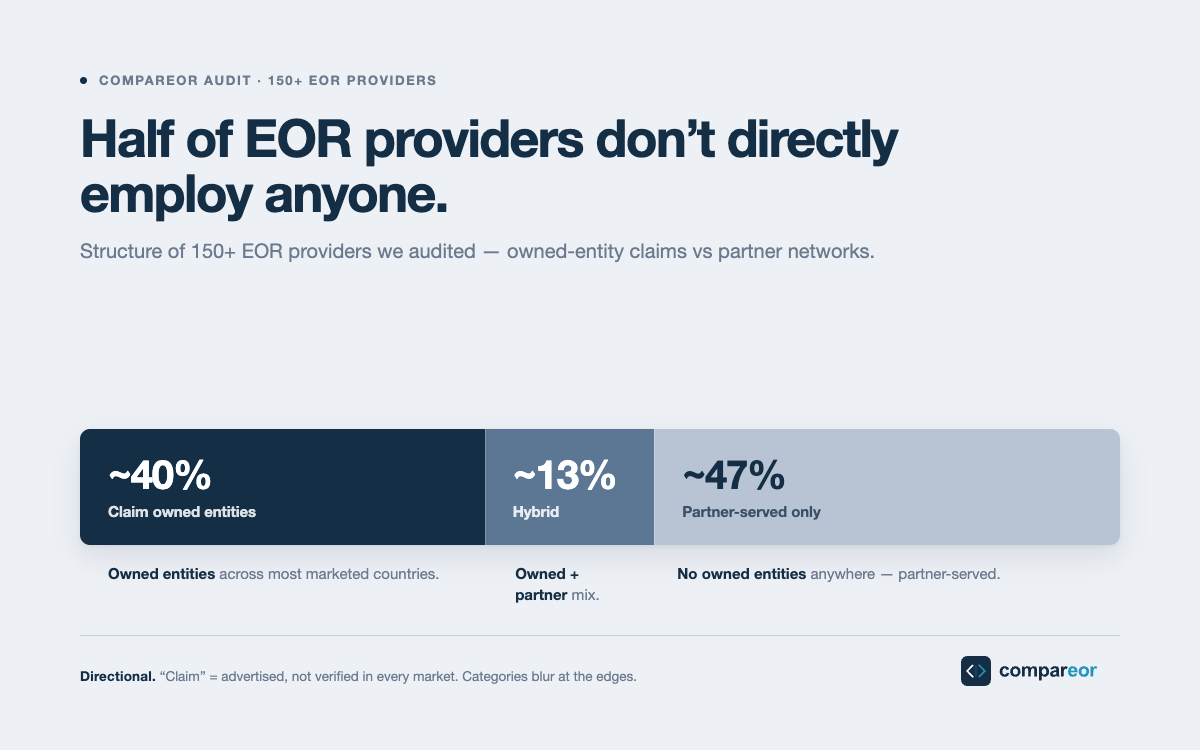
About 40% of EOR providers I audited claim and substantiate owned entities across most of their marketed countries. About 12 to 15% run an honest hybrid. About 45 to 50% are partner-served only, with no owned entities anywhere. The numbers, the methodology, the one honest caveat, and what they mean for buyers.


June 3, 2026
6 min read
Every EOR contract has an expiration date
The EOR model has a built-in expiration date, somewhere between 15 and 20 employees in one country. Past that threshold, the EOR stops being the cheapest option and starts being a tax on growth. Most companies miss it for a year or more, because the contract doesn't mention it and nobody inside is responsible for noticing.

May 25, 2026
5 min read
Why "150+ countries" is the most misleading number in global employment
Every EOR homepage leads with a country count, and after auditing 150+ providers it's the number most likely to lead you to the wrong choice. Coverage comes in three forms, and depth in your countries matters more than breadth across 185 of them.
Stay Updated on Global Hiring
Get weekly insights on EOR trends, compliance updates, and cost-saving strategies

Find a better EOR — without risk
Compare EOR providers to gain insights on cost, coverage, and contract flexibility, ensuring compliance and payroll continuity.


.png)
.png)



