
How to Negotiate EOR Pricing: The 7-Layer Playbook to Cut 15–25% From Your Contract
EOR pricing is built on seven layers, and 15–25% of the real cost hides in the six no one negotiates. Here's the playbook to flatten the gap — or have a Compareor advisor run it for you, for free.


.png)
EOR pricing is the most opaque category in B2B HR — and the most negotiable
Every EOR provider quotes a monthly fee — typically $400–$700 per employee per month for the major providers, $300–$500 for the mid-tier, $700–$1,200 for specialised or premium players. That number is the headline of every pricing conversation, and it is the wrong number to focus on. The actual cost of running an employee through an EOR is 15–25% higher than the headline, and that gap is structural: it is built into how EOR pricing is constructed, not an aberration in any specific contract.
The 15–25% gap shows up in seven places that the headline fee does not cover: setup and onboarding fees, benefits administration markup, FX spreads on cross-currency payroll, equity processing fees, offboarding and termination charges, statutory float requirements, and annual renewal uplifts. Most companies do not see the gap until month four or five, when the third or fourth invoice arrives and reconciliation against the original budget shows a meaningful overrun. By that point, the contract is signed and the leverage has evaporated.
This post covers exactly where the 15–25% gap hides, what is actually negotiable (most of it), the leverage points that move the price, the tactical playbook for the negotiation itself, and the red flags that should make you walk away. Pair this with our overpayment diagnostic and the country-by-country cost breakdown — or skip straight to a Compareor advisor, who runs the playbook on your behalf at no cost and unlocks pre-negotiated partner discounts on top.
How EOR pricing is actually constructed
Every EOR contract has seven cost layers. The headline fee is one of them. Understanding the other six is how you flatten the 15–25% gap.
1. The headline monthly fee
This is what gets quoted on the website, in the RFP response, and in the sales conversation — usually $400–$700 per employee per month in most markets, with the high end in markets with deep statutory load (Brazil, Argentina, France) and the low end in lighter-load markets (UK, Spain, most of Asia). The headline fee is the most negotiable line item and the one that most procurement teams focus on, which is why the discounts here are often the smallest in real terms. Pushing the fee from $599 to $499 saves $1,200/employee/year. The other six layers, in aggregate, are usually worth 2–4× that.
2. Setup and onboarding fees
Some providers charge a one-time setup fee of $200–$500 per employee, framed as the cost of contract drafting, compliance review, registration with local authorities, and payroll system configuration. Other providers — Deel, Remote, and most of the top tier — charge nothing. The setup fee is fully negotiable; if the provider quotes one, ask for it to be waived. It is almost always waivable for any deal above 3 employees, and the provider is testing whether you ask.
3. Benefits administration markup
This is the largest of the hidden layers. The EOR sources health insurance, pension, life and disability coverage, and other statutory and supplemental benefits from local providers, then bills you for the cost — plus a markup. Markups range from 0% (rare, but offered by a handful of providers as a competitive differentiator) to 25%+ (common, especially in mid-market providers). On a $500/month benefits package, a 20% markup is $1,200/employee/year — more than the difference between two providers' headline fees. Always ask: is the benefits cost passed through at cost, or with a markup? What is the markup percentage? Get the answer in writing.
4. FX spreads and float requirements
If you pay your EOR in USD, EUR, or GBP and the employee is paid in MXN, BRL, INR, or any other currency, the EOR converts the currency at some rate and pockets the spread between the rate they charge you and the rate they get on the wholesale FX market. The spread ranges from 0% (Deel converts at mid-market interbank rate) to 3–4% (mid-tier providers) to 5%+ (older legacy providers). A 3% FX spread on a $5,000/month gross salary is $1,800/employee/year. Always ask for the FX rate disclosure and the exact spread, and compare against the mid-market rate published by XE or OFX on the date of quote.
Many providers also require a payroll float — typically 1–2 months of payroll deposited upfront and held as a reserve against payment failures. The float is your cash, but it is sitting in the provider's account earning interest for them. On a 10-person team with $50,000/month total payroll, that is $50,000–$100,000 of working capital you have given up. Negotiable, especially for established companies with strong credit history.
5. Equity processing fees
If your employees receive RSUs or options, the EOR has to administer the equity vesting, withholding, and reporting through local payroll. Some providers charge $50–$200 per equity event (each vest, each exercise). For a fast-growing team with quarterly vesting, this adds up — $100/event × 4 vests/year × 30 employees = $12,000/year. Ask whether equity processing is included or charged separately, and if separately, what the per-event fee is.
6. Offboarding and termination fees
Some EORs charge a termination fee — typically 1 month's service fee, sometimes 1.5–2×. This is on top of the statutory severance and notice pay required by local law, which is passed through. The termination fee is the EOR's compensation for the procedural work of executing the termination (final payroll, statutory filings, settlement documentation). In high-litigation jurisdictions (Brazil, France, Italy), the work is real and the fee is more defensible. In low-friction jurisdictions, it is mostly margin. Always ask: what is the termination fee, and what does it cover? Negotiate it down or out where you can.
7. Annual renewal uplifts
The headline fee in year one is rarely the headline fee in year two. Standard renewal uplifts run 3–8% per year, sometimes higher if statutory costs rise materially in the country. The uplift is presented as an annual market adjustment, but it is mostly margin protection. The leverage point is to negotiate a renewal cap (e.g., uplifts capped at CPI + 2% annually) at signing, not at renewal. By renewal time, you are 12 months into onboarded employees and switching costs are real.
What is actually negotiable
The myth in EOR procurement is that pricing is fixed. It is not. Every line item except statutory pass-throughs is negotiable, with different degrees of flexibility depending on the provider's margin structure and your leverage. The relative negotiability of each line item:
Monthly fee — High negotiability. Typical achievable discount: 10–20%.
Setup fee — Very high. Typical achievable discount: 100% (full waiver).
Benefits markup — High. Typical compression: 50–100% toward pass-through.
FX spread — Medium. Typical reduction: 1–3 percentage points.
Float requirement — Medium. Often waivable for established companies with audited financials.
Equity processing — Medium. Often bundled into the monthly fee on request.
Termination fee — Medium. Typical achievable reduction: 50% or full waiver.
Renewal uplift cap — High. Achievable: CPI-linked or capped at 3–5%.
Statutory pass-through — Zero. Not negotiable.
The largest savings come from the layers procurement teams ignore. The headline fee gets the attention; the benefits markup, FX spread, and renewal cap drive the actual total cost. Focusing 80% of negotiation energy on the headline fee leaves money on the table.
Leverage points — when you have negotiating power
EOR providers price-discriminate aggressively based on perceived buyer leverage. Five things move the needle.
Volume
Below 5 employees, you are paying close to rack rate. Between 5 and 15, you should see 5–10% off headline. Between 15 and 50, expect 15–25% off plus most fees waived. Above 50, you are in custom enterprise pricing territory with annual contracts, tiered fees, and bundled benefits at near-pass-through. The biggest cliff is around 15 employees — many providers have an internal threshold there that unlocks the enterprise pricing book.
Multi-year commitment
A 2- or 3-year commitment instead of annual rolling typically unlocks 5–10% additional discount and a fixed renewal cap. The trade-off is real — you are committing to the provider for the term — but if the operational fit is proven, the discount is meaningful. Build in an exit clause for material service failures.
Country mix
EORs price differently by country, and the provider's margin profile by country is uneven. If your mix includes high-margin countries for the provider (typically markets where they have owned entities with low overhead — Netherlands, Spain, Portugal, much of Eastern Europe), you have more room to negotiate than if your mix is all high-cost-to-serve markets (Brazil, India, China, where the statutory and operational overhead is heavier). The country-by-country cost breakdown identifies where the structural margin sits.
Competitive RFP
Running a formal RFP with at least 3 providers — and making it visible to the sales teams that they are in a competitive process — typically extracts 10–15% additional discount versus a sole-sourced negotiation. The discount is not from the listed price; it is from the price the provider would have settled at without competitive pressure. The RFP itself does not need to be elaborate; a clear scope document with country list, headcount, and required service levels is enough.
Renewal vs new sales
EOR sales teams are compensated more aggressively on new logos than on renewals. New sales reps have monthly quotas, end-of-quarter pressure, and discretion to discount; renewal teams operate on different incentives. The implication: you have more leverage in the first contract than at renewal. Push hard at signing, lock in the renewal cap, and the second-year negotiation is mostly a confirmation exercise.
The tactical playbook
Six moves consistently work. Execute them in order.
1. Get three quotes minimum, in writing, with full pricing schedules
Not just the headline fee. The full pricing schedule covering all seven cost layers. Most providers will resist disclosing the schedule until late in the sales cycle; insist on it as a prerequisite to the next conversation. If a provider will not share the full schedule, that is signal about how their pricing is structured. The Compareor comparison tool has standardised pricing data for most major providers.
2. Anchor against the lowest credible benchmark
When you have three quotes, the negotiation anchor is not the average — it is the lowest credible price. Use the lowest quote (assuming the provider is credible) as the reference point in conversations with the others. The sales conversation goes: Provider X has quoted $X, which is the all-in price including benefits at cost. I would like to understand your pricing on a comparable basis. That forces structural comparability, not just headline comparison.
3. Push the benefits markup to zero or near-zero
This is the single highest-impact negotiating move. Moving from a 20% benefits markup to 5% on a $500/month benefits package is $900/employee/year — more than most procurement teams achieve on the headline fee. Frame it as: we will pay your monthly EOR fee in full, but benefits should pass through at provider cost with a small administrative load — 3–5%.
4. Disclose the FX rate at quote
Ask the provider to disclose the FX rate they will use, and lock it as mid-market + maximum X bps spread in the contract. If the provider cannot or will not disclose, that is signal. The major top-tier providers (Deel especially) have moved to mid-market pricing and will disclose readily; smaller providers often resist.
5. Negotiate the renewal cap at signing
Annual renewal uplift capped at CPI or 3%, whichever is lower. This is the single highest-leverage clause in the contract. Most providers will agree because they assume you will not enforce it at renewal time — but you should, and the clause makes it a contract issue rather than a negotiation.
6. Get offboarding terms in writing
Specifically: what is the termination fee, what is the data return process, what is the timeline for final payroll, what happens to benefits continuity. Surprise termination fees are one of the most common post-signing complaints. Read our liability and termination guide before signing.
Country-specific dynamics
EOR pricing flexibility varies by country, driven by the underlying margin structure. Three patterns.
High-cost-to-serve markets — Brazil, India, China, Japan — have less pricing flexibility because the provider's underlying cost stack is heavy. Brazilian statutory load (covered in detail in our Brazil hiring guide) eats 35–42% of gross before the EOR earns a margin. Indian payroll is operationally complex and tax-heavy. In these markets, headline discounts are smaller and benefits markup is harder to compress. The math just leaves less margin to give up.
Light-friction markets — UK, Spain, Netherlands, Portugal, most of Eastern Europe — have substantial pricing flexibility because the provider's operational overhead is low and the margin is high. This is where the headline-fee discounts and benefits markup compression are most achievable. If your country mix includes these markets, lean on the negotiation there.
Volatile-FX markets — Argentina, Turkey, Egypt, parts of Africa — have unique dynamics because the FX spread itself is the largest single cost line item. Push extra hard on FX disclosure and rate-fixing mechanics in these markets. The 1–2 percentage points of FX spread can be worth more than the entire headline EOR fee.
When to walk away
Some pricing structures are red flags. The list:
- Refusal to disclose the full pricing schedule before contract signing
- Benefits markup above 20% without a clear rationale
- FX spread above 3%, or refusal to disclose the rate at all
- Termination fees above 1.5× monthly service fee
- Renewal uplift uncapped or capped above 8%
- Float requirement above 2 months of payroll
- Setup fees on small-deal contracts (under 10 employees) that the provider will not waive
Any one of these is a yellow flag; two or more is a structural problem and you should look at a different provider. The G2-ranked EOR leaderboard filters for providers with consistently transparent pricing.
RFP vs direct negotiation — which to use
Direct negotiation works when you are buying for fewer than 10 employees, your country mix is straightforward, and you have a clear preference between 2–3 providers. The conversation is faster, less procurement overhead, and the discount opportunity is real if you execute the tactical playbook.
A formal RFP makes sense above 25 employees, complex multi-country mixes, or where the procurement function requires it. The RFP discipline forces structural comparability — every provider responds to the same scope, the same headcount, the same country list — and the comparison is genuinely apples-to-apples. The trade-off is timeline (8–12 weeks typical) and procurement bandwidth. Our 12-question evaluation framework doubles as an RFP question bank.
A middle path that works well for 10–25 employees: a streamlined competitive process. Send a brief scope document to 3 providers, ask for written pricing on a standardised template, run one round of negotiations with the two best responses, and decide. Two to three weeks, most of the discount of a full RFP, none of the procurement burden.
The fastest path — a Compareor advisor
For most companies, the highest-leverage move is to bring in a Compareor advisor before the negotiation starts. The service is free to buyers — Compareor is compensated by the provider on closing, not by you — and the advisor's role is to run the seven-layer playbook on your behalf: collect the quotes, normalise the pricing schedules across providers, anchor the negotiation against benchmark data from hundreds of comparable deals, and push the discount levers that procurement teams without category specialisation typically miss.
The discount delivery comes in two forms. The first is advisor-negotiated savings — typically 10–20% off the rack-rate quote — driven by the same playbook described above but executed by someone who has run it dozens of times and knows where each provider's flex actually lives, by country and by deal size. The second is automatic partner discounts — a number of providers in the Compareor partner network apply pre-negotiated rates to Compareor-referred buyers that sit below their public pricing, baked into the first quote without further negotiation. Combined, the typical Compareor-supported deal lands 15–25% below sole-sourced rack rate, which matches the high end of what a well-executed direct negotiation achieves — but in a fraction of the procurement time and without committing your team's bandwidth to running an RFP.
The one trade-off is timing. The advisor needs to be involved before you have signed anything or made a substantive commitment to a provider, because partner discounts only apply to net-new opportunities and the negotiation leverage exists only while you have credible alternatives. Buyers who have already signed or are at final-mile negotiation have already lost most of the value. For companies still in evaluation, the entry point is a 30-minute scoping call followed by the advisor running the process end-to-end. Start with the comparison tool or request an advisor directly to get the partner-discount quote alongside.
Frequently asked questions
How much can I realistically save through EOR negotiation?
10–25% of total cost is typical for companies that work through the full seven-layer playbook. The savings come less from the headline fee and more from benefits markup compression, FX disclosure, and renewal cap. For a 20-employee team paying nominally $480,000/year, that is $48,000–$120,000 in annual savings — usually paid back in the first month of the contract relative to a sole-sourced sign-up.
What does the Compareor advisor service cost?
Nothing. Compareor is compensated by the provider on closing the deal, not by the buyer. The buyer pays the same — or, more commonly, less — than they would have paid sole-sourcing the same provider, because partner discounts and advisor-negotiated savings flow directly to the buyer. The combination of free advisory plus partner-network discounts is why most companies that know the service exists use it as the default path rather than the exception.
Is the lowest-priced provider always the best choice?
No. Pricing is one of five evaluation dimensions, alongside country coverage depth, compliance track record, platform quality, and customer support. The lowest-priced provider on a comparable scope is usually a credible option; the lowest-priced provider with structural service gaps is not. Use the 12-question evaluation framework alongside pricing analysis.
Should I sign a multi-year contract for a discount?
Only if you have validated the provider over a full annual cycle, including at least one termination and one country expansion. Multi-year contracts trade flexibility for 5–10% additional discount, which is worthwhile only if the operational fit is proven. For first-time EOR buyers, a 12-month contract with negotiated renewal cap is the safer structure.
How do I handle the renewal negotiation?
If you negotiated a renewal cap at signing, the renewal is mostly a confirmation exercise — the cap holds and the price moves within the agreed range. If you did not, treat the renewal as a fresh negotiation with the leverage of we are evaluating alternatives credibly in play. The provider's renewal team has less discount discretion than new sales, but the threat of churn creates upward leverage.
Can I switch EOR providers mid-employment?
Yes, but it is operationally non-trivial — the employee technically gets re-employed by the new provider, with implications for tenure, benefits continuity, and statutory entitlements in some jurisdictions. The switch is most cleanly executed at the calendar year boundary and with 60–90 days of preparation. Most major providers can handle the migration; the friction is in the employee experience, not the EOR mechanics.
What if my provider raises prices outside the renewal cap?
Push back in writing, with the contract clause cited. If the provider invokes a force majeure or material change clause (statutory cost increase, regulatory change), validate the underlying claim against public sources — most statutory increases cited as justification for price moves are normal annual inflation that should already be priced into the cap. If the provider persists, document the dispute and consider it grounds for early termination if your contract allows.
Bottom line
EOR pricing is not the fixed-quote category most procurement teams treat it as. Every line item except the statutory pass-throughs is negotiable, and the seven-layer structure means the negotiation that matters is rarely about the headline fee. The 15–25% total-cost gap between rack rate and well-negotiated price hides in the benefits markup, the FX spread, the float, the termination fee, and the renewal uplift — none of which appear on the website pricing page and most of which procurement does not ask about.
Three things separate the buyers who get a fair deal from the buyers who overpay. First, they ask for the full pricing schedule before signing, not after. Second, they run a credible competitive process — even a streamlined one — so the provider knows they have alternatives. Third, they negotiate the renewal cap at signing, because the leverage at renewal is much weaker than the leverage at first contract.
The math is straightforward. For a 20-person international team paying $500/employee/month nominal, the difference between rack rate and well-negotiated pricing is $50,000–$100,000/year in recoverable cost. That is not procurement marginalia — it is the difference between a hiring budget that closes the headcount plan and one that does not. Run the audit, run the negotiation, and lock the renewal terms. If you would rather skip the procurement legwork, a Compareor advisor runs the same playbook for free and brings partner-network discounts on top. Either way, the saving is there — the only question is who captures it.
Get your shortlist
Takes ~3 minutes. No account needed.
June 3, 2026
6 min read
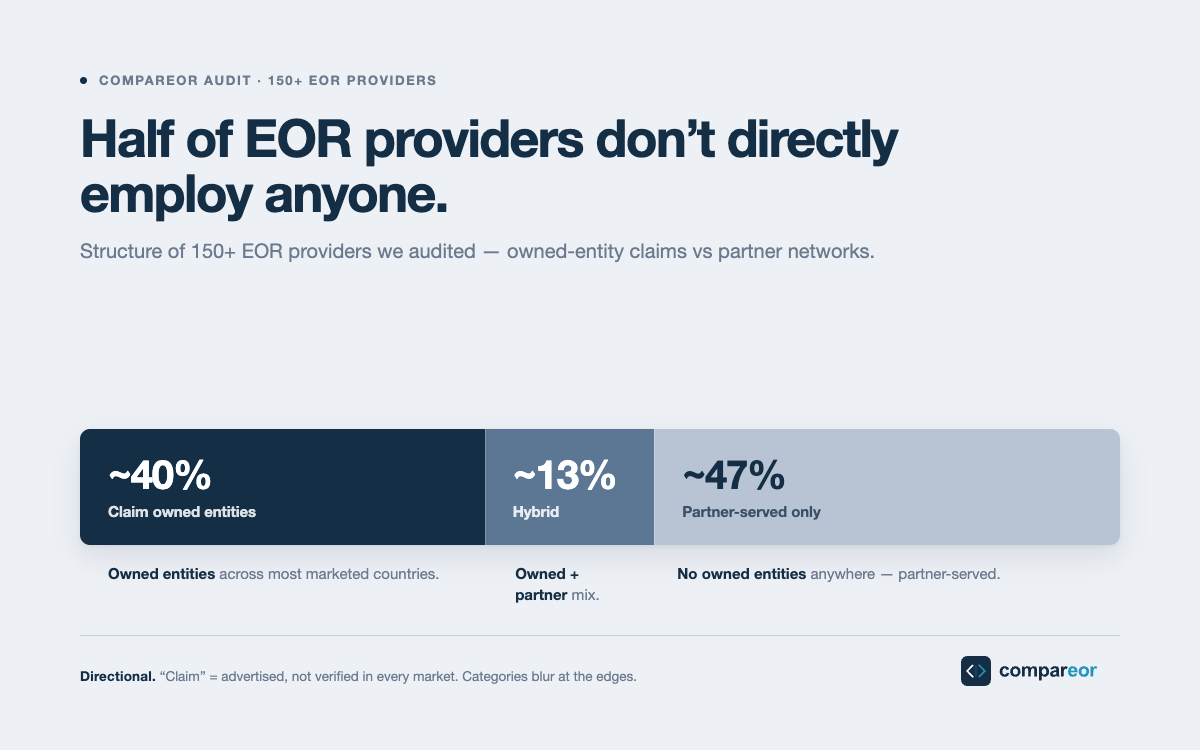
I checked the structure of 150+ EOR providers. Here's how many actually own their entities.
About 40% of EOR providers I audited claim and substantiate owned entities across most of their marketed countries. About 12 to 15% run an honest hybrid. About 45 to 50% are partner-served only, with no owned entities anywhere. The numbers, the methodology, the one honest caveat, and what they mean for buyers.


June 3, 2026
6 min read
Every EOR contract has an expiration date
The EOR model has a built-in expiration date, somewhere between 15 and 20 employees in one country. Past that threshold, the EOR stops being the cheapest option and starts being a tax on growth. Most companies miss it for a year or more, because the contract doesn't mention it and nobody inside is responsible for noticing.

May 25, 2026
5 min read
Why "150+ countries" is the most misleading number in global employment
Every EOR homepage leads with a country count, and after auditing 150+ providers it's the number most likely to lead you to the wrong choice. Coverage comes in three forms, and depth in your countries matters more than breadth across 185 of them.
Stay Updated on Global Hiring
Get weekly insights on EOR trends, compliance updates, and cost-saving strategies

Find a better EOR — without risk
Compare EOR providers to gain insights on cost, coverage, and contract flexibility, ensuring compliance and payroll continuity.


.png)
.png)



