
5 Red Flags in EOR Contracts: What to Catch Before You Sign
Most EOR overpayment is locked in at contract signing, not at the quote stage. Here are the 5 red flags that cost buyers $10,000–$50,000 per deal — plus the exact redline for each, and the free checklist that catches them in 30 minutes.


.png)
Contract signing is the moment of maximum leverage and minimum vigilance
Most EOR overpayment is not negotiated; it is signed. By the time the contract lands on the desk, the buyer has run an RFP, reviewed three quotes, picked a provider, and emotionally committed to the deal. The contract review feels like a procedural finish line — a 30-page document to skim, redline if anything stands out, sign, move on. That is exactly the moment the provider's contract template earns its margin.
The five red flags below appear in 60–80% of EOR contracts. Some are standard provider boilerplate that becomes harmful only over time; some are deliberate margin protections designed to slip past the buyer at signing. All of them cost more than the headline service fee discount you negotiated to get here. Catching them at signing is straightforward — the fix is usually a single sentence redline. Catching them at the second-year renewal, after the cost has compounded, is much harder and sometimes impossible.
This post covers the five red flags that matter most, the contract language to search for, the math impact of each, and the specific redline that closes the gap. Run it alongside the Compareor contract review checklist, and pair with the negotiation playbook and the quote decoder for the upstream pricing work.
Red Flag #1 — The unbounded renewal escalator
The clause appears in the Fees or Term section, usually a single innocuous-sounding sentence: Service fees are subject to annual review and may be adjusted to reflect changes in statutory costs, market conditions, and inflation. Or, more compact: Fees subject to annual adjustment. That language is the renewal escalator. It gives the provider a unilateral right to increase the headline service fee at each contract anniversary, with no defined limit, no defined formula, and no meaningful right of refusal on your side.
Why it matters. Standard renewal uplifts in the EOR market run 3–8% annually. With no cap, that becomes 5–10%+ in years when the provider has pricing power or when statutory costs rise. On a 30-employee team paying $500/month service fee, a 7% uplift is $12,600/year on top — every year, compounding. Over a three-year contract, the cost of an unbounded escalator is typically $25,000–$50,000 more than a capped one.
The fix is one sentence. Insert: Annual service fee adjustment capped at CPI or 3%, whichever is lower. Most providers accept this redline because they assume you will not enforce it at renewal time — but you should, and the clause makes it a contract issue rather than a negotiation. The minority of providers that refuse it should be asked why; the answer reveals how they intend to manage the relationship.
Quick test: search the contract for annual review or annual adjustment in the fees section. If you find that language without a numeric cap attached, this red flag is in your contract.
Red Flag #2 — The undisclosed FX rate
The contract describes how cross-currency payments are converted, but the language is deliberately vague. Common patterns: FX conversion at prevailing market rate, Currency conversion at the rate determined by the Service Provider, Conversion at the bank rate on the date of invoice. Sometimes the FX clause is missing entirely and the contract simply states amounts in your billing currency with no methodology disclosed.
Why it matters. The FX spread — the difference between the rate the provider charges you and the rate they get on the wholesale market — ranges from 0% (Deel's published mid-market policy) to 5%+ (legacy providers). On a 20-employee team with $200,000/month in local-currency payroll, a 3% spread is $72,000/year — invisible in the quote, invisible in the invoice, and impossible to audit unless the rate methodology is disclosed in writing.
The fix is a redline of the FX clause to specify methodology and spread. Insert: Currency conversion at the mid-market rate as published by XE or OFX on the date of invoice, plus a maximum spread of 150 basis points. A 100–150 bps cap is reasonable; anything higher should be challenged with specific justification. If the provider cannot or will not commit to a number, that is itself the answer — the rate is being set at their discretion, and you will pay accordingly.
Quick test: search the contract for FX, currency conversion, or exchange rate. If the methodology is missing or vague, this red flag is in your contract.
Red Flag #3 — The hidden benefits markup
The contract describes benefits as a pass-through cost, but the actual quote and invoice bundle benefits under a single line with no itemisation. The contract language may say Benefits will be charged at cost plus a reasonable administrative fee without defining what reasonable means, or Benefits package: $X per employee per month with no breakdown of the underlying components.
Why it matters. The EOR sources health insurance, pension, life and disability coverage from local providers at wholesale prices, then bills you at retail. The markup ranges from 0% (rare, but offered by a handful of providers as a competitive differentiator) to 25%+ (common in mid-market providers). On a $500/month benefits package across 20 employees, a 20% markup is $24,000/year that does not show up anywhere visible in the contract — it is folded into a single bundled line.
The fix is two redlines. First, require itemisation: Provider will itemise each benefit, including the underlying provider, policy detail, and gross cost, alongside any administrative fee charged. Second, cap the administrative fee: Administrative fee on benefits capped at 10% of underlying cost. A 5–10% admin fee is defensible for the operational work of benefits administration; anything higher should be justified line by line.
Quick test: pull the most recent quote alongside the contract. If the benefits line is a single number with no breakdown, and the contract does not require itemisation, this red flag is in your contract.
Red Flag #4 — The minimum employment lock-in
Buried in the Term or Termination section, a clause specifying that each employment relationship must run for a minimum period — typically 6 or 12 months — with an early termination penalty if you offboard the employee sooner. The language varies: Minimum service period of 12 months per employee, Early termination penalty equal to three months of service fee, Pro-rated reimbursement of onboarding costs for terminations within six months.
Why it matters. If a hire does not work out — wrong fit, performance issues, role redundancy, business pivot — you should be able to offboard cleanly through statutory channels. A 12-month minimum lock-in means a $7,000 penalty (12 months × $599 service fee) on top of statutory severance, just for using the termination procedure the contract already provides for. Worse, the lock-in incentivises you to keep an underperforming hire to avoid the cost, which compounds the original mistake.
The fix is to either eliminate the minimum service period entirely (achievable with most major providers) or compress it to 90 days with no penalty. The clause should clearly distinguish without-cause termination (your choice, no service-fee penalty) from termination during a defined onboarding window (where some recoupment of actual setup cost may be reasonable, but capped at the actual setup fee paid, not the future service fee owed). Statutory severance is always pass-through and not part of this discussion.
Quick test: search for minimum, service period, or early termination. If you find a lock-in longer than 90 days with any service-fee penalty attached, this red flag is in your contract.
Red Flag #5 — The unilateral material change clause
Tucked into the Fees or General Provisions section, a clause that reads something like: Provider reserves the right to revise the Service Fee upon material changes in statutory costs, regulatory requirements, or market conditions. Or shorter: Fees subject to revision based on material changes.
Why it matters. The word material is doing a lot of work here, and without a defined threshold, it is effectively unilateral. The provider decides what is material. A 1% statutory increase, a regulatory update, a vague reference to market conditions — any of these can be the trigger for an unscheduled fee increase outside the annual renewal cycle. Combined with Red Flag #1, the material change clause creates a contract with no fixed price at any point in the term.
The fix is to define material with a specific threshold. Insert: Provider may revise the Service Fee only in the event of a statutory cost increase exceeding 3% of the existing baseline, and any such revision shall be limited to the pass-through of the increase itself, not the Service Fee component. This restricts the clause to actual statutory changes (which are pass-through anyway) and prevents the provider from using it as a back-channel for service-fee increases.
Quick test: search for material change, material adjustment, or reserves the right to revise. If the language is open-ended without a defined threshold, this red flag is in your contract.
Bonus red flags worth catching
Three more clauses that appear less frequently but matter when they do.
Auto-renew without explicit notice. The contract auto-renews at the end of each term unless you give 30, 60, or 90 days notice. Standard practice, but the notice window is often missed and the auto-renew triggers a fresh annual term with the uncapped escalator (Red Flag #1) intact. Fix: calendar the notice deadline at signing, or negotiate the auto-renew out entirely in favour of a positive-confirmation renewal.
Vague indemnification. The contract should specify that the EOR indemnifies you for compliance failures arising from its own conduct (missed filings, incorrect tax remittance, employment-law violations) while you indemnify the EOR for failures arising from your direction (asking the EOR to misclassify a worker, providing false employment information). If the indemnification language is one-sided or absent, push back. Our liability guide has the full framework.
Inadequate data return at termination. What happens to employee records, payroll history, and benefits documentation when the contract ends? The default should be: provider returns all data in machine-readable format within 30 days of termination, then deletes its copies within 60 days. If the contract is silent or vague on this, switching providers becomes a documentation nightmare and the data effectively becomes hostage to a renewal.
Quick-reference summary
Red flagSearch the contract forWhat good looks like1. Unbounded renewal escalatorannual review, annual adjustmentCapped at CPI or 3%, whichever is lower2. Undisclosed FX rateprevailing market rate, bank rateMid-market + max 150 bps, methodology specified3. Hidden benefits markupbenefits package bundled, no breakdownItemised lines + admin fee capped at 10%4. Minimum employment lock-inminimum service period, early termination penaltyNo lock-in, or ≤90 days with capped recoupment5. Unilateral material change clausematerial change, reserves the right to reviseDefined threshold (e.g., 3%+ statutory change)
Use a checklist, not memory
The five red flags above are not exhaustive, but they cover the highest-impact patterns. Trying to catch them from memory while skim-reading a 30-page contract is unreliable — the clauses are spread across different sections, the language varies by provider, and the eye glazes over after about page 12.
A pre-built checklist that walks you through each clause — what to search for, what good looks like, what bad looks like — is the difference between catching all five and catching two. The Compareor contract review checklist takes 20–30 minutes per contract and surfaces every red flag described above, plus the procedural ones (notice periods, governing law, dispute resolution, data residency, insurance limits). Run it before signing, on every contract, regardless of how confident you are in the provider. The cost is half an hour. The savings are typically $10,000–$50,000 over a three-year contract term.
When to bring in a Compareor advisor
A self-led contract review with a checklist catches the structural red flags. What it does not do is interpret the grey-zone language — the clauses that are not obviously bad but might be problematic in your specific context, the industry-standard phrasings that need negotiation depending on your country mix, the redlines that the provider will accept versus the ones they will resist.
A Compareor advisor is the human in the loop for that interpretation. The service is free to the buyer (Compareor is compensated by the provider on closing, not by you) and built around the same line-by-line review described in this post and in the EOR quote decoder. The advisor reads the contract with you on a call, walks through each clause, flags what to redline, explains what the provider will accept based on dozens of comparable contracts, and (for providers in the partner network) applies pre-negotiated terms on top. Where a checklist gets you to 80% of the red flags, a human advisor gets you to 95–100% and handles the back-and-forth with the provider's legal team.
The trade-off is timing. The advisor needs to be involved before you sign — after signing, the structural clauses are locked in and the leverage is gone. For most companies, the cleanest flow is: run the checklist first to identify the obvious red flags, then bring in an advisor for the negotiation and any grey-zone interpretation.
Frequently asked questions
How long should I budget for contract review?
60–90 minutes for the first read with a structured checklist, plus 1–2 weeks for two rounds of redline negotiation with the provider. The first contract takes longer; subsequent contracts go faster as you learn the standard patterns. Build the time into the procurement timeline rather than treating contract review as a last-minute step before signing.
What if the provider refuses to redline?
It depends on the clause. The headline service fee is sometimes hard-capped by provider policy. The structural clauses — renewal cap, FX disclosure, material change definition — are almost always negotiable. If the provider refuses to redline any of them, that itself is a signal about how the relationship will go. Consider a different provider. The G2-ranked leaderboard filters for providers with consistently flexible contract terms.
Can I switch EOR providers if I signed a bad contract?
Yes, but it is operationally non-trivial. Each employee technically gets re-employed by the new provider, with implications for tenure, benefits continuity, and statutory entitlements. The switch is cleanest at the calendar year boundary with 60–90 days of preparation. The cost of switching is rarely zero, which is why catching the contract issues at signing is the high-leverage move.
Should I get a lawyer to review the EOR contract?
For deals above 50 employees or in highly regulated industries (healthcare, finance, defence), yes. For most deals below 50 employees, a structured checklist plus a Compareor advisor delivers 95% of the value at zero cost. A specialist EOR lawyer adds the final 5% — clauses around IP ownership, data sovereignty, and indemnification depth — but the marginal value relative to the legal cost is questionable for smaller deals.
What about clauses I do not understand?
Ask. Either the provider's legal team, a Compareor advisor, or external counsel. The cost of not understanding a clause is paying for it for 12–36 months. The cost of asking is the time of one email or one call. The asymmetry is overwhelming.
What is the difference between the checklist and the advisor?
The checklist is a self-serve tool that walks you through the contract clause by clause and flags the structural red flags. It is free and takes 20–30 minutes. The advisor is a human you talk to on a call who reads the contract with you, interprets the grey-zone language, and handles the negotiation back-and-forth with the provider. Also free. Most companies use both — checklist for the systematic review, advisor for the interpretation and negotiation.
Bottom line
The contract is where the savings you negotiated upstream either get locked in or get given back. Most EOR overpayment is not a pricing problem at the quote stage; it is a contract problem at the signing stage. Five clauses account for most of the damage: the unbounded renewal escalator, the undisclosed FX rate, the hidden benefits markup, the minimum employment lock-in, and the unilateral material change clause. Catch them at signing with a 20–30 minute checklist. Miss them, and they compound across the contract term — typically $10,000–$50,000 per 20-employee deal, sometimes more.
The buyers who get fair deals are the ones who treat contract review as a discrete procurement step with its own checklist, its own time budget, and its own decision criteria — not as a procedural finish line. The buyers who overpay are the ones who let the emotional momentum of having chosen a provider carry them through a 30-page document without proper review.
If you want to run the review yourself, start with the contract review checklist. If you want a human to do it with you, request a Compareor advisor — a person who reads the contract on a call, flags every red flag, and handles the negotiation back-and-forth. Either way, the contract you sign should be a contract you have read line by line and understood clause by clause. Everything else is overpayment in slow motion.
Get your shortlist
Takes ~3 minutes. No account needed.
June 3, 2026
6 min read
I checked the structure of 150+ EOR providers. Here's how many actually own their entities.
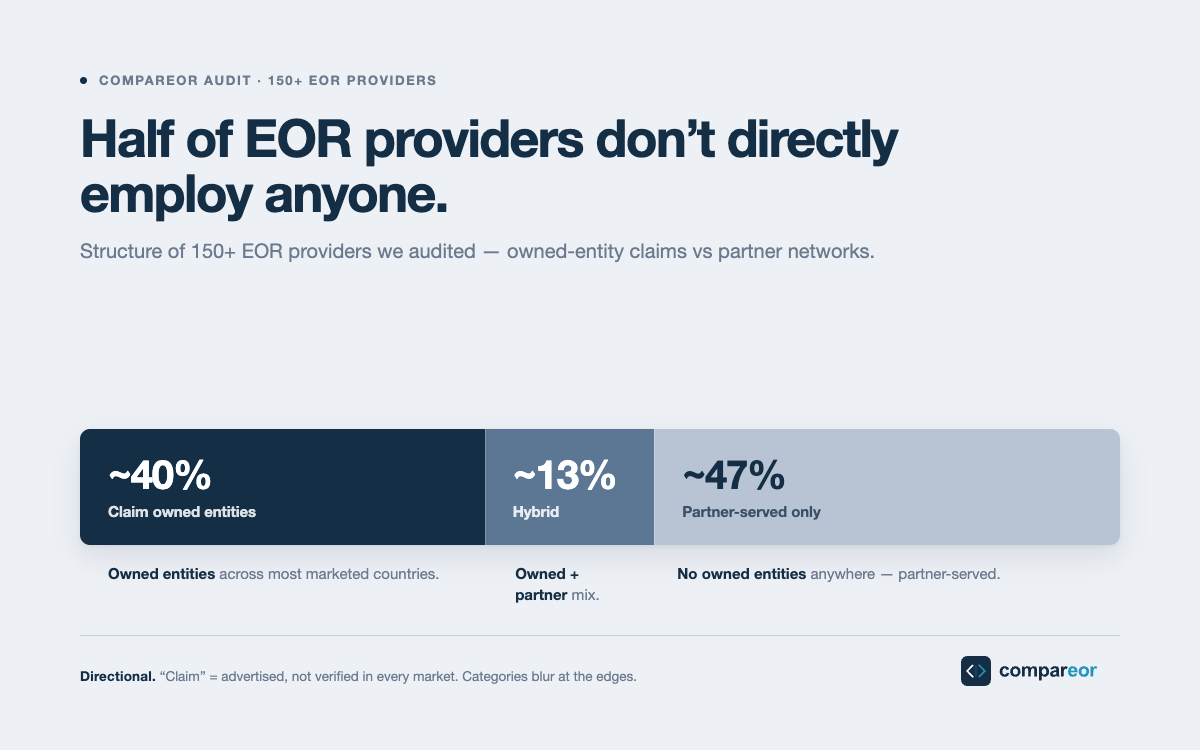
About 40% of EOR providers I audited claim and substantiate owned entities across most of their marketed countries. About 12 to 15% run an honest hybrid. About 45 to 50% are partner-served only, with no owned entities anywhere. The numbers, the methodology, the one honest caveat, and what they mean for buyers.


June 3, 2026
6 min read
Every EOR contract has an expiration date
The EOR model has a built-in expiration date, somewhere between 15 and 20 employees in one country. Past that threshold, the EOR stops being the cheapest option and starts being a tax on growth. Most companies miss it for a year or more, because the contract doesn't mention it and nobody inside is responsible for noticing.

May 25, 2026
5 min read
Why "150+ countries" is the most misleading number in global employment
Every EOR homepage leads with a country count, and after auditing 150+ providers it's the number most likely to lead you to the wrong choice. Coverage comes in three forms, and depth in your countries matters more than breadth across 185 of them.
Stay Updated on Global Hiring
Get weekly insights on EOR trends, compliance updates, and cost-saving strategies

Find a better EOR — without risk
Compare EOR providers to gain insights on cost, coverage, and contract flexibility, ensuring compliance and payroll continuity.


.png)
.png)



