
Why "150+ countries" is the most misleading number in global employment
Every EOR homepage leads with a country count, and after auditing 150+ providers it's the number most likely to lead you to the wrong choice. Coverage comes in three forms, and depth in your countries matters more than breadth across 185 of them.


.png)
Every EOR homepage leads with a number
Every EOR homepage leads with a number. 150 countries. 185 countries. Some claim more. It's the first thing you see and it's designed to be the thing you remember.
It's also close to meaningless, and after auditing more than 150 providers I'd go further. The country count is the number most likely to lead you to the wrong choice.
Here's why. "Coverage" isn't one thing. It comes in three very different forms, and the homepage number lumps them together on purpose.
Coverage comes in three forms
The first form is an owned entity. The provider has a real legal company registered in that country, with local staff, running payroll directly. When they employ your person, the chain is short and you can see all of it. One company, one accountable party, one compliance trail you can actually audit.
The second form is an established partner. The provider doesn't operate in that country themselves. They have a standing relationship with a local firm that does. This can work fine. It also means your employee's real legal employer is a company you've never heard of, and the provider sits between you and them as a layer of remove.
The third form is the one the homepage number really inflates. Sourced on demand. The provider doesn't operate there and doesn't have a standing partner there, but if you ask, they'll go find one. That's not coverage in any meaningful sense. It's a promise to arrange coverage. But it counts toward the number just the same.
So when a provider says 185 countries, the honest translation is usually: a few dozen we operate in directly, a band we cover through partners, and a long tail we'll assemble if you ask. The number is real. The impression it creates is not.
Even "owned entity" is less clean than it sounds
There's a wrinkle worth knowing, too, because it makes you a sharper buyer. Even "owned entity" is less clean than it sounds. A provider can own a legal company in a country and still run the actual payroll through a licensed local specialist, sometimes because the regulation there requires it. Some own entities in their core markets and serve the rest through partners. And a good "local partner" is sometimes deeper in that market than the global brand on the invoice. None of this makes the tiers useless. It just means "owned entity" is a starting signal, not a finish line, and the smart question goes one level deeper than owned-or-partner.
The count rewards the wrong behavior
This matters because of how buyers actually use the country count. They treat it as a proxy for capability. More countries, more capable, safer choice. The logic feels sound and it's backwards. The providers with the highest counts are often the ones leaning hardest on the third tier, because adding a country to a partner-sourcing list is cheap and adding an owned entity is slow and expensive. The count rewards the wrong behavior.
What you actually care about is depth in your countries. Not 185 countries. The four or six or ten where you'll genuinely hire over the next two years. In those specific places, who actually employs your person, who runs the payroll, and who carries the compliance risk? That's the question the homepage is built to stop you from asking, and it's a better question than "owned or partner."
Depth in your countries is the product
Here's the reframe I'd offer any team evaluating providers. Throw out the country count entirely. Write down the countries you'll actually hire in. For each one, find out which tier the provider sits in. A provider with tier-one depth in your six countries beats a provider with tier-three "coverage" in 185, every time, for your situation.
How do you find out the tier? You ask directly, in writing, country by country. Do you employ through your own entity here, or through a partner? If it's a partner, which one, and how long has the relationship been in place? The answers, and how readily they come, tell you almost everything the homepage number was designed to hide.
The takeaway
I'll put hard numbers to this pattern in a few days. I went through the structure of the most-marketed providers in the market and counted how many actually operate the way their coverage claims imply. The split surprised me, and I've been looking at this for years.
For now, the takeaway is simple. The country count is marketing. Depth in your countries is the product. Don't confuse the two, and don't let a homepage decide your shortlist for you.
I run Compareor, an independent comparator for EOR providers. If you're evaluating a shortlist and want a read on real depth in your specific countries, that's what it's for.
Get your shortlist
Takes ~3 minutes. No account needed.
June 3, 2026
6 min read
I checked the structure of 150+ EOR providers. Here's how many actually own their entities.
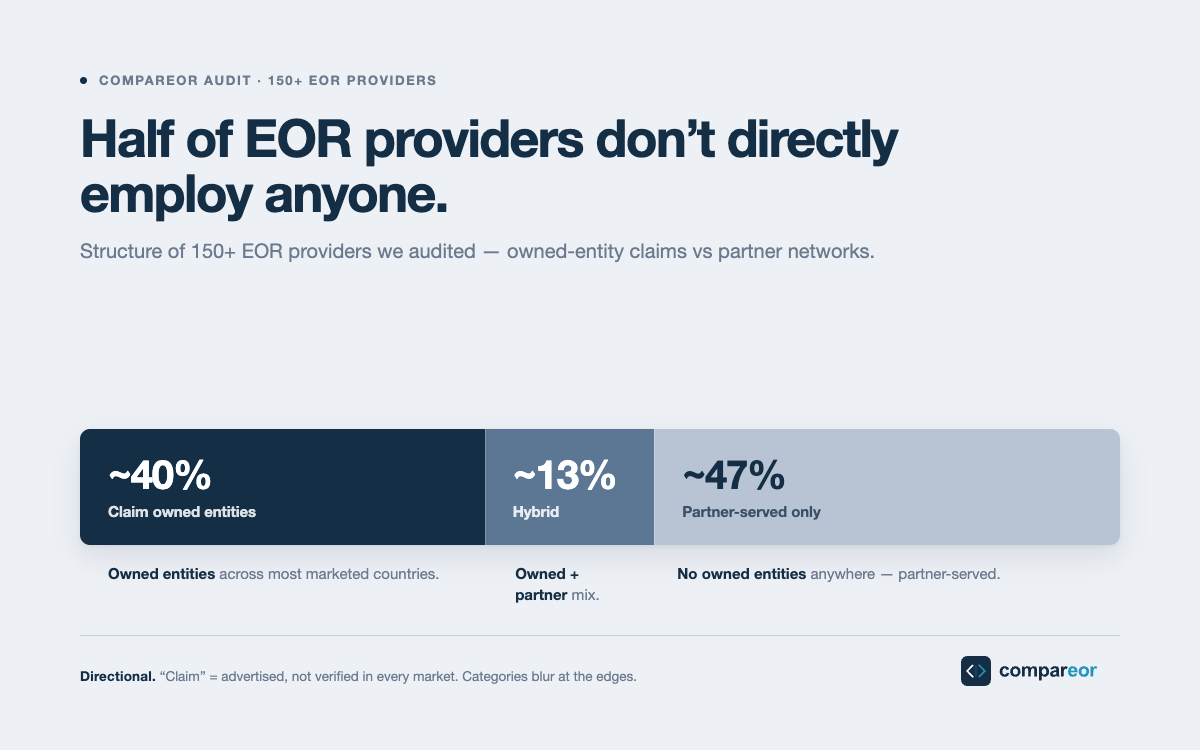
About 40% of EOR providers I audited claim and substantiate owned entities across most of their marketed countries. About 12 to 15% run an honest hybrid. About 45 to 50% are partner-served only, with no owned entities anywhere. The numbers, the methodology, the one honest caveat, and what they mean for buyers.


June 3, 2026
6 min read
Every EOR contract has an expiration date
The EOR model has a built-in expiration date, somewhere between 15 and 20 employees in one country. Past that threshold, the EOR stops being the cheapest option and starts being a tax on growth. Most companies miss it for a year or more, because the contract doesn't mention it and nobody inside is responsible for noticing.

May 14, 2026
13 min read
FX Markup: The EOR Fee No One Discloses on Sales Calls
Of the seven cost layers in a typical EOR contract, FX markup is the most opaque — and on a 20-employee team, it costs more per year than the negotiated service-fee discount. Provider benchmarks from Deel (0%) to legacy providers (5%+), plus the contract redline that locks the spread.
Stay Updated on Global Hiring
Get weekly insights on EOR trends, compliance updates, and cost-saving strategies

Find a better EOR — without risk
Compare EOR providers to gain insights on cost, coverage, and contract flexibility, ensuring compliance and payroll continuity.


.png)
.png)



